By: Paul Goldberg – Senior Correspondent | LGBT Politics USA
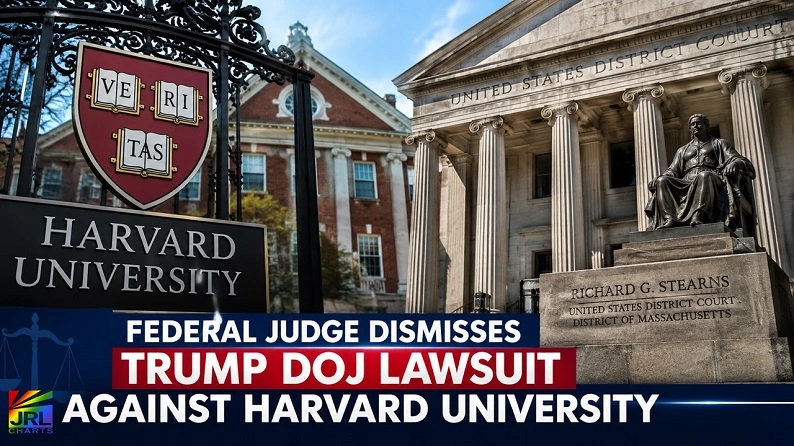
BOSTON, MA — (August 13, 2026) — The Trump administration suffered a new legal setback Thursday after a federal judge dismissed the Justice Department’s civil rights lawsuit against Harvard University, rejecting the government’s attempt to establish that the Ivy League institution remained in violation of Title VI of the Civil Rights Act.
U.S. District Judge Richard G. Stearns of the District of Massachusetts concluded in his 4-Page Ruling that the Justice Department had failed to plausibly establish ongoing institutional noncompliance with the federal civil rights law.
Now Trending on LGBTQ Politics News on JRL CHARTS:
• VA Loses Again as Judge Blocks Third Attempt to Cancel AFGE Contract
• Judge Hands Trump Major Win in Minnesota Transgender Title IX Battle
• Trump Cuts Medicare Drug Subsidies—LGBTQ Seniors Could Pay More
• America’s ‘Golden Age’? U.S. Job Growth Since January 2025 Tells a Different Story
• Federal Judge Delivers Major Blow to DOJ Effort Targeting Transgender Youth Care
• Millions of Working Americans Are Going Hungry—and Nobody Is Talking About It
• Review More in LGBTQ Politics News Exclusively on JRL CHARTS
The decision brings an abrupt end, at least at the district court level, to a lawsuit the Justice Department filed in March accusing Harvard of failing to adequately protect Jewish and Israeli students from harassment and discrimination following the October 7, 2023 Hamas attack on Israel and the wave of campus demonstrations that followed.
The ruling does not conclude that antisemitic incidents did not occur at Harvard. Instead, the court focused on whether the government’s allegations were legally sufficient to establish the ongoing Title VI violation necessary to sustain its enforcement action.
Judge Finds Government’s Allegations Too Isolated
At the center of Stearns’ decision was the government’s attempt to demonstrate that Harvard remained institutionally out of compliance with Title VI.
The Justice Department had pointed to incidents involving Jewish and Israeli students as evidence that Harvard tolerated a hostile educational environment and had been deliberately indifferent to harassment, intimidation and exclusion.
Stearns found the incidents identified by the government insufficient to plausibly establish that systemic noncompliance continued at the university.
The distinction is significant.
Title VI prohibits discrimination based on race, color or national origin in programs and activities receiving federal financial assistance. The Trump administration argued that Harvard’s handling of alleged harassment targeting Jewish and Israeli students placed the university in violation of those federal protections.
But the court concluded that the government’s complaint failed to bridge the gap between individual incidents and an ongoing institutional violation capable of supporting the enforcement action.
Court Rejects DOJ’s Compliance Argument
The ruling also dealt with a second and potentially consequential question: whether the government had adequately followed the statutory process required before pursuing enforcement.
Federal agencies enforcing Title VI are expected to provide notice of noncompliance and seek voluntary compliance before escalating the dispute.
The administration argued that it had fulfilled those requirements and determined that voluntary resolution with Harvard was no longer possible.
Stearns was unconvinced.
The judge’s analysis emphasized that Title VI’s enforcement structure is intended to secure compliance with federal civil rights requirements rather than simply punish a funding recipient for previous conduct.
That distinction became particularly important because the administration’s dispute with Harvard had expanded far beyond allegations of antisemitism.
Harvard Became a Major Target of Trump’s Higher-Education Campaign
Harvard has emerged as one of the most prominent institutional opponents of President Donald Trump’s campaign to force changes at major American universities.
The confrontation intensified in 2025 after the administration presented Harvard with demands involving university governance, campus disciplinary policies, diversity programs and the handling of demonstrations.
Harvard President Alan Garber rejected the administration’s approach and argued that the federal government was attempting to dictate decisions traditionally belonging to the university.
The conflict quickly escalated.
The administration moved against billions of dollars in federal research funding, challenged Harvard’s ability to enroll international students and raised questions surrounding the university’s tax-exempt status.
Harvard responded in court, transforming what began as a dispute over campus antisemitism into a much larger confrontation over federal power, academic independence and the conditions Washington can attach to taxpayer funding.
DOJ Filed Its Title VI Case in March
The Justice Department formally sued Harvard on March 20, 2026, alleging race and national-origin discrimination against Jewish and Israeli students in violation of Title VI.
Federal prosecutors accused the university of being deliberately indifferent to harassment and of selectively enforcing campus rules in ways that allowed Jewish and Israeli students to face hostility and exclusion.
The government’s complaint sought sweeping remedies.
Those included declarations that Harvard had violated Title VI, orders requiring changes to university practices and potential consequences involving federal financial assistance.
The Justice Department argued that institutions accepting billions of dollars in taxpayer-supported grants must comply with federal civil rights requirements.
Harvard disputed the government’s legal theory and moved to dismiss the case.
Antisemitism Allegations Remain a Serious Campus Issue
Thursday’s ruling should not be interpreted as a finding that concerns about antisemitism at Harvard were fabricated or insignificant.
Harvard itself has taken steps to address antisemitism and anti-Israeli bias on campus, including examining its policies and response to incidents involving Jewish students.
The legal question before Stearns was narrower: whether the federal government’s complaint plausibly alleged the type of continuing institutional violation required to maintain this particular Title VI enforcement action.
The judge concluded that it did not.
That distinction could become especially important as the Trump administration continues using federal civil rights statutes to challenge universities over campus policies.
Another Courtroom Setback in the Harvard-Trump Battle
The dismissal adds another chapter to an extraordinary confrontation between the White House and one of the country’s most prominent universities.
Harvard has already fought the administration in court over federal research funding, while the administration has continued pursuing separate investigations and legal actions involving university policies.
The Justice Department has also been examining Harvard on other civil rights issues, meaning Thursday’s dismissal does not necessarily end the broader federal scrutiny facing the institution.
Nor does it necessarily end this case permanently. The administration could pursue additional legal options following the district court ruling.
What Thursday’s decision does establish is that the government’s existing allegations were not enough to keep this Title VI lawsuit alive.
For an administration that has made enforcement against elite universities a prominent component of its higher-education agenda, that represents a significant judicial setback.
Title VI Fight Could Reach Beyond Harvard
The implications extend beyond Cambridge.
The Trump administration has increasingly relied on federal civil rights laws and the leverage created by federal funding to pressure educational institutions over discrimination, campus protests and university policies.
Harvard’s resistance has therefore become a major test of where presidential authority ends and the legal protections afforded to federally funded institutions begin.
Stearns’ ruling reinforces an important limitation: allegations of serious past misconduct do not automatically establish that an institution remains in violation of federal law.
For the government to prevail in a Title VI enforcement action, it must still satisfy the statutory and legal requirements governing that enforcement power.
In the Harvard case, the court concluded that the Trump Justice Department had not done so.
The administration’s next move will determine whether Thursday’s dismissal closes this particular front in its battle with Harvard — or simply sends the dispute into its next round.
Stay with JRL CHARTS LGBT Politics USA for continuing coverage of the Trump administration, federal courts, civil rights enforcement and the political battles reshaping American higher education.
His reporting focuses on federal court rulings, legislative developments, international human rights issues, and government actions impacting LGBTQ communities worldwide.
With nearly two decades of experience, Goldberg is recognized for his balanced analysis, investigative insight, and commitment to accurate, fact-based journalism that informs readers on the political forces shaping equality and justice.
- GameStop Hit With Federal Lawsuit After Gay Employee Reports Threats — Then Gets Fired - October 16, 2026
- Meta Paid 29 Anti-LGBTQ Accounts as 2026 Midterm Misinformation Spreads - October 14, 2026
- Orbán’s Anti-LGBTQ Legacy Crumbles as Hungary Votes 139–51 for Change - October 13, 2026