By Paul Goldberg – Senior Correspondent | LGBT Politics USA
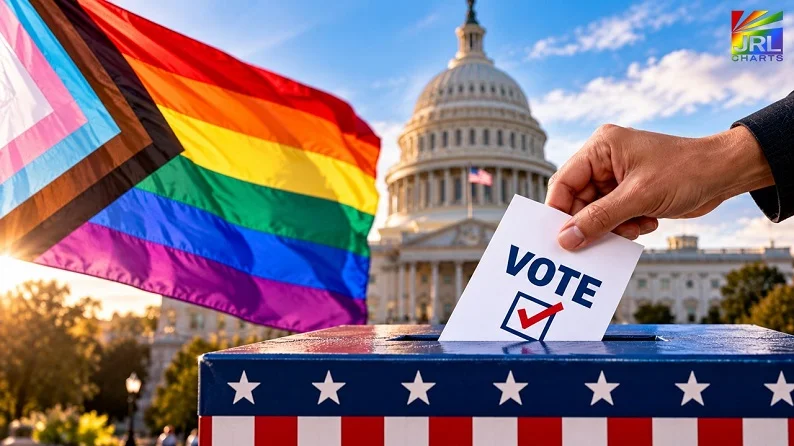
WASHINGTON, D.C. — (October 11, 2026) — With America’s November 3 midterm elections approaching, new research from the Human Rights Campaign Foundation (HRC) reveals overwhelming voting enthusiasm among surveyed LGBTQ Americans, with 87% of registered respondents saying they definitely intend to cast a ballot in an election that could reshape the balance of power in Washington.
Released October 6, the organization’s 2026 Annual LGBTQ+ Community Survey paints a picture of an electorate increasingly concerned about civil rights, economic security and the future of federal protections under President Donald Trump’s second administration.
Trending LGBTQ Business and Politics News on JRL CHARTS:
• Pete Buttigieg Hits 6 States for Democrats as the 2028 Question Gets Louder
• LGBTQ Students Lose a Major Federal Title IX Protection as Trump Administration Acts
• America Granted Them Protection — Then Deported LGBTQ Migrants Somewhere Else
• UNT Deletes LGBTQ History Page After Texas Lawmaker Attack — But the Archive Isn’t Gone
• Michigan Church Targets LGBTQ Acceptance in California With Massive 248-Page Complaint
• Review More in LGBTQ Business and Politics News on JRL CHARTS
Another 7.5% of registered respondents said they would probably vote, bringing the combined share expressing at least probable voting intentions to 94.5%.
The findings arrive as Republicans and Democrats compete for control of Congress, with all 435 House seats and approximately one-third of the Senate on the November ballot.
Civil Rights Dominate LGBTQ Voter Concerns
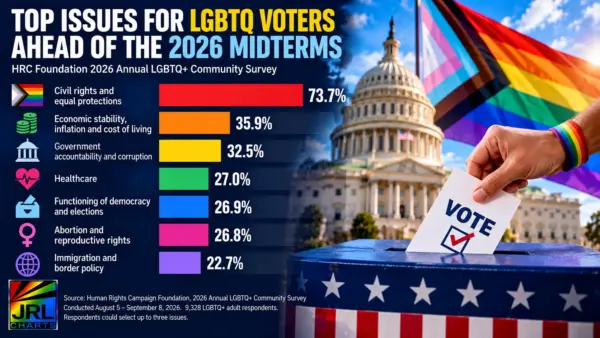
Civil rights lead the political priorities of LGBTQ respondents at 73.7%, followed by economic stability at 35.9% and government accountability at 32.5%, according to the HRC Foundation’s 2026 community survey. Graphic: JRL CHARTS.
According to HRC’s findings, protecting fundamental rights has emerged as the leading political priority among LGBTQ survey respondents.
Nearly three-quarters of respondents, 73.7%, selected civil rights and equal protections among the three issues most important in shaping their votes.
But the research also challenges the assumption that LGBTQ Americans are exclusively focused on identity-related policies.
Economic stability, inflation and the cost of living ranked second, followed by government accountability, democratic institutions, healthcare and reproductive freedom.
For political candidates competing in closely contested congressional districts, the findings suggest that economic issues and civil liberties may be closely connected in the minds of LGBTQ voters.
Supreme Court Fears Put Marriage Equality Back in the Spotlight
Anxiety surrounding the Supreme Court’s conservative majority is another major theme emerging from the survey.
According to the reported findings, 49% of respondents were very worried and another 37% somewhat worried that the nationwide recognition of same-sex marriage could be overturned or restricted.
The concern centers on the future of the Supreme Court’s landmark 2015 decision in Obergefell v. Hodges, which established a constitutional right to same-sex marriage.
The issue has attracted renewed attention following comments by Justice Samuel Alito, a longtime critic of the Court’s marriage equality ruling.
Alito, 76, has also addressed speculation about his retirement, indicating that he intends to remain on the Court through its current term rather than depart during a possible post-election lame-duck congressional session.
Although marriage equality remains federal constitutional law, concerns about its long-term security have become part of the broader debate over judicial appointments and the direction of the Supreme Court.
Gallup Finds Marriage Equality Still Has Majority Support
Separate research from Gallup provides important context for the debate.
Its June 3, 2026, report found that 65% of Americans support legal same-sex marriage, down six percentage points from the 71% high recorded in 2022 and 2023.
The decline has been particularly pronounced among Republicans, with support falling to 37%, compared with 67% among independents and 87% among Democrats.
Despite the decline, a clear majority of Americans continue to support legal marriage equality.
Economic Pressures Add Another Layer to Midterm Anxiety
Civil rights are not the only issue influencing LGBTQ political attitudes.
The HRC survey also highlights significant financial insecurity, with approximately half of respondents reporting difficulty making ends meet.
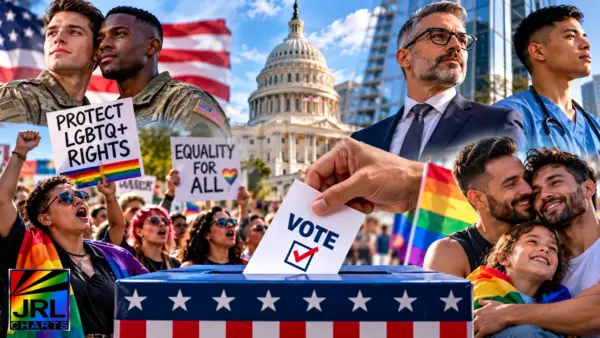
From military service and workplace protections to healthcare, marriage equality and family rights, LGBTQ Americans face a wide range of policy issues heading into the 2026 midterm elections. Illustration: JRL CHARTS.
Many participants expressed dissatisfaction with their financial circumstances and attributed worsening economic conditions to policies pursued by the Trump administration.
These responses reflect participants’ perceptions of federal policy and its effects on their lives, rather than an independent economic assessment establishing the causes of those financial difficulties.
The distinction matters because the research suggests that LGBTQ political engagement extends beyond debates over sexual orientation and gender identity.
Housing costs, employment opportunities, healthcare expenses and household finances are also shaping how respondents view the upcoming election.
HRC’s Midterm Campaign Targets Equality-Minded Voters
The Human Rights Campaign has been expanding its election-year outreach through its $15 million Let’s Get Free public education and engagement initiative.
The campaign aims to reach millions of equality-minded Americans while drawing attention to federal and state policies affecting LGBTQ communities.
HRC also maintains an online voting information center offering resources on registration, voter rights and election participation.
In California, the Secretary of State confirms that October 19 is the regular online voter registration deadline for the November 3 general election. Eligible voters who miss that deadline may still use the state’s conditional voter registration process.
What the 87% Figure Really Means for November
Despite the striking numbers, the HRC survey does not establish that 87% of all LGBTQ Americans will actually vote.
The research surveyed 9,328 LGBTQ adults between August 5 and September 8, 2026, using a nonprobability online recruitment process. The results were weighted to better reflect the LGBTQ adult population, but they are not equivalent to a nationally representative random-sample election forecast.
The 87% figure applies specifically to registered respondents who said they definitely intended to vote.
Nor does the survey establish which political party those respondents will ultimately support.
Nevertheless, the findings provide a significant snapshot of political engagement among LGBTQ Americans at a moment when congressional control, economic policy and the future of civil rights remain central national issues.
With Election Day approaching, the ultimate test will come on November 3, when expressed voting intentions meet actual turnout.
JRL CHARTS – LGBT Politics USA will continue covering the 2026 midterm elections, LGBTQ voter participation, marriage equality developments and the federal policies shaping the future of LGBTQ civil rights across America.
His reporting focuses on federal court rulings, legislative developments, international human rights issues, and government actions impacting LGBTQ communities worldwide.
With nearly two decades of experience, Goldberg is recognized for his balanced analysis, investigative insight, and commitment to accurate, fact-based journalism that informs readers on the political forces shaping equality and justice.