By: Paul Goldberg – Senior Correspondent | LGBT Politics USA
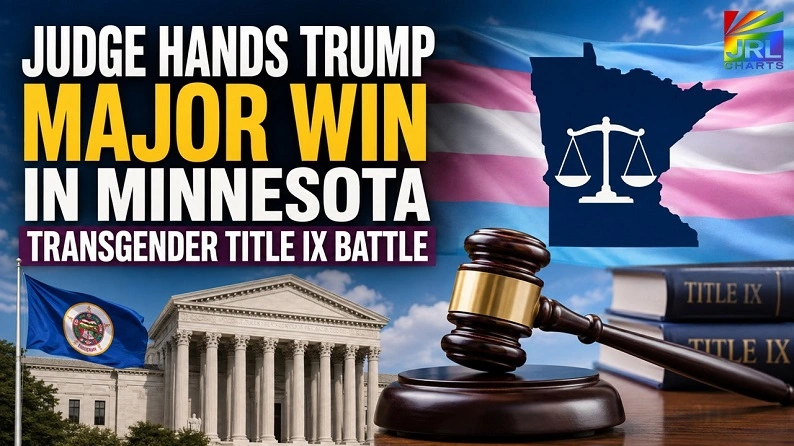
MINNEAPOLIS, MN — (August 10, 2026) — The Trump administration scored a significant legal victory Monday in its escalating battle with Minnesota over transgender students, school athletics and Title IX after a federal judge dismissed most of the state’s challenge to the administration’s interpretation of the landmark federal education law.
But the ruling does not completely end Minnesota’s case.
U.S. District Chief Judge Eric Tostrud allowed one potentially consequential constitutional claim to move forward: Minnesota’s argument that the federal government cannot impose newly interpreted conditions on billions of dollars in federal funding without giving the state sufficiently clear notice of those conditions.
Now Trending on Transgender News on JRL CHARTS:
• Did the Pentagon Force Scouting America to Change Its Transgender Policy?
• Federal Judge Delivers Major Blow to DOJ Effort Targeting Transgender Youth Care
• Appeals Court Deals Major Blow to Trump Military Transgender Ban
• VA Loses Again as Judge Blocks Third Attempt to Cancel AFGE Contract
• Millions of Working Americans Are Going Hungry—and Nobody Is Talking About It
• Review More Transgender News Exclusively on JRL CHARTS
That surviving dispute could determine whether the Trump administration can use approximately $2.9 billion in federal funding as leverage in its effort to force Minnesota education officials to change policies covering transgender students.
The decision represents the latest development in a national legal battle over transgender participation in school sports, the meaning of “sex” under Title IX and the federal government’s authority to attach conditions to education funding.
Judge Dismisses Most of Minnesota’s Claims
Minnesota sued after President Donald Trump’s administration moved to enforce its interpretation of Title IX against states and school systems maintaining transgender-inclusive policies.
Trump issued executive orders declaring federal policy recognizes two sexes — male and female — and directing agencies to oppose the participation of transgender women and girls in female athletic categories.
Minnesota has resisted that interpretation, arguing its own laws prohibit discrimination based on gender identity and require protections for transgender students.
Tostrud, however, rejected most of Minnesota’s current legal arguments.
The judge determined that Minnesota had not established actionable violations of the Administrative Procedure Act or the 10th Amendment based on the federal government’s findings and correspondence to the state.
Central to that conclusion was the absence of final federal action actually terminating Minnesota’s funding.
Tostrud wrote that Minnesota would not face legal consequences unless federal administrative proceedings ultimately determine the state is violating Title IX or a federal court reaches that conclusion in an enforcement action.
In other words, federal findings and warning letters by themselves have not yet produced the type of final legal injury necessary to sustain several of Minnesota’s claims.
Supreme Court Ruling Changes the Title IX Landscape
Minnesota is also fighting on a dramatically different legal playing field following the US Supreme Court’s June 30, 2026 ruling in West Virginia v. B.P.J.
The Supreme Court held that Title IX permits schools to maintain separate male and female athletic teams defined according to biological sex. The Court also upheld West Virginia and Idaho policies restricting female athletic teams to biological females against an Equal Protection Clause challenge.
That ruling does not establish that every state is legally required to prohibit transgender athletes from participating on teams corresponding with their gender identity.
That distinction is important.
But Tostrud indicated the Supreme Court’s interpretation of “sex” under Title IX provides support for the Trump administration’s statutory position.
The result significantly changes the national legal environment surrounding transgender school athletics and strengthens arguments from states and federal officials seeking sex-based athletic classifications.
Minnesota Law Collides With Federal Title IX Policy
Minnesota maintains protections for gender identity that put the state on a collision course with the Trump administration.
The Minnesota Human Rights Act prohibits discrimination in educational institutions based on gender identity. Minnesota’s school laws also require policies addressing bullying and other prohibited conduct involving gender identity.
The Minnesota State High School League has maintained a policy allowing students to participate in athletics consistent with their gender identity or expression.
That policy has already generated separate federal litigation.
In an April 2026 decision involving Female Athletes United, the Eighth Circuit documented the conflict between the Minnesota State High School League’s transgender participation policy, Minnesota’s Human Rights Act and the federal government’s interpretation of Title IX.
The legal question is therefore becoming larger than whether individual transgender students may participate on particular teams.
Courts are increasingly being asked to determine where state civil-rights protections end and federal Title IX requirements begin.
Trump Administration Has Its Own Minnesota Lawsuit
The litigation is even more complicated because the federal government has separately taken Minnesota to court.
The Trump administration is seeking a ruling that the Minnesota Department of Education and Minnesota State High School League are violating Title IX through policies permitting transgender girls to participate on girls’ athletic teams and access facilities consistent with their gender identity.
That parallel federal enforcement action proved important to Tostrud’s analysis of whether Minnesota’s own lawsuit was ready for judicial review.
The judge rejected the administration’s broader argument that Minnesota’s dispute was not yet ripe, observing that the United States itself had gone to court seeking resolution of substantially the same underlying Title IX dispute.
The competing lawsuits have effectively transformed Minnesota into one of the country’s most important legal battlegrounds over transgender students and federal education policy.
Minnesota’s $2.9 Billion Argument Survives
Despite dismissing most of Minnesota’s case, Tostrud allowed the state’s Spending Clause claim to continue.
That could ultimately become the most financially consequential part of the litigation.
Title IX operates through Congress’s Spending Clause authority because educational institutions receiving federal funds agree to comply with federal nondiscrimination requirements.
Courts have consequently treated federal funding requirements as having characteristics similar to a contract: recipients must have adequate notice of the conditions attached to accepting federal money.
Federal courts have repeatedly recognized that notice principle in Title IX litigation.
Minnesota argues that the Trump administration is effectively changing the conditions attached to federal education dollars after the state already agreed to receive those funds.
Tostrud determined that argument deserves further consideration.
“It may be that Title IX does in fact prohibit transgender women and girls from participating on sports teams designated for women and girls or from using restrooms or locker rooms consistent with their gender identity,” Tostrud wrote.
But, he continued, that does not necessarily establish that Minnesota had sufficiently clear notice of such a condition when it originally accepted federal funding.
That distinction leaves the administration facing a potentially significant constitutional hurdle even after prevailing on most of Minnesota’s other claims.
Keith Ellison Says Constitutional Fight Continues
Minnesota Attorney General Keith Ellison focused on the surviving portion of the lawsuit following Monday’s decision.
Ellison said he was pleased that what he characterized as a major constitutional claim against President Trump would continue and said Minnesota intends to prove its case in court.
The state’s position also fits into a broader legal strategy Ellison’s office has pursued against attempts by the federal government to attach new requirements to federal grants.
In other 2026 litigation, the Minnesota Attorney General has similarly invoked the Spending Clause and argued that Washington cannot impose unclear or coercive new conditions on money states previously agreed to accept.
Title IX Battle Is Far From Finished
Monday’s ruling therefore delivers the Trump administration a substantial victory — but not the final word.
Minnesota lost most of the claims it used to challenge the administration’s Title IX enforcement strategy.
At the same time, the state preserved a constitutional argument that could restrict the federal government’s ability to threaten billions of dollars in funding as a means of compelling compliance.
Meanwhile, the administration’s separate lawsuit against Minnesota education officials continues, putting the underlying question of transgender participation in school athletics directly before the federal courts.
And hanging over both cases is the Supreme Court’s June ruling establishing that Title IX permits schools to define separate male and female athletic teams according to biological sex.
The next phase could determine something the Supreme Court did not resolve: whether Title IX merely permits sex-based athletic restrictions or whether the federal law can be interpreted to require them nationwide as a condition of receiving federal education funding.
That distinction could have consequences extending far beyond Minnesota.
JRL CHARTS LGBT Politics USA will continue tracking the Minnesota transgender Title IX lawsuits, Trump administration education policy, federal court rulings and developing legal battles affecting LGBTQ Americans nationwide.

His reporting focuses on federal court rulings, legislative developments, international human rights issues, and government actions impacting LGBTQ communities worldwide.
With nearly two decades of experience, Goldberg is recognized for his balanced analysis, investigative insight, and commitment to accurate, fact-based journalism that informs readers on the political forces shaping equality and justice.
- Taipei Gay Bar Raid Sparks Outrage as Police Face LGBTQ Backlash - October 11, 2026
- LGBTQ Voters Are Fired Up for the 2026 Midterms — HRC Survey Reveals 87% Plan to Vote - October 11, 2026
- OnlyFans and MYM Escape Sweeping French Crackdown After Parliament Showdown - October 8, 2026