By: Paul Goldberg – Senior Correspondent | LGBT Politics Europe
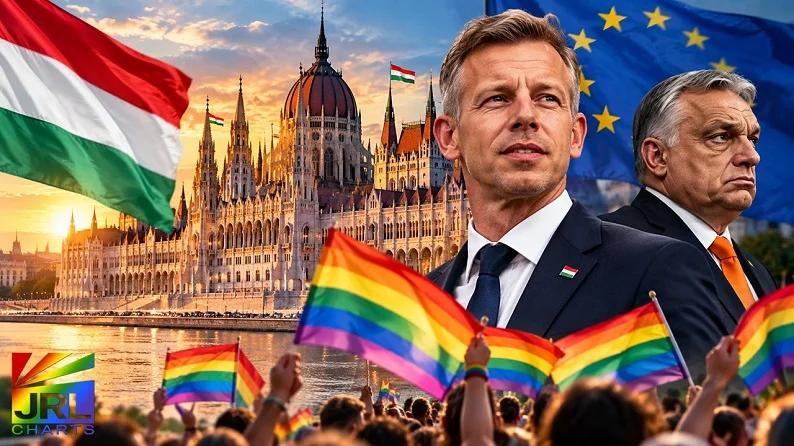
BUDAPEST, HUNGARY — (October 13, 2026) — In a major political reversal, Hungary’s Parliament has voted 139–51 to repeal discriminatory provisions of former Prime Minister Viktor Orbán’s 2021 child-protection law, dismantling restrictions that targeted the portrayal of homosexuality and transgender identities in educational materials, media, and other content accessible to minors.
The landmark vote marks one of the most significant LGBTQ policy changes in Hungary in years, as Prime Minister Péter Magyar’s Tisza government moves to reverse parts of Orbán’s controversial political legacy.
Trending LGBT Politics Europe News on JRL CHARTS:
• German High Court Stops Pornhub and YouPorn Block in Major EU Law Showdown
• Hungary’s New Government Moves to Scrap Orbán-Era Anti-LGBTQ Adoption Restrictions
• OnlyFans and MYM Escape Sweeping French Crackdown After Parliament Showdown
• DOJ Throws U.S. Weight Behind Musk as X Battles €120M EU Fine
• LGBT Politics Europe – Updates on Hate Crimes, Judicial Rulings
The decision comes amid renewed cooperation between Budapest and the European Union, including an announcement that €4.2 billion in previously frozen EU funding is being made available following progress on rule-of-law reforms.
Hungary Reverses Orbán’s Controversial 2021 LGBTQ Restrictions
Passed under Orbán’s Fidesz government, Hungary’s 2021 child-protection legislation restricted the depiction and discussion of homosexuality and gender transition in materials accessible to people under 18.
The restrictions affected schools, publishing, television, and other media, prompting criticism from LGBTQ organizations, European institutions, and human rights advocates.
Under the amendments approved Tuesday, the provisions targeting LGBTQ representation are removed. The revised law instead focuses on protecting minors from content considered seriously harmful to their physical, intellectual, emotional, or moral development.
The change also addresses a major source of conflict with the European Union, whose highest court ruled earlier this year that the discriminatory restrictions violated EU law.
Péter Magyar’s Government Breaks with the Orbán Era
Prime Minister Péter Magyar, whose Tisza party defeated Orbán’s Fidesz in April, has moved cautiously on LGBTQ policy while pursuing broader reforms aimed at restoring Hungary’s relationship with European institutions.
Tisza’s parliamentary supermajority enabled the government to pass the amendments despite opposition from Fidesz and its political allies.
Orbán’s party opposed the changes, arguing that the government was weakening child-protection safeguards in response to pressure from Brussels.
Magyar’s administration has framed the legislation primarily as a child-protection and legal-compliance reform rather than a comprehensive LGBTQ equality initiative.
Nevertheless, the removal of the restrictions represents a substantial departure from the previous government’s policies.
LGBTQ Advocates Welcome Victory but Demand More
LGBTQ rights organizations welcomed the parliamentary decision while emphasizing that Hungary still has significant work ahead.
Tamás Dombos of the Háttér Society, a Hungarian LGBTQ civil rights organization, described the removal of restrictions on LGBTQ content as an important step forward.
However, advocates warn that other Orbán-era policies remain in place, including barriers to legal gender recognition for transgender people and restrictions affecting adoption by same-sex couples.
Hungary also continues to prohibit same-sex marriage, while discriminatory constitutional language and assembly-related restrictions remain unresolved.
For LGBTQ organizations, Tuesday’s vote is therefore a major victory — but not the completion of Hungary’s equality reforms.
Hungary’s LGBTQ Reversal Comes Alongside €4.2 Billion EU Funding Decision
The parliamentary vote coincided with another major development in Hungary’s relationship with Brussels.
Hungary announced that the European Union had agreed to make €4.2 billion in previously frozen funding available following progress on rule-of-law reforms.
The funding decision reflects a broader process involving EU budget safeguards and institutional reforms, rather than a direct payment triggered solely by Tuesday’s LGBTQ legislation.
The developments nevertheless highlight the Magyar government’s efforts to repair relations with European institutions after years of disputes under Orbán.
Restored access to EU funding and educational programs could carry significant economic and political benefits for Hungary.
A New Chapter for LGBTQ Rights in Hungary — But the Fight Continues
The legislative reversal follows years of public resistance to Orbán-era restrictions, including Budapest’s massive 2025 Pride demonstration, which drew international attention despite government opposition.
The 2026 Pride event proceeded without the same restrictions, reflecting the country’s changing political climate.
Tuesday’s parliamentary decision now creates a significant opening for further debate over LGBTQ equality, civil liberties, and Hungary’s relationship with European democratic institutions.
But with major legal inequalities still unresolved, advocates are watching closely to see whether the Tisza government will move beyond reversing discriminatory media restrictions toward broader protections.
For Hungary’s LGBTQ community, October 13, 2026, marks a turning point — and the beginning of another chapter in the country’s long struggle over equality and civil rights.
Stay connected with JRL CHARTS LGBT Politics Europe for continuing coverage of Hungary LGBTQ News, European politics, human rights, and the global fight for LGBTQ equality.
His reporting focuses on federal court rulings, legislative developments, international human rights issues, and government actions impacting LGBTQ communities worldwide.
With nearly two decades of experience, Goldberg is recognized for his balanced analysis, investigative insight, and commitment to accurate, fact-based journalism that informs readers on the political forces shaping equality and justice.
- Orbán’s Anti-LGBTQ Legacy Crumbles as Hungary Votes 139–51 for Change - October 13, 2026
- Japan Faces a $101.5 Billion LGBTQ Equality Problem, Economic Study Warns - October 12, 2026
- Alito Says Gay Marriage Is Safe — But Didn’t They Say That About Roe v. Wade? - October 12, 2026