By Paul Goldberg – Senior Correspondent | LGBT Business Finance News
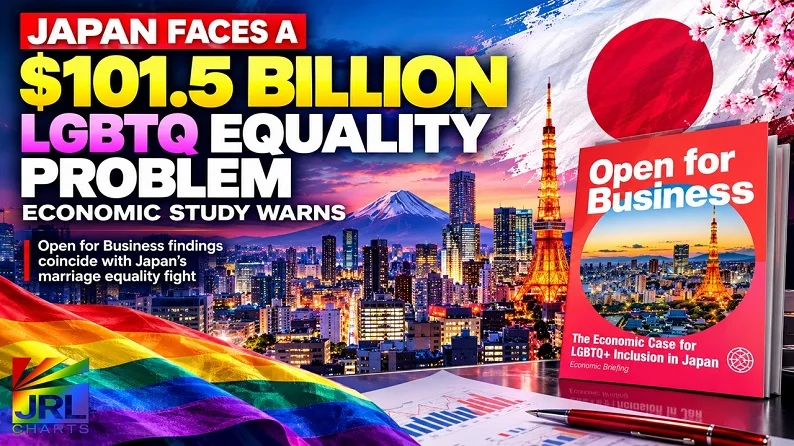
TOKYO, JAPAN — (October 12, 2026) — LGBTQ discrimination and exclusion could be costing Japan’s economy as much as $101.5 billion annually, according to a new economic briefing from Open for Business that places workforce equality at the center of the country’s growing demographic and economic challenges.
The 34-page report, The Economic Case for LGBTQ+ Inclusion in Japan, estimates that exclusion carries an annual economic burden of ¥6.04 trillion to ¥16.42 trillion ($37.3 billion to $101.5 billion), equivalent to approximately 0.87% to 2.38% of Japan’s gross domestic product.
Trending LGBT Asia Politics Coverage on JRL CHARTS:
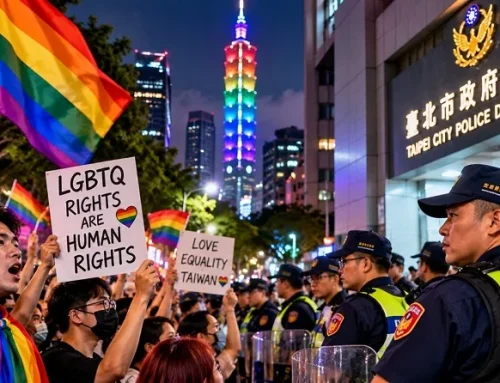
• Taipei Gay Bar Raid Sparks Outrage as Police Face LGBTQ Backlash
• Turkey LGBTQ Crackdown Explodes as 47 Detained in Sweeping Raids on Gay Bars and Activists
• Israeli LGBTQ Teens Delay Mental Health Care Over Fear of Bias, New Studies Find
• Turkey Blocks American LGBTQ Cruise, Citing ‘Moral Values’ in Growing Crackdown
• China’s Rising Yuan Could Hit LGBTQ Businesses Worldwide
• Trending LGBT International News on JRL CHARTS
The findings arrive as Japan continues debating marriage equality, national anti-discrimination protections and the role of major employers in advancing LGBTQ inclusion.
Japan’s LGBTQ Exclusion Cost: Where the Billions Come From
Open for Business estimates that health-related burdens account for approximately $25.1 billion to $75.1 billion annually, while lost earnings associated with LGBTQ wage disparities contribute another $12.3 billion to $26.3 billion.
The health model examines excess burdens associated with cardiovascular disease, depression, suicide and self-harm, and HIV/AIDS.
Cardiovascular disease represents the largest individual component, with estimated annual costs ranging from $16.5 billion to $49.5 billion. Wage disparities represent the next-largest component.
The organization calculates these figures using Japanese health and labor-market data, published research and economic modeling. The estimates are not direct measurements of national spending, nor do they establish that adopting a particular law would recover the full amount.
Nevertheless, the report presents a substantial economic argument: discrimination-related health disparities and barriers to full workforce participation may have consequences for employers, productivity and national competitiveness.
Japan’s Shrinking Workforce Makes Inclusion an Economic Issue
Japan’s population is projected to decline from approximately 125 million in 2020 to fewer than 87 million by 2070.
That demographic shift has significant implications for businesses already confronting labor shortages, employee retention challenges and growing competition for skilled workers.
The report highlights a striking contrast in Japan’s international talent position.
According to the 2025 IMD World Talent Ranking cited by Open for Business, Japan ranks 14th for talent appeal but 55th for talent readiness.
The distinction suggests that attracting interest from potential workers is not the same as maintaining an adequate supply of skilled labor.
For businesses, the report identifies employee wellbeing, inclusive workplace practices and effective talent utilization as potential contributors to economic resilience.
Japan’s Marriage Equality Debate Carries Business Implications
Japan does not currently recognize same-sex marriage nationwide, although local partnership recognition systems have expanded rapidly.
The briefing reports that nearly 93% of Japan’s population lived in municipalities with partnership systems as of 2024.
However, those arrangements do not provide the full legal protections associated with marriage.
Same-sex couples may still encounter complications involving inheritance, medical decision-making, taxation, social security and survivor benefits.
For employers, the legal differences can create additional administrative challenges involving spousal benefits, relocation policies and family leave.
The report also notes that Japan’s Supreme Court Grand Bench took up marriage equality challenges in March 2026, following lower-court rulings addressing constitutional questions surrounding the country’s marriage laws.
While the judicial process continues, the economic briefing provides another perspective on how legal uncertainty can affect employees and businesses.
Japanese Corporations Lead on LGBTQ Inclusion — But a Workplace Gap Remains
Corporate Japan has made measurable progress in LGBTQ workplace policies.
In 2025, 80% of the 931 organizations assessed under the PRIDE Index received its highest Gold certification.
The index, administered by Work with Pride, evaluates participating organizations’ LGBTQ employee initiatives.
The briefing also reports that approximately 707 Japanese and multinational companies had publicly supported marriage equality as of July 7, 2026.
Yet broader workplace surveys present a different picture.
Nijiiro Diversity’s 2026 workplace white paper found that 55% of surveyed employees reported no concrete LGBTQ measures at their workplaces.
Separate research cited in the briefing found that 30% of surveyed professionals reported workplace discrimination or bias related to sexual orientation, while 27% reported bias related to gender identity.
Only about one-third reported feeling comfortable disclosing their sexual orientation or gender identity at work.
These studies examine different populations, but together they illustrate the difference between corporate inclusion commitments and employees’ reported experiences.
LGBTQ Wage Disparities Could Cost Japan $26.3 Billion Annually
Lost earnings represent one of the briefing’s most direct business-finance findings.
Open for Business estimates that LGBTQ workers account for approximately ¥28.35 trillion ($175 billion) of Japan’s earned income.
Applying an estimated LGBTQ wage gap of 7% to 15%, the organization calculates annual lost earnings of approximately ¥1.98 trillion to ¥4.25 trillion ($12.3 billion to $26.3 billion).
The wage-gap range is informed by OECD research rather than a comprehensive measurement of individual LGBTQ salaries across Japan.
The report also cites Japanese research identifying particular economic vulnerabilities among transgender workers, including greater representation in non-regular employment and lower-income groups.
For employers, the findings raise questions about compensation equity, hiring practices, career advancement and employee retention.
Public Support for Marriage Equality Reaches 67%
The report cites a 2026 Dentsu survey finding that 67% of respondents supported legalizing same-sex marriage.
Another 82% supported addressing sexual diversity in school education.
These findings suggest that public attitudes have shifted considerably even as national legislation remains limited.
Japan enacted its Act on the Promotion of Public Understanding of the Diversity of Sexual Orientation and Gender Identity in 2023.
However, the law emphasizes understanding and does not establish comprehensive nationwide anti-discrimination protections covering sexual orientation and gender identity.
Open for Business identifies this gap between public attitudes, corporate initiatives and national legal protections as a significant feature of Japan’s current policy environment.
Can LGBTQ Inclusion Improve Japan’s Economic Competitiveness?
Beyond its cost estimates, the briefing examines international relationships between LGBTQ legal inclusion, talent competitiveness and life satisfaction.
Its cross-country analysis identifies a positive statistical association between stronger LGBTQ legal protections and higher talent competitiveness.
A separate analysis also finds a positive association between legal inclusion and reported life satisfaction.
Importantly, the researchers caution that these relationships do not establish causation. Countries with stronger legal protections may differ in other economic and social characteristics that also influence the results.
The report therefore presents LGBTQ inclusion as one possible component of a broader economic strategy, rather than a standalone solution to Japan’s demographic and productivity challenges.
Japan’s Economic Future Puts LGBTQ Workplace Equality in Focus
The Open for Business briefing adds a significant financial dimension to Japan’s ongoing discussions about marriage equality and workplace protections.
Its central finding is that exclusion may impose substantial annual costs through health disparities, wage inequality and barriers to workforce participation.
For Japan’s business community, the study raises practical questions about employee wellbeing, talent retention, equal benefits and the consistency of workplace protections.
For policymakers, it provides an economic framework for examining the relationship between legal recognition and participation in the labor market.
The estimates remain subject to the assumptions and limitations of the organization’s model. Even so, the report places LGBTQ inclusion within a larger conversation about Japan’s ability to sustain its workforce and remain competitive as its population contracts.
Source: Open for Business, The Economic Case for LGBTQ+ Inclusion in Japan, 2026 Economic Briefing.
JRL CHARTS LGBT Politics Asia will continue tracking Japan’s marriage equality developments, LGBTQ workplace protections and the economic policies shaping business and employment across Asia.

His reporting focuses on federal court rulings, legislative developments, international human rights issues, and government actions impacting LGBTQ communities worldwide.
With nearly two decades of experience, Goldberg is recognized for his balanced analysis, investigative insight, and commitment to accurate, fact-based journalism that informs readers on the political forces shaping equality and justice.
- Japan Faces a $101.5 Billion LGBTQ Equality Problem, Economic Study Warns - October 12, 2026
- Alito Says Gay Marriage Is Safe — But Didn’t They Say That About Roe v. Wade? - October 12, 2026
- Feds Raid Ilhan Omar’s Home — She Fires Back at Trump: ‘I Will Not Be Silenced’ - October 12, 2026