By: Paul Goldberg – Senior Correspondent | LGBT Business Finance News
LAS VEGAS, NV — (August 6, 2026) — For years, the U.S. economy routinely produced monthly job gains well above 150,000 during periods of sustained expansion. While monthly payroll reports naturally fluctuate and are often revised, recent employment data points to a noticeably slower pace of hiring than the levels many economists became accustomed to during much of the previous decade.
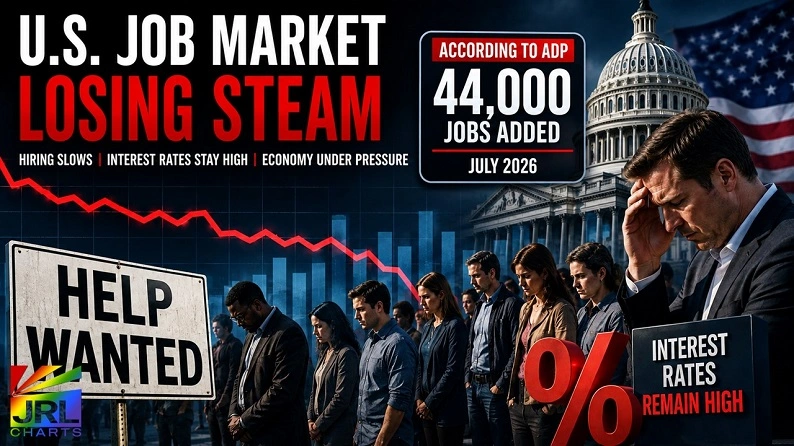
The latest ADP National Employment Report showed private employers adding 44,000 jobs in July, below economists’ expectations and down from a revised 95,000 in June. Most of July’s gains came from education and health services, while financial activities also added jobs.
Now Trending in LGBT Business Finance and Politics News on JRL CHARTS:
• What Happened to the Gay Adult Webmaster Industry? Inside the Digital Market Shift
• Trump Cuts Medicare Drug Subsidies—LGBTQ Seniors Could Pay More
• EEOC Moves to End 60 Years of Workplace Diversity Data Collection
• Project 2025 Already 50% Complete: Inside Trump’s Plan Reshaping America
• Judge Kacsmaryk Guts LGBTQ Job Protections in Texas Ruling
• From Sandy Hook to Voting Rights: How Conservative Courts Are Rewriting U.S Laws
Hiring Has Slowed
Economists have increasingly described the current labor market as a “low-hire, low-fire” environment. Companies are generally avoiding mass layoffs but are also hiring fewer workers than in earlier years of the post-pandemic recovery. Recent months have seen softer payroll growth, including 57,000 jobs added in June according to the Bureau of Labor Statistics, with downward revisions to prior months.
Interest Rates Continue to Weigh on Business
Higher borrowing costs have affected businesses across numerous sectors. Elevated interest rates increase financing costs for retailers, manufacturers, distributors, and consumers, often leading businesses to delay expansion plans or new hiring. The Federal Reserve Board has kept its focus on inflation, while many employers remain cautious about increasing payrolls.
Retailers Feel the Pressure
Retail spending tends to soften when consumers face higher borrowing costs and become more selective with discretionary purchases.
That trend has also reached industries that historically viewed themselves as relatively resilient during economic downturns.
Even the Adult Industry Has Changed
For decades, many segments of the adult industry were widely regarded by business owners as comparatively resilient during recessions because consumer demand often remained steady. Today’s marketplace, however, is shaped by very different economic and technological forces.
Independent retailers now contend with higher operating costs, cautious consumer spending, intense online competition, subscription-based entertainment, and changing digital advertising models. Those factors have made maintaining growth more challenging than in previous economic cycles.
Looking Ahead
The official Bureau of Labor Statistics employment report remains the benchmark for measuring U.S. job growth, while ADP provides an important private-sector snapshot ahead of the government’s monthly release. Together, recent reports suggest a labor market that continues to expand, but at a significantly slower pace than many economists expected earlier in the recovery.
Stay informed with JRL CHARTS as we continue to examine the economic trends shaping retailers, LGBTQ businesses, financial markets, and the industries that depend on consumer spending.
His reporting focuses on federal court rulings, legislative developments, international human rights issues, and government actions impacting LGBTQ communities worldwide.
With nearly two decades of experience, Goldberg is recognized for his balanced analysis, investigative insight, and commitment to accurate, fact-based journalism that informs readers on the political forces shaping equality and justice.
- Stocks Up 12%, Bonds Under Pressure — Morningstar Reveals Wall Street’s Growing Divide - October 26, 2026
- American Express Profits Surge 28% — Then Comes the 3,500 Job Cut Bombshell - October 26, 2026
- Jamie Dimon Sounds the Alarm: 5 Economic Threats That Could Shake America - October 25, 2026