By: Paul Goldberg – Senior Correspondent | LGBT Business Finance News
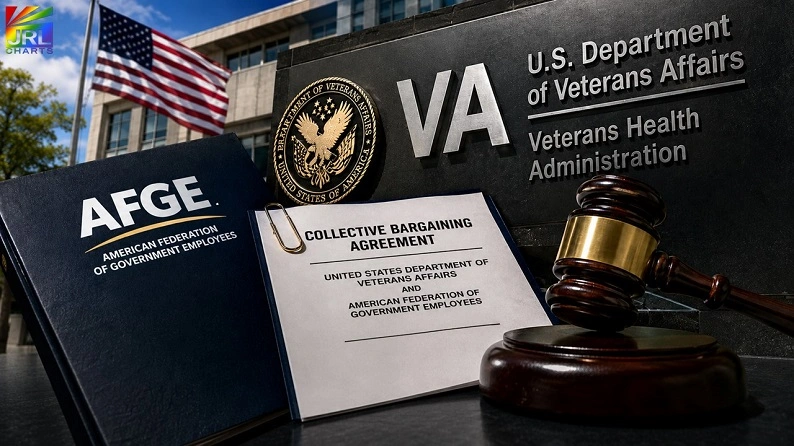
The court victory preserves collective bargaining for roughly 320,000 VA employees, including LGBTQ+ federal workers who rely on union representation and negotiated workplace protections.
PROVIDENCE, RI — (August 8, 2026) — The Department of Veterans Affairs has suffered another major courtroom setback in its escalating battle with the nation’s largest federal employee union, after a federal judge blocked the agency’s third attempt to terminate a collective bargaining agreement covering approximately 320,000 VA workers.
U.S. District Judge Melissa DuBose on Friday, Aug. 7, granted a motion to enforce her previous preliminary injunction preserving the master collective bargaining agreement between the VA and the American Federation of Government Employees’ National Veterans Affairs Council.
Trending LGBT Breaking Military News Coverage on JRL CHARTS:
• Hegseth’s $37.5 Billion Iran War Admission Sparks Online Firestorm
• Third Missing U.S. Service Member Confirmed Dead After Iran’s Jordan Base Attack
• Did the Pentagon Force Scouting America to Change Its Transgender Policy?
• VA Restructures LGBTQ+ Veteran Programs Under New Federal Policy Changes
• DOJ Refuses Judge’s Demand to Kill $1.8 Billion Trump-Era Compensation Fund
• Breaking Military News involving LGBTQ Service Members and Security
The ruling arrived just one day before the VA planned to terminate the agreement on Aug. 8.
DuBose concluded that the department’s latest effort ran contrary to her previous orders, rejecting the VA’s argument that AFGE had failed to begin negotiations within the required timeframe.
For hundreds of thousands of federal workers — including LGBTQ+ employees represented within the VA workforce — the immediate consequence is significant: their collective bargaining agreement remains in force while the larger legal battle continues.
VA’s Third Attempt Runs Into the Same Federal Judge
The confrontation stretches back to President Donald Trump’s March 2025 executive order restricting collective bargaining at numerous federal agencies and subdivisions based on national-security determinations.
The VA subsequently moved in August 2025 to terminate collective bargaining agreements covering most of its bargaining-unit workforce.
The department argued that ending those agreements would provide management with greater flexibility, improve accountability and redirect resources toward serving veterans.
AFGE fought the action in federal court.
In March 2026, DuBose issued a preliminary injunction requiring the VA to restore its master agreement with AFGE. When the department subsequently pursued another route toward terminating the contract, the court intervened again.
The First Circuit Court of Appeals later upheld major portions of the district court’s order in May.
But the legal fight was far from finished.
August 8 Deadline Sets Up a Third VA-AFGE Showdown
The latest confrontation centered on a critical date: Aug. 8, 2026.
The current VA-AFGE Master Agreement took effect Aug. 8, 2023, with a three-year term and provisions governing renegotiation and continuation of the agreement.
VA informed the union that it intended to end the agreement when that term expired.
AFGE countered that management had already triggered the renegotiation process and that provisions within the agreement required the existing contract to continue while the parties worked toward a successor.
The disagreement once again landed before DuBose.
Judge DuBose Rejects VA’s Negotiation Argument
The VA argued that AFGE failed to comply with a requirement to begin negotiations within 30 days of management’s request.
DuBose wasn’t persuaded.
The judge pointed to correspondence between the two sides concerning renegotiation of the master agreement and concluded that the department could not rely on its negotiation argument to terminate the contract.
The proposed Aug. 8 termination, she determined, conflicted with the court’s existing injunction.
The decision doesn’t settle every underlying dispute surrounding the administration’s federal labor policies.
Instead, it prevents the VA from using the agreement’s scheduled expiration to accomplish a termination while the existing court protections remain in place.
Roughly 320,000 VA Employees Remain Covered
The scale of the agreement makes the case especially consequential.
AFGE says its National Veterans Affairs Council represents approximately 320,000 employees at the VA, making the agreement one of the most significant collective bargaining arrangements in the federal workforce.
Those employees work throughout the sprawling VA system responsible for delivering health care, benefits and other services to millions of American veterans.
Federal collective bargaining agreements can establish procedures involving working conditions, employee representation, grievances and management changes affecting represented employees.
That makes this considerably more than a fight between union executives and agency leadership.
Its outcome could directly shape workplace representation for hundreds of thousands of federal employees.
LGBTQ+ VA Workers Have a Stake in the Union Fight
For JRL CHARTS readers, an important distinction needs to be made: DuBose’s ruling is not an LGBTQ+ rights decision.
LGBTQ+ employees are nevertheless among the workers potentially affected by the future of collective bargaining at the VA.
AFGE maintains programs supporting LGBTQ+ union members and has advocated for workplace equality and protections against discrimination across the federal workforce.
Collective bargaining can also provide represented employees with formal mechanisms for addressing grievances and challenging changes to working conditions.
For LGBTQ+ federal employees, those mechanisms can become particularly important when disputes involve workplace treatment, nondiscrimination policies or changes affecting employee protections.
Friday’s decision doesn’t establish new LGBTQ+ rights.
What it does is preserve, for now, the collective bargaining structure available to the approximately 320,000 VA workers represented under the agreement — including LGBTQ+ members of that workforce.
VA Battle Comes Amid Broader LGBTQ+ Federal Workforce Changes
The significance for LGBTQ+ workers also extends beyond this individual lawsuit.
The VA union battle is unfolding amid a broader transformation of federal workforce policies under the Trump administration, including changes involving diversity, equity and inclusion programs.
That makes the future strength of federal employee unions especially relevant to workers who may depend on representation when management changes workplace policies.
AFGE and other labor organizations have historically positioned collective bargaining as a check on unilateral changes to working conditions.
The administration, by contrast, argues that collective bargaining restrictions are necessary at designated agencies to protect national-security interests and ensure that managers can effectively carry out their missions.
The courts are increasingly becoming the arena where those competing claims are tested.
AFGE Celebrates Another Major Court Victory
AFGE National VA Council President Mary Jean Burke welcomed Friday’s ruling and portrayed it as vindication of the union’s continuing effort to preserve representation at the department.
The union argues that its role extends beyond protecting employees and helps workers advocate for the staffing, workplace conditions and resources needed to provide services to veterans.
AFGE has also repeatedly warned that weakening organized labor inside the VA could make broader restructuring or privatization of veterans’ services easier.
The VA rejects that characterization.
The department has maintained that restrictions on collective bargaining would increase management flexibility, improve accountability and allow resources currently associated with union activities to be redirected toward veterans.
Those competing positions help explain why the dispute has become one of the federal government’s most consequential labor battles.
National Security Argument Could Have Consequences Far Beyond VA
At the center of the larger confrontation is presidential authority over federal labor relations.
Federal employees don’t negotiate wages in the same manner as many private-sector union workers because federal compensation is largely determined through statute and government-wide policy.
Collective bargaining nevertheless gives represented federal employees a formal role in negotiating certain working conditions and provides established procedures for challenging management decisions.
The Trump administration maintains that national-security responsibilities justify excluding designated agencies and subdivisions from portions of the federal labor-relations system.
Labor unions argue that such authority cannot simply be used as a sweeping mechanism for dismantling collective bargaining across large portions of the government.
How courts ultimately resolve that conflict could have consequences far beyond the Department of Veterans Affairs.
Three Attempts to End the Contract — and It’s Still Standing
The chronology underscores just how contentious the battle has become.
The VA moved to terminate the AFGE agreement.
A federal judge ordered the agreement restored.
The department pursued another termination.
The court intervened.
Then, as the agreement approached its Aug. 8 expiration date, the VA prepared a third effort to bring the contract to an end.
Once again, DuBose blocked the move.
For approximately 320,000 represented VA employees, the immediate result couldn’t be clearer:
Their union contract remains standing.
For the Trump administration and AFGE, however, the stakes are considerably larger.
The continuing litigation is becoming a major test of presidential power over federal labor relations, agency authority, national-security exemptions and the ability of federal unions to defend negotiated workplace protections through the courts.
For LGBTQ+ federal workers, it also demonstrates why the future of collective bargaining can matter even when LGBTQ+ rights aren’t explicitly named in the lawsuit.
The third attempt may have failed.
The larger battle over the future of organized labor inside the federal government is nowhere near finished.
Stay with JRL CHARTS Breaking Military News as we track the VA-AFGE court battle and the federal workforce policies affecting collective bargaining, workplace protections and LGBTQ+ employees across the federal government.
His reporting focuses on federal court rulings, legislative developments, international human rights issues, and government actions impacting LGBTQ communities worldwide.
With nearly two decades of experience, Goldberg is recognized for his balanced analysis, investigative insight, and commitment to accurate, fact-based journalism that informs readers on the political forces shaping equality and justice.