By: Paul Goldberg – Senior Correspondent | LGBT Business Finance News
LAS VEGAS, NV — (June 12, 2026) — While cable news focuses on politics, elections, and Wall Street earnings reports, a different reality is playing out across America.
Food banks from California to Kentucky are reporting increased demand as millions of Americans struggle with rising living costs, stagnant wages, housing expenses, and reduced government assistance programs.
Now Trending on LGBT Business Finance News on JRL CHARTS:
• LGBTQ Business Owners Join Growing Coalition Against Bank Account Closures
• U.S. Debt Nears $41 Trillion Ceiling as Economists Warn of Business and Market Risks
• China’s Rising Yuan Could Hit LGBTQ Businesses Worldwide
• Project 2025 Already 50% Complete: Inside Trump’s Plan Reshaping America
• U.S. Banking Rule Ends ‘Reputational Risk’ Barrier, Expands Access for Legal Businesses
• LGBTQ Corporate Participation Plunges 65% in 2026 as DEI Retreat Reshapes Business Landscape
The growing pressure is exposing what advocates call “America’s hidden hunger crisis” — a problem affecting not only the unemployed but also millions of working households.
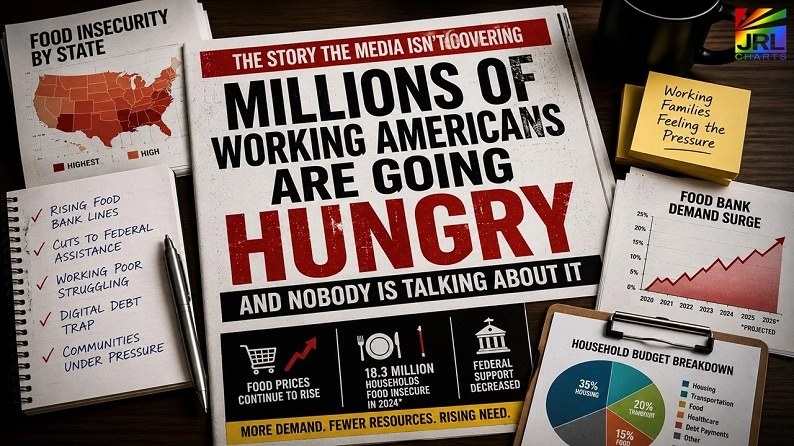
According to the USDA, 18.3 million U.S. households experienced food insecurity during 2024, representing nearly 48 million Americans who faced uncertainty about obtaining enough food for their families. Children remain particularly vulnerable, with more than 7 million living in food-insecure households. What makes the situation particularly alarming is that many of those seeking assistance are employed.
The Rise of the Working Poor
Food banks increasingly report serving individuals who work full-time jobs but still cannot consistently afford groceries after paying rent, utilities, transportation, healthcare, and childcare expenses.
Economic experts describe this as the “working poor” phenomenon, where employment no longer guarantees financial stability.
Unlike the unemployment crisis witnessed during the COVID pandemic, today’s hardship is often less visible because households continue working while quietly falling behind financially.
Many families are making difficult choices between food, rent, prescription medications, and transportation costs.
As a result, food banks are becoming a critical safety net for workers who previously never imagined they would need charitable assistance.
States Facing Severe Food Insecurity Challenges
Food insecurity remains especially concentrated throughout portions of the South and rural America, though major metropolitan areas are also experiencing growing demand.
States frequently identified with elevated food insecurity rates include:
- Arkansas
- Kentucky
- Louisiana
- Mississippi
- Oklahoma
- Texas
- Nevada
- California
- Massachusetts
Feeding America research shows that hunger affects every congressional district and county in the United States, with many of the highest food insecurity rates occurring in rural communities. More than 80 percent of counties with the highest child food insecurity rates are rural areas. Rural communities continue to face unique challenges including limited employment opportunities, transportation barriers, and reduced access to social services.
The Funding Squeeze
Food banks are facing a difficult reality.
Demand continues to rise while several federal food assistance programs have been reduced or eliminated. Food bank networks across the country have warned that reductions in USDA food purchasing programs and other assistance initiatives are removing millions of meals from local distribution systems.
Many organizations are increasingly dependent on private donations, charitable foundations, churches, community fundraisers, and corporate sponsors to fill the growing gap.
Several food banks have reported significant reductions in federally supplied food inventory at the same time more families are seeking assistance.
Digital Debt Is Hiding Financial Distress
One reason the crisis remains largely invisible is what economists increasingly describe as “digital debt.”
Instead of immediately missing rent payments or utility bills, many households are using financial technology apps, payday loan platforms, earned-wage advance programs, and short-term online lenders.
Consumers frequently stack multiple loans together to cover basic living expenses.
Financial counselors report seeing households juggling three, four, or even five separate lending products simply to buy groceries, fuel vehicles, or pay utility bills.
While these tools may temporarily delay financial collapse, they often create higher long-term debt burdens through fees and interest charges.
The result is a population that appears financially stable on paper while quietly sinking deeper into economic distress.
Food Insecurity Is Becoming More Difficult to Measure
Unlike the highly visible food bank lines seen during the COVID pandemic, today’s hunger crisis is decentralized.
Many Americans receive assistance through neighborhood food pantries, church programs, community distribution centers, mobile food trucks, mutual aid groups, and local charities.
This fragmented system makes the scale of the problem less visible to national media coverage.
As a result, many communities are experiencing increased hardship without generating the dramatic images that typically attract national attention.
Federal Data Signals Growing Pressure
Recent economic indicators suggest financial stress continues to build among lower-income households.
Researchers at the Federal Reserve Bank of New York recently reported a notable increase in food insecurity among lower-income Americans, households with children, and workers with lower educational attainment.
The report found increasing numbers of families reporting difficulty obtaining enough food, skipping meals, or relying on food assistance programs.
At the same time, many charitable organizations report rising demand for food assistance as inflation, housing costs, insurance expenses, and utility bills continue consuming larger portions of household budgets.
The Question Washington Cannot Ignore
The growing disconnect between headline economic statistics and household financial realities is becoming increasingly difficult to dismiss.
While policymakers debate economic growth, millions of Americans continue searching for ways to put food on the table.
Food banks remain on the front lines of that struggle. For many families, hunger is no longer an emergency brought on by job loss. It has become a permanent part of daily life despite being employed. And that may be the most troubling economic warning sign of all.
For continuing coverage on economic trends, food insecurity, and the challenges facing working Americans, stay with JRL CHARTS LGBT Business Finance News.

His reporting focuses on federal court rulings, legislative developments, international human rights issues, and government actions impacting LGBTQ communities worldwide.
With nearly two decades of experience, Goldberg is recognized for his balanced analysis, investigative insight, and commitment to accurate, fact-based journalism that informs readers on the political forces shaping equality and justice.
- Japan Faces a $101.5 Billion LGBTQ Equality Problem, Economic Study Warns - October 12, 2026
- Alito Says Gay Marriage Is Safe — But Didn’t They Say That About Roe v. Wade? - October 12, 2026
- Feds Raid Ilhan Omar’s Home — She Fires Back at Trump: ‘I Will Not Be Silenced’ - October 12, 2026