By Paul Goldberg – Senior Correspondent | LGBT Business Finance News
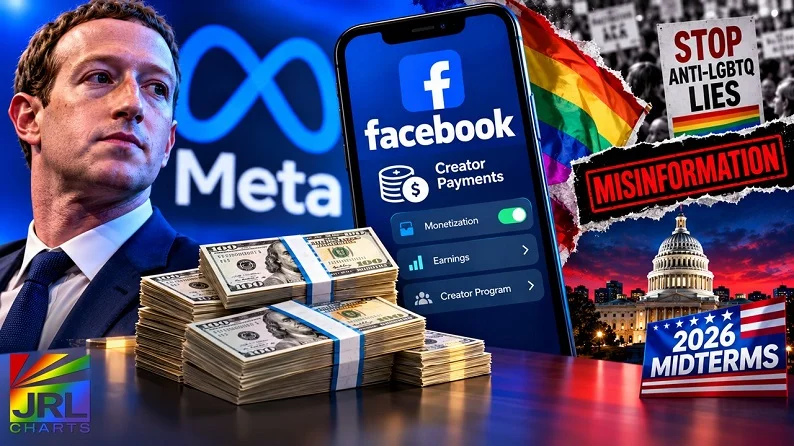
SAN FRANCISCO, CA — (October 14, 2026) — Meta Platforms, the parent company of Facebook and Instagram, is facing renewed scrutiny over its creator payment practices after an investigation identified at least 29 accounts with histories of anti-LGBTQ rhetoric participating in the company’s Facebook Content Monetization program.
The investigation, published Wednesday by The 19th and Uncloseted Media, raises questions about whether Meta’s financial incentives are rewarding accounts that circulate inflammatory content and misleading political claims ahead of the November 3, 2026, U.S. midterm elections.
Trending LGBTQ Business and Politics News on JRL CHARTS:
• Alito Says Gay Marriage Is Safe — But Didn’t They Say That About Roe v. Wade?
• Feds Raid Ilhan Omar’s Home — She Fires Back at Trump: ‘I Will Not Be Silenced’
• LGBTQ Voters Are Fired Up for the 2026 Midterms — HRC Survey Reveals 87% Plan to Vote
• Pete Buttigieg Hits 6 States for Democrats as the 2028 Question Gets Louder
• Review More in LGBTQ Business and Politics News on JRL CHARTS
Investigation Identifies 29 Monetized Accounts
The reporting identified several prominent conservative commentators and social media personalities among the monetized accounts, including Chaya Raichik’s Libs of TikTok, Benny Johnson, Candace Owens and Turning Point USA.
Investigators used information compiled by the Dutch technology accountability organization What To Fix, whose Meta Monetization Archive tracks publicly disclosed information about accounts enrolled in the program.
According to the investigation, the identified accounts remained enrolled as of the archive’s September 15 update.
The findings establish participation in Meta’s monetization system but do not independently quantify how much each account earned or establish that specific misleading posts generated payments.
Facebook’s Creator Payment System Faces Questions
Introduced in 2024, Facebook Content Monetization allows eligible creators to earn money from qualifying content, consolidating several earlier monetization opportunities. The business model has attracted scrutiny because engagement can influence creator earnings, potentially creating financial incentives for material that generates intense reactions.
Jason Hong, a Carnegie Mellon University computer science professor interviewed for the investigation, described the tension between maximizing engagement and protecting the quality of public discourse.
Meanwhile, What To Fix policy manager Belén Luna Sanz questioned the transparency of Meta’s enrollment and enforcement procedures.
The investigation also identified official Republican Party pages participating in the program, despite restrictions on monetization by political and government entities.
Political Misinformation Adds Pressure Before Midterms
The controversy comes as political misinformation becomes a major concern during the final weeks of the 2026 election cycle.
Investigators documented multiple posts from Benny Johnson during the first week of October connecting Democrats to allegations of election fraud.
Separately, the Brennan Center for Justice warned in an October 9 research briefing that misleading election claims can spread through misunderstanding of voting procedures or deliberate attempts to undermine public confidence.
These developments highlight the importance of distinguishing verified election information from unsupported political allegations.
Meta Defends Its Election Safeguards
Meta has publicly outlined safeguards for the 2026 midterms, including political advertising transparency requirements, restrictions on new political advertisements during the final campaign week, and expanded information about AI-generated advertising.
The company also uses Community Notes to provide context on potentially misleading Facebook, Instagram and Threads posts.
However, the investigation questions whether those broader election safeguards adequately address the separate issue of financially rewarding creators whose content may conflict with monetization standards.
Meta did not respond to the investigating newsrooms’ requests for comment, according to their report.
Corporate Accountability and LGBTQ Digital Safety
For LGBTQ communities, the controversy raises questions about how social media companies balance freedom of expression, content moderation and commercial incentives.
Meta’s published safety policies prohibit certain forms of hateful conduct, harassment and threats against LGBTQ users. Its monetization rules separately establish eligibility requirements for earning revenue.
Whether those standards are consistently enforced remains a central issue raised by the investigation.
Researchers and digital accountability advocates have called for greater transparency surrounding monetized accounts, stronger reporting mechanisms and clearer explanations of how platforms enforce their financial eligibility rules.
With the midterms approaching, the findings place Meta’s creator economy under additional examination at the intersection of technology, political communications and corporate responsibility.
JRL CHARTS LGBT Business Finance News continues covering the intersection of corporate accountability, LGBTQ rights, digital media and the business decisions shaping America’s political landscape.
His reporting focuses on federal court rulings, legislative developments, international human rights issues, and government actions impacting LGBTQ communities worldwide.
With nearly two decades of experience, Goldberg is recognized for his balanced analysis, investigative insight, and commitment to accurate, fact-based journalism that informs readers on the political forces shaping equality and justice.
- Meta Paid 29 Anti-LGBTQ Accounts as 2026 Midterm Misinformation Spreads - October 14, 2026
- Orbán’s Anti-LGBTQ Legacy Crumbles as Hungary Votes 139–51 for Change - October 13, 2026
- Japan Faces a $101.5 Billion LGBTQ Equality Problem, Economic Study Warns - October 12, 2026