By: Paul Goldberg — Senior Correspondent | JRL CHARTS LGBT Politics USA
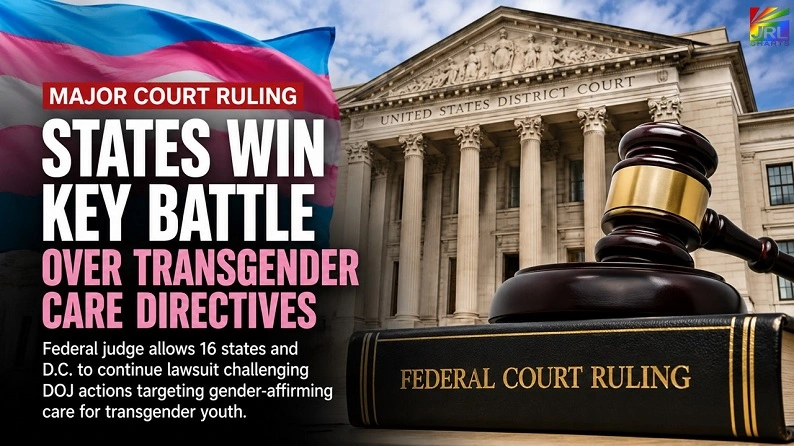
BOSTON, MA — (June 6, 2026) — A federal judge has delivered a significant legal setback to the Department of Justice after ruling that a coalition of 16 states and the District of Columbia may continue pursuing a lawsuit challenging federal efforts aimed at providers of gender-affirming healthcare for transgender youth.
In a decision issued this week, U.S. District Judge Angel Kelley rejected the DOJ’s request to dismiss the case, finding that the states had plausibly alleged that federal directives went beyond internal enforcement guidance and may have unlawfully altered how federal law is interpreted and enforced.
Trending LGBT Politics and Transgender Rights News on JRL CHARTS:
• Appeals Court Deals Major Blow to Trump Military Transgender Ban
• Dallas LGBTQ Community Defies Setback as Pride Celebrations Continue Without Rainbow Crosswalks
• IOC Bans Transgender Athletes from Women’s Olympic Sports Ahead of LA 2028
• Nevada Ranked Safest State for LGBTQ Residents in 2026 National Study
• Six Idaho Republicans Break Ranks on Transgender Bathroom Criminalization Bill
The lawsuit was originally filed by a coalition of Democratic-led states and Washington, D.C., which argue that federal actions targeting gender-affirming care providers interfere with state authority over healthcare regulation and exceed the powers granted to federal agencies.
Judge Questions DOJ Interpretation of Federal Law
At the center of the dispute are Justice Department memoranda issued following executive actions directing federal agencies to scrutinize medical providers offering gender-affirming care to minors.
Judge Kelley wrote that the states had presented sufficient evidence to proceed with claims that federal officials adopted novel interpretations of existing laws in a manner designed to pressure providers and discourage treatment programs. The ruling specifically referenced federal reliance on statutes including the Female Genital Mutilation Act, the Food, Drug, and Cosmetic Act, and the False Claims Act as part of the government’s enforcement strategy.
According to the court, the states plausibly argued that these directives represented more than routine prosecutorial priorities and could amount to agency action subject to judicial review under the Administrative Procedure Act.
States Claim Federal Actions Threatened Healthcare Access
The states contend that the federal government’s actions created uncertainty for hospitals, physicians, and healthcare systems across the country. Court filings cited investigations, subpoenas, and warnings directed at providers involved in gender-affirming care programs for minors.
The lawsuit argues that these actions effectively sought to discourage or halt medical services that remain lawful in numerous states.
Several healthcare systems nationwide have already modified or paused certain gender-affirming care services amid ongoing legal disputes and concerns about potential federal enforcement actions.
Growing National Legal Battle
The Massachusetts case is one of several high-profile court battles involving transgender healthcare policies currently unfolding across the United States.
Recent federal court rulings have addressed DOJ subpoenas seeking medical records from healthcare providers, while separate lawsuits continue over federal funding restrictions, healthcare regulations, and state-level policies affecting transgender youth.
Legal observers say Judge Kelley’s ruling does not determine the ultimate outcome of the case but allows the states to continue pursuing their constitutional and administrative law claims against the federal government.
What Happens Next?
With the DOJ’s dismissal effort rejected, the litigation will now move into its next phase, where the states will seek to prove that federal directives unlawfully interfered with state healthcare authority and violated federal administrative law requirements.
The case, Commonwealth of Massachusetts v. Trump, is expected to become one of the most closely watched legal challenges involving transgender healthcare policy as courts continue to evaluate the scope of federal authority in regulating gender-affirming care nationwide.
For continuing coverage of federal court rulings, LGBTQ rights litigation, and transgender healthcare policy developments, stay with JRL CHARTS LGBT Politics USA, your source for breaking political and legal news impacting the LGBTQ community.
His reporting focuses on federal court rulings, legislative developments, international human rights issues, and government actions impacting LGBTQ communities worldwide.
With nearly two decades of experience, Goldberg is recognized for his balanced analysis, investigative insight, and commitment to accurate, fact-based journalism that informs readers on the political forces shaping equality and justice.