By Paul Goldberg – Senior Correspondent | LGBT Business Finance News
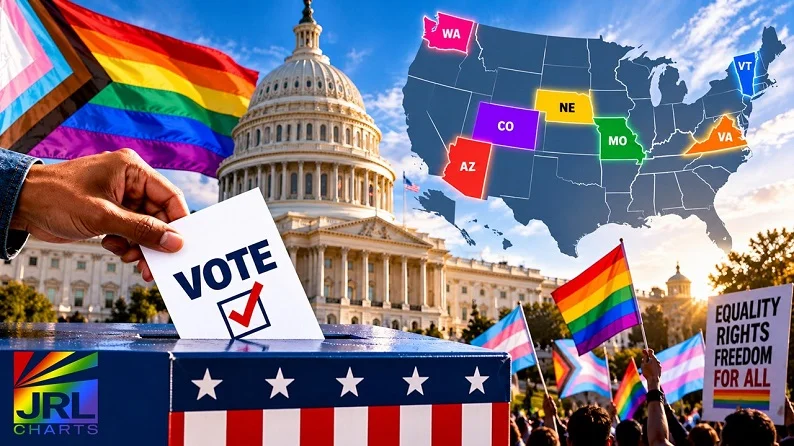
LAS VEGAS, NV — (October 24, 2026) — LGBTQ rights will be decided directly by voters in seven states during the November 3, 2026, midterm elections, with eight ballot measures addressing transgender student athletics, gender-affirming healthcare, marriage equality and constitutional protections against discrimination.
Arizona, Colorado, Missouri, Nebraska, Vermont, Virginia and Washington will each put LGBTQ-related policies before voters, potentially reshaping state laws and constitutional protections affecting millions of Americans.
Trending LGBTQ Business and Politics News on JRL CHARTS:
• Lindsey Graham Accused of Paying 3 Male Escorts — One Claims He Was 17
• Supreme Court Blocks Trump’s Transgender Prison Care Ban in Major Legal Setback
• UNC Settles 18 Trump Administration Probes as Race and DEI Rules Face New Scrutiny
• Catholic Relief Services Loses Major LGBTQ Benefits Battle in Federal Appeals Court
• LGBTQ Voters Are Fired Up for the 2026 Midterms — HRC Survey Reveals 87% Plan to Vote
• Review More in LGBTQ Business and Politics News on JRL CHARTS
The measures reflect sharply different approaches to LGBTQ policy. Six would establish or reinforce restrictions affecting transgender young people, while proposals in Vermont and Virginia would expand or affirm constitutional protections.
According to Ballotpedia and the nonpartisan voter organization HeadCount, all eight measures have qualified for the November ballot.
Arizona: Proposition 318 Targets Transgender Student Athletics
Arizona voters will consider Proposition 318, which would require schools and athletic associations to classify sports participation and certain private facilities according to sex assigned at birth.
The proposal would restrict transgender students from competing on teams or accessing athletic facilities consistent with their gender identity.
Supporters describe the measure as a protection for sex-separated athletics and privacy. Opponents argue that it would discriminate against transgender students and create additional barriers to school participation.
Colorado: Two Ballot Measures Address Sports and Healthcare
Colorado voters face two separate proposals.
Proposition 134 would require school and college athletic participation to follow sex-based classifications rather than gender identity.
Proposition 135 would prohibit specified transition-related surgeries for patients younger than 18 and restrict public funding and insurance coverage for those procedures.
The healthcare proposal does not impose a general ban on all nonsurgical gender-affirming treatment.
Medical organizations opposing the measure argue that treatment decisions should remain between patients, families and qualified healthcare professionals. Supporters maintain that additional restrictions are necessary for medical interventions involving minors.
Missouri: Amendment 3 Combines Abortion and Transgender Healthcare Restrictions
Missouri voters will consider Amendment 3, a constitutional proposal addressing both reproductive rights and gender-affirming healthcare.
The measure would repeal constitutional abortion protections approved by voters in 2024 and establish new restrictions with specified exceptions.
It would also prohibit certain gender-transition procedures and treatments for minors, including puberty-blocking medications and cross-sex hormones.
Missouri already has statutory restrictions on gender-affirming treatment for minors. The proposed amendment would place additional restrictions into the state constitution.
The combination of abortion and transgender healthcare provisions makes Missouri’s measure particularly consequential for debates over constitutional rights and medical regulation.
Nebraska: Initiative 442 Seeks Constitutional Sports Restrictions
Nebraska’s Initiative Measure 442 would amend the state constitution to require schools to classify athletic teams by biological sex.
The measure would prohibit students classified as male from participating on teams designated for girls and women.
Nebraska already restricts transgender participation in school athletics under state law, but the initiative would establish the policy at the constitutional level.
A legal challenge sought to remove the proposal from the ballot. However, Nebraska’s Supreme Court upheld dismissal of the challenge, allowing the measure to proceed to voters.
Vermont: Proposal 4 Would Expand Constitutional Equality Protections
Vermont voters will consider Proposal 4, an equal protection amendment that would expressly prohibit denial of rights based on several protected characteristics.
Those characteristics include race, ethnicity, sex, religion, disability, sexual orientation, gender identity, gender expression and national origin.
Unlike the measures restricting transgender participation or healthcare, Vermont’s proposal would establish explicit constitutional nondiscrimination language covering LGBTQ residents.
If approved, the amendment would provide an additional state constitutional basis for evaluating government actions involving those protected characteristics.
Virginia: Question 2 Would Remove Same-Sex Marriage Ban
Virginia voters will decide whether to remove the state’s longstanding constitutional prohibition on same-sex marriage.
Question 2 would replace the existing restriction with language affirming the right of two consenting adults to marry regardless of sex, gender or race.
Virginia’s constitutional marriage ban has been unenforceable since the U.S. Supreme Court’s 2015 decision in Obergefell v. Hodges, which recognized marriage equality nationwide.
However, the outdated prohibition remains written into Virginia’s constitution.
Approval of Question 2 would remove that language and establish an affirmative state constitutional marriage protection, although the proposal would not itself change the current nationwide legality of same-sex marriage.
Washington: Student Sports and Parental Rights Face Separate Votes
Washington voters will consider Initiative 638, which would impose sex-verification requirements for participation in girls’ school sports.
The proposal would require documentation from healthcare providers to establish eligibility and restrict participation by students classified as biologically male.
Supporters argue that the measure would protect competitive fairness in girls’ athletics. Opponents raise concerns about student privacy, medical documentation and the potential exclusion of transgender athletes.
Washington voters will also consider a separate parental-rights initiative seeking to restore provisions of a 2024 state law concerning public schools.
Critics of that second proposal argue that certain notification requirements could compromise LGBTQ students’ privacy, while supporters emphasize parental access to information about their children’s education.
The parental-rights proposal is an additional education-policy measure and is not included in the eight measures identified in the principal seven-state LGBTQ ballot count.
Why the November 3 Election Matters for LGBTQ Americans
The eight statewide ballot measures illustrate the growing role of direct democracy in shaping LGBTQ policy across the United States.
Four proposals address transgender participation in school athletics, two concern gender-affirming healthcare, one would expand constitutional nondiscrimination protections, and another would remove a constitutional same-sex marriage prohibition.
Some proposals would establish new statutory restrictions, while others would change state constitutions, potentially making future legislative revisions more difficult.
The outcome will determine the immediate future of these state-level policies, although litigation and federal constitutional questions could continue after Election Day.
For LGBTQ families, transgender students, healthcare professionals and civil rights organizations, the November election represents an important moment in the continuing debate over equality, individual rights and state authority.
JRL CHARTS LGBT Politics continues delivering independent coverage of the 2026 midterm elections, LGBTQ civil rights, transgender healthcare, marriage equality and the political decisions shaping America’s LGBTQ communities.
His reporting focuses on federal court rulings, legislative developments, international human rights issues, and government actions impacting LGBTQ communities worldwide.
With nearly two decades of experience, Goldberg is recognized for his balanced analysis, investigative insight, and commitment to accurate, fact-based journalism that informs readers on the political forces shaping equality and justice.
- LGBTQ Rights on the Line in 7 States as 2026 Midterm Elections Near - October 24, 2026
- Gay Dad Cleared After Punching MAGA Influencer Who Targeted His Family - October 24, 2026
- Oil Prices Explode to $117 a Barrel as Iran War Sends Shockwaves Through U.S. Economy - October 23, 2026