By Paul Goldberg — Senior Correspondent | LGBT Business Finance News
WASHINGTON, D.C. — (November 8, 2026) — A federal court battle over transgender healthcare benefits is intensifying just days before the government’s 2027 health insurance enrollment period begins, as federal employees seek emergency judicial intervention against the Trump administration’s restrictions on gender-affirming medical coverage.
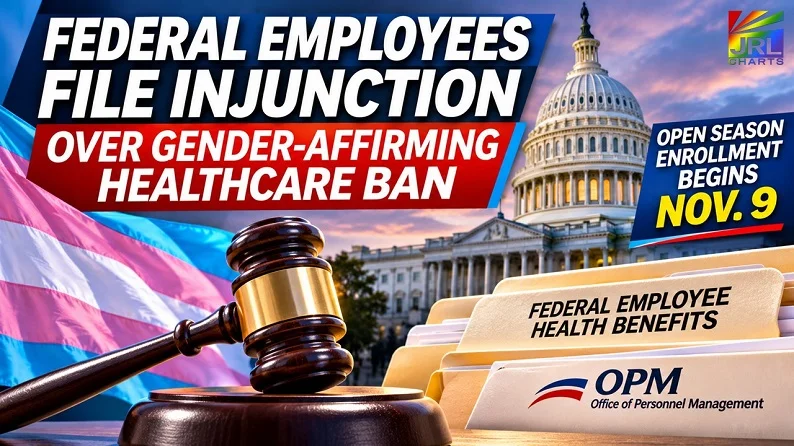
On November 4, attorneys representing federal workers filed a motion for a preliminary injunction in the U.S. District Court for the District of Columbia, seeking to prevent the Office of Personnel Management (OPM) from enforcing restrictions that would further eliminate insurance coverage for gender-affirming treatment under two major federal employee health programs.
Trending LGBTQ Business and Politics News on JRL CHARTS:
• Wall Street’s AI Bubble Warning: Democratic Sweep Triggers $2.5 Trillion Nasdaq Meltdown
• Fed Holds Rates at 4% as Wall Street Bets on December Hike
• Stocks Up 12%, Bonds Under Pressure — Morningstar Reveals Wall Street’s Growing Divide
• American Express Profits Surge 28% — Then Comes the 3,500 Job Cut Bombshell
• LGBTQ Nonprofit Makes $3 Million Move to Transform Downtown Buffalo
• Breaking Now on LGBT Business Finance News
The lawsuit challenges changes affecting the Federal Employees Health Benefits (FEHB) and Postal Service Health Benefits (PSHB) programs, which provide insurance options to eligible federal and postal workers, retirees and their families.
At the center of the dispute is a significant employment benefits question: whether the federal government can exclude certain medically prescribed treatments from employee insurance plans based on the purpose for which those treatments are provided.
Federal Healthcare Restrictions Face Title VII Discrimination Challenge
The case, Doe et al. v. Kupor, challenges OPM’s restrictions under Title VII of the Civil Rights Act of 1964, which prohibits discrimination in employment based on protected characteristics, including sex.
Plaintiffs argue that the government’s insurance policies discriminate against transgender employees and covered dependents by denying treatments that may remain available to other beneficiaries for different medical indications.
One example cited in the litigation involves breast reconstruction or implants. According to the plaintiffs, certain procedures may be covered following a mastectomy while being excluded when prescribed as gender-affirming treatment.
Their argument centers on whether these differences in insurance eligibility constitute unlawful sex discrimination in federal employment compensation and benefits.
The administration’s position is reflected in OPM guidance restricting coverage for medical interventions intended to modify sex characteristics. The government opposes the preliminary injunction request, and the underlying legal dispute remains unresolved.
Nearly 58,000 Transgender Beneficiaries Could Be Affected
Research cited by the plaintiffs from the Williams Institute at UCLA estimates that between 39,400 and 57,800 transgender individuals are enrolled in the FEHB and PSHB programs.
The estimate includes federal employees, retirees and covered dependents.
The figures represent the potentially affected population rather than a confirmed number of individuals currently receiving gender-affirming treatment or filing denied insurance claims.
Nevertheless, the litigation raises substantial questions about the financial exposure of federal households whose medical treatment may no longer qualify for reimbursement.
The plaintiffs contend that affected beneficiaries could face substantial out-of-pocket expenses, treatment interruptions and difficult employment decisions.
The Human Rights Campaign Foundation has also reported that the coverage restrictions have contributed to financial hardship and, in some cases, decisions to leave federal employment.
November 9 Open Season Raises the Stakes for Federal Workers
Timing has become a central element of the litigation.
The federal government’s annual Open Season enrollment period begins November 9, 2026, giving eligible workers and retirees an opportunity to review or change their health insurance selections for the 2027 plan year.
The enrollment period is scheduled to conclude December 14.
The plaintiffs argue that without immediate court intervention, affected beneficiaries will be required to make important insurance decisions under a policy that they contend unlawfully excludes necessary medical treatment.
The distinction between the 2026 and 2027 policies is especially significant.
For 2026, OPM generally eliminated coverage for gender-affirming medical interventions while retaining counseling services and allowing limited case-by-case exceptions for individuals already undergoing treatment.
For 2027, the agency directed carriers to eliminate that exceptions process, further restricting coverage for individuals receiving ongoing hormonal or surgical care.
Under the announced policy, counseling services would remain covered.
Healthcare Costs Become a Federal Employment Benefits Issue
Beyond the constitutional and civil rights debate, the case presents a direct financial question for federal employees and their households.
Employer-sponsored health insurance is a major component of total employee compensation. Restrictions on covered medical services can shift costs from insurance plans to individual workers.
In the federal lawsuit, plaintiffs describe the potential consequences of paying directly for treatment previously covered by insurance.
One plaintiff, identified by the pseudonym Charlotte Coe, is a State Department employee who reportedly requires corrective surgery following complications from an earlier procedure.
According to the court filing, the operation could cost tens of thousands of dollars without insurance, creating a substantial financial barrier to obtaining treatment.
Another employee described in reporting, Vanessa Voe, works for the Defense Department and alleges that losing insurance coverage has forced difficult decisions about continuing prescribed treatment.
These accounts form part of the plaintiffs’ argument that the restrictions could produce irreparable harm before the court reaches a final decision.
The financial consequences may extend beyond direct medical bills, potentially influencing household savings, employment decisions and the perceived value of federal benefits packages.
Those broader economic effects, however, have not been independently quantified in the litigation.
Human Rights Campaign Foundation Backs Federal Class Action
The legal challenge is supported by the Human Rights Campaign Foundation and the law firms Correia & Puth and Cohen Milstein Sellers & Toll.
The underlying lawsuit was filed in August 2026, following unsuccessful administrative efforts to challenge the restrictions.
The plaintiffs are seeking class certification, which would allow the litigation to proceed on behalf of a broader group of affected beneficiaries if approved by the court.
The November 4 preliminary injunction motion represents a request for temporary protection while the underlying case continues.
A preliminary injunction would not itself constitute a final judgment that OPM violated federal employment law.
The court must determine whether the legal requirements for such extraordinary relief have been satisfied.
As of November 8, the litigation remains pending, with no reported ruling granting the requested preliminary injunction.
Why This Case Matters Beyond the Federal Workforce
The dispute could have implications for how employers, insurers and benefits administrators evaluate coverage exclusions under federal employment discrimination law.
A ruling addressing the relationship between gender-affirming care exclusions and Title VII could contribute to the broader legal debate over whether employer-sponsored insurance plans may distinguish between otherwise comparable treatments based on medical purpose.
However, any immediate court order would have to be evaluated according to its precise language and scope. It would not automatically rewrite every private employer’s health insurance policy.
For LGBTQ professionals and business owners, the case highlights the growing intersection of workplace equality, employee compensation, healthcare affordability and federal regulatory policy.
For federal employees preparing to select 2027 health insurance coverage, the immediate question is whether the court will intervene before the new restrictions take effect.
JRL CHARTS LGBT Business Finance News will continue tracking the federal court proceedings, OPM healthcare policy and the employment benefits decisions affecting LGBTQ workers and their families nationwide.

His reporting focuses on federal court rulings, legislative developments, international human rights issues, and government actions impacting LGBTQ communities worldwide.
With nearly two decades of experience, Goldberg is recognized for his balanced analysis, investigative insight, and commitment to accurate, fact-based journalism that informs readers on the political forces shaping equality and justice.
- Federal Workers Take Trump Healthcare Ban to Court as 2027 Benefits Deadline Looms - November 8, 2026
- Wall Street’s AI Bubble Warning: Democratic Sweep Triggers $2.5 Trillion Nasdaq Meltdown - November 7, 2026
- Trump White House Reportedly Weighed Jailing Journalists — Stephen Miller Backed the Move - November 7, 2026