By Paul Goldberg — Senior Correspondent | LGBT Politics USA / LGBT Business Finance News
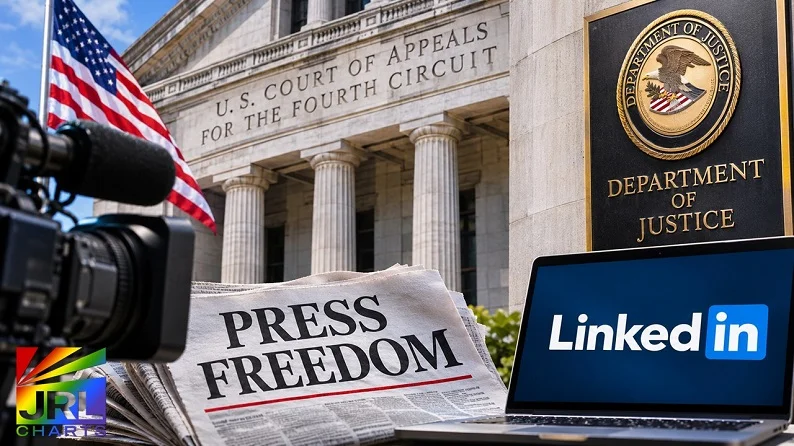
WASHINGTON, D.C. — (November 10, 2026) — The Trump administration suffered a significant First Amendment setback Tuesday after a unanimous federal appeals court ruled that the Justice Department’s sweeping demand for journalists’ LinkedIn records threatened confidential sources and exceeded permissible limits under federal law.
The U.S. Court of Appeals for the Fourth Circuit ordered a lower court to narrow disclosure requirements targeting journalists involved in a national security leak investigation, delivering an important victory for press freedom advocates and digital privacy protections.
Trending LGBTQ Business and Politics News on JRL CHARTS:
• Federal Workers Take Trump Healthcare Ban to Court as 2027 Benefits Deadline Looms
• Wall Street’s AI Bubble Warning: Democratic Sweep Triggers $2.5 Trillion Nasdaq Meltdown
• Google’s AI Gamble: Can Gemini Save Search Without Destroying Its Cash Machine?
• Exxon, Chevron Cash In as $130 Billion Oil Boom Threatens Trump’s Midterms
• Get the Latest in LGBT Business Finance News on JRL CHARTS
The ruling, authored by Judge J. Harvie Wilkinson III, a Ronald Reagan appointee, warned that exposing journalists’ confidential sources unrelated to a criminal investigation could undermine independent reporting and government accountability.
Federal Judges Reject Sweeping Trump DOJ Records Demand
At the center of the dispute is a Justice Department investigation involving classified information allegedly disclosed in reporting about a top-secret American military operation overseas.
Federal investigators sought LinkedIn metadata covering an 18-month period, potentially exposing the identities of confidential sources who communicated with journalists through the professional networking platform.
According to court documents, the targeted reporters collectively published nearly 1,000 articles, fewer than five percent of which appeared connected to the subject of the government’s investigation.
The three-judge appellate panel determined that the government’s disclosure demands reached far beyond records reasonably relevant to the suspected national security leak.
Wilkinson emphasized that protecting confidential sources remains essential to independent journalism.
“Confidentiality of sources is the lifeblood of a free press,” the judge wrote.
The decision was joined by Judge James Andrew Wynn, appointed by President Barack Obama, and Judge Nicole Berner, appointed by President Joe Biden.
Press Freedom Advocates Celebrate Major First Amendment Victory
The Reporters Committee for Freedom of the Press (RCFP) praised the decision as a major development in protecting journalists and the individuals who provide sensitive information to news organizations.
The nonprofit press advocacy organization characterized the ruling as a “big deal,” highlighting its potential importance for future disputes involving government surveillance, confidential sources and technology companies.
The ruling reinforces the principle that government investigators cannot automatically obtain extensive records of journalists’ professional communications simply because those records are held by third-party digital platforms.
For investigative reporters covering federal agencies, military operations, political misconduct and other matters of public interest, protecting source identities can be critical to uncovering information that government officials might otherwise keep from public scrutiny.
LinkedIn Wins Limits on Government Access — But Investigation Continues
The dispute began after LinkedIn challenged federal disclosure and secrecy orders issued under the Stored Communications Act.
A federal district court in Virginia initially upheld the government’s demands, prompting LinkedIn to appeal.
Tuesday’s ruling partially reversed that decision, requiring the district court to reconsider the scope of the records request.
Importantly, the appeals court did not eliminate the Justice Department’s authority to investigate classified information leaks or obtain relevant evidence.
Instead, the judges concluded that federal investigators must demonstrate appropriate limits when seeking records that could expose confidential sources unrelated to the investigation.
The court also required modification of a separate secrecy order to permit disclosure of the government’s demands to one appropriately vetted attorney representing the affected news organization.
Why the Fourth Circuit Ruling Matters for American Journalism
Beyond the immediate dispute, the decision raises important questions about the intersection of press freedom, government surveillance, national security and digital communications privacy.
Modern investigative journalism increasingly depends on professional networking platforms, encrypted communications and online messaging services to connect reporters with sources.
Sweeping government demands for digital records could discourage whistleblowers, federal employees and other confidential sources from communicating with journalists, even when their information concerns legitimate matters of public interest.
The Fourth Circuit’s decision establishes an important boundary: national security investigations deserve serious judicial consideration, but constitutional protections cannot be disregarded merely for investigative convenience.
For independent publishers and investigative newsrooms, the ruling represents a significant affirmation of the First Amendment’s continuing importance in the digital media era.
JRL CHARTS — LGBTQ Digital Media Network continues delivering independent coverage of federal court rulings, First Amendment protections, press freedom and government accountability.
Subscribe to the JRL CHARTS Newsletter for the latest breaking news, political developments, business intelligence and entertainment headlines delivered directly to your inbox.
Media Partners: For licensing inquiries, media usage rights, or republication requests, please visit our Contact Us page. All content © JRL CHARTS Media Network. Unauthorized use is strictly prohibited.
His reporting focuses on federal court rulings, legislative developments, international human rights issues, and government actions impacting LGBTQ communities worldwide.
With nearly two decades of experience, Goldberg is recognized for his balanced analysis, investigative insight, and commitment to accurate, fact-based journalism that informs readers on the political forces shaping equality and justice.
- Trump DOJ Suffers First Amendment Setback as Federal Court Protects Journalists’ Sources - November 10, 2026
- Wall Street Sinks as Inflation Shock Sends Treasury Yields Toward 5% - November 10, 2026
- Pornhub Parent Aylo Faces $120 Million Settlement as Federal Judge Clears Major Legal Hurdle - November 9, 2026