By: Paul Goldberg – Senior Correspondent | LGBT Politics USA
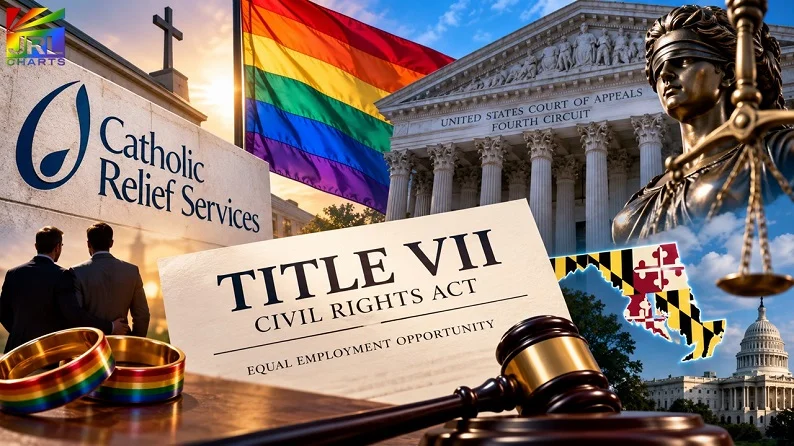
BALTIMORE, MD — (October 19, 2026) — A federal appeals court has upheld a discrimination judgment against Catholic Relief Services after the Baltimore-based humanitarian organization terminated health insurance coverage for a gay employee’s husband, rejecting its argument that religious freedom protections shielded the decision from federal and Maryland employment laws.
In a 2–1 ruling issued October 16, the U.S. Court of Appeals for the Fourth Circuit affirmed the lower court’s judgment in John Doe v. Catholic Relief Services, a closely watched dispute involving LGBTQ workplace protections, religious liberty, and employee compensation.
Trending LGBTQ Business and Politics News on JRL CHARTS:
• Wall Street Gets Hammered as AI Stocks Tumble and Oil Prices Surge
• Bank of America Faces Historic $1.2B Reckoning as Q3 Profits Plunge 17%
• CVS Hit with $315 Million Opioid Settlement — What LGBTQ+ and Cancer Patients Need to Know
• Trump Takes Transgender Military Ban to Supreme Court Before Explosive 2027 Trial
• LGBTQ Voters Are Fired Up for the 2026 Midterms — HRC Survey Reveals 87% Plan to Vote
• Review More in LGBTQ Business and Politics News on JRL CHARTS
The decision leaves intact a $60,000 compensatory damages award for the employee, who brought the lawsuit under the pseudonym John Doe.
Federal Appeals Court Rejects Broad Religious Exemption
Writing for the majority, Senior Circuit Judge Henry F. Floyd concluded that existing religious-employer exemptions do not provide Catholic Relief Services with blanket immunity from sex discrimination claims involving nonministerial employees.
The court examined Title VII of the Civil Rights Act of 1964, Maryland’s Fair Employment Practices Act, and constitutional protections governing religious institutions.
Although religious organizations receive important statutory and constitutional protections, the majority determined those protections did not exempt CRS from liability in this case.
The court distinguished employment decisions involving religious ministers from those affecting lay employees performing ordinary administrative and technical duties.
Floyd concluded that the sweeping immunity sought by CRS was not required under existing federal law or the Constitution.
Gay Employee Was Initially Promised Husband’s Health Coverage
According to the court’s published opinion, John Doe joined Catholic Relief Services in 2016 after being assured that his husband would qualify for dependent health insurance coverage.
Approximately five months after his employment began, the organization informed Doe that his husband’s enrollment conflicted with its religious beliefs concerning marriage.
CRS offered alternative compensation arrangements, which Doe declined, before terminating his husband’s dependent benefits.
Doe subsequently challenged the decision under federal and Maryland employment discrimination laws.
He continued working for the organization until resigning in 2024.
The litigation ultimately centered on whether the charity’s religious identity and sincerely held beliefs permitted it to deny benefits that otherwise would have been available to similarly situated employees.
Judge’s Dissent Warns of Religious Freedom Consequences
Circuit Judge A. Marvin Quattlebaum Jr. dissented, arguing that the majority adopted an excessively narrow interpretation of constitutional protections for religious institutions.
His dissent emphasized the historical importance of church autonomy and maintained that religious organizations must retain meaningful authority over employment policies connected to their faith.
Quattlebaum argued that the church autonomy doctrine extends beyond decisions involving ministers and can protect religiously motivated employment decisions affecting other workers.
Circuit Judge James Andrew Wynn joined Floyd’s majority opinion but wrote separately to challenge the dissent’s interpretation of religious freedom and constitutional history.
The disagreement highlights an ongoing legal debate over how courts should balance religious institutional autonomy against generally applicable workplace discrimination protections.
What the Fourth Circuit Ruling Means for LGBTQ Workers
The decision carries implications for religiously affiliated employers and LGBTQ employees throughout the Fourth Circuit, which covers Maryland, Virginia, West Virginia, North Carolina, and South Carolina.
The majority’s reasoning reinforces the distinction between religious employment functions protected by the ministerial exception and ordinary employment relationships governed by federal and state anti-discrimination statutes.
For LGBTQ workers employed in nonministerial positions, the ruling provides an important example of how courts may evaluate unequal spousal benefits and compensation.
However, the decision does not eliminate religious-employer exemptions or establish that every employment dispute involving a religious institution must produce the same outcome.
Its application depends on the employee’s responsibilities, the applicable statutes, and the specific circumstances of the dispute.
The court also dismissed the appeal concerning the Equal Pay Act claim as moot while affirming the judgment on the remaining issues.
Employment Rights Organizations Respond to Decision
The National Employment Lawyers Association and Americans United for Separation of Church and State were among the organizations supporting the employee’s position through amicus briefs.
Their arguments emphasized the importance of maintaining workplace discrimination protections while recognizing established constitutional exceptions for religious institutions.
Americans United President and CEO Rachel Laser said religious freedom should not be interpreted as permission to deny employment benefits to LGBTQ workers.
The case also attracted support for Catholic Relief Services from religious organizations concerned about the potential implications for faith-based employers.
Those competing arguments reflect the broader legal significance of the dispute and the questions courts continue to confront regarding religious freedom and civil rights.
Read the Fourth Circuit’s Published Ruling:
The October 16 decision, John Doe v. Catholic Relief Services, Case No. 25-1569, includes the majority opinion, a separate concurrence, and an extensive dissent.
Read the official 173-page federal appeals court ruling:
https://www.ca4.uscourts.gov/opinions/251569.P.pdf
The published decision provides the court’s reasoning on Title VII, Maryland employment discrimination law, the Equal Pay Act, and First Amendment religious protections.
Stay connected to JRL CHARTS LGBT Politics for continuing coverage of LGBTQ civil rights, federal court decisions, workplace discrimination, religious freedom disputes, and U.S. political developments affecting the LGBTQ community.
His reporting focuses on federal court rulings, legislative developments, international human rights issues, and government actions impacting LGBTQ communities worldwide.
With nearly two decades of experience, Goldberg is recognized for his balanced analysis, investigative insight, and commitment to accurate, fact-based journalism that informs readers on the political forces shaping equality and justice.
- Catholic Relief Services Loses Major LGBTQ Benefits Battle in Federal Appeals Court - October 19, 2026
- Welker Corners Treasury Secretary Bessent Over Trump Economy: “636 Days” - October 18, 2026
- Wall Street Gets Hammered as AI Stocks Tumble and Oil Prices Surge — LGBTQ Businesses Brace for Fallout - October 18, 2026