By Paul Goldberg — Senior Correspondent | Business Finance News
NEW YORK, NY — (November 13, 2026) — Wall Street is facing a renewed wave of financial uncertainty after U.S. Treasury yields surged Thursday, November 12, as investors braced for additional Federal Reserve interest-rate increases amid stubborn inflation and growing concerns over the central bank’s monetary policy direction.
The policy-sensitive two-year Treasury yield climbed to 4.862%, recording a staggering 38.8-basis-point increase over four trading sessions — its largest four-session surge since June 2022, according to MarketWatch.
Trending LGBTQ Business and Politics News on JRL CHARTS:
• Wall Street Sinks as Inflation Shock Sends Treasury Yields Toward 5%
• UK Lawmakers Push to Ban Adult Livestreaming Platforms in Sweeping New Crackdown
• Federal Workers Take Trump Healthcare Ban to Court as 2027 Benefits Deadline Looms
• Wall Street’s AI Bubble Warning: Democratic Sweep Triggers $2.5 Trillion Nasdaq Meltdown
• Google’s AI Gamble: Can Gemini Save Search Without Destroying Its Cash Machine?
• Get the Latest in LGBT Business Finance News on JRL CHARTS
Meanwhile, the benchmark 10-year Treasury yield climbed above the psychologically significant 5% threshold, reaching 5.10%, according to U.S. Treasury Department data.
The dramatic rise in borrowing costs has intensified pressure on financial markets, raising fresh concerns for American consumers, homebuyers, business owners and investors already navigating an increasingly uncertain economic landscape.
Wall Street Braces for More Federal Reserve Rate Hikes
The latest bond market selloff follows stronger-than-expected inflation data that has forced investors to reconsider how aggressively the Federal Reserve may need to tighten monetary policy heading into 2027.
The central bank currently maintains its benchmark federal funds rate within a target range of 3.75% to 4.00%, following its September decision to raise interest rates for the first time in three years.
However, financial markets are increasingly anticipating additional increases, with expectations mounting that the Federal Reserve could raise rates in December and again in January.
Federal Reserve Governor Christopher Waller has further fueled those concerns by signaling that a half-percentage-point increase could be warranted in December if inflationary pressures remain elevated.
Such a move would represent a significant escalation in the central bank’s efforts to contain inflation and could send borrowing costs even higher across the American economy.
Kevin Warsh’s Federal Reserve Faces Growing Scrutiny
Adding to Wall Street’s uncertainty is Federal Reserve Chairman Kevin Warsh’s approach to communicating monetary policy.
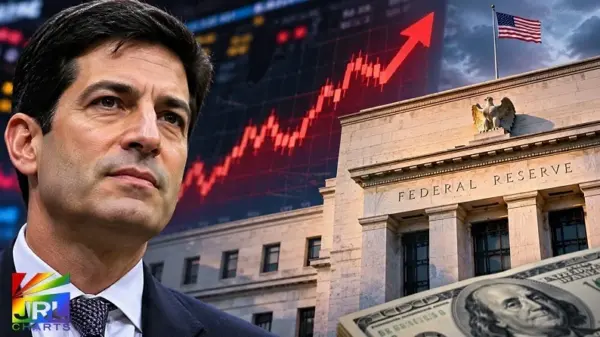
Treasury yields surge as Wall Street braces for additional Federal Reserve rate hikes under Chairman Kevin Warsh. (JRL CHARTS Editorial Illustration)
Warsh has advocated for a less vocal central bank, moving away from the extensive forward guidance that investors had grown accustomed to under previous Federal Reserve leadership.
While the strategy is intended to give policymakers greater flexibility to respond to changing economic conditions, it also leaves financial markets with fewer advance signals about potential interest-rate decisions.
The result is an environment in which inflation reports, employment figures and individual comments from Federal Reserve officials can trigger substantial market movements.
Market participants are now confronting the possibility that interest rates could remain elevated for longer than previously anticipated, complicating investment strategies and increasing uncertainty for businesses planning their 2027 budgets.
The latest Treasury selloff underscores how rapidly expectations can shift when investors receive new economic data without a clear indication of the central bank’s next move.
Rising Treasury Yields Put American Businesses and Consumers on Alert
The consequences of rising bond yields extend well beyond Wall Street trading floors.
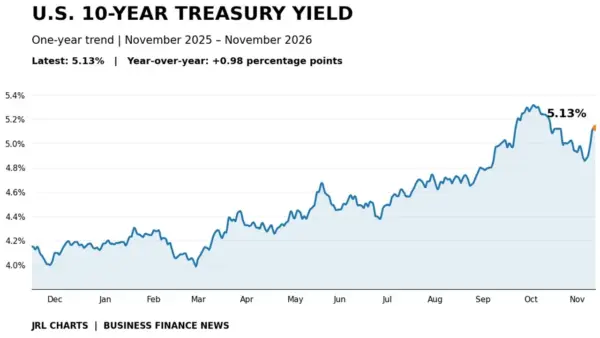
The U.S. 10-year Treasury yield climbs to 5.13% as Wall Street braces for additional Federal Reserve rate hikes. (JRL CHARTS Business Finance News)
Higher Treasury yields can translate into increased mortgage rates, more expensive corporate financing and additional pressure on businesses seeking capital for expansion, inventory purchases and operational expenses.
For small businesses and specialty retailers, the prospect of higher interest rates presents another challenge heading into the critical holiday shopping season and the first quarter of 2027.
Consumers could also face renewed pressure from elevated credit card interest rates, auto financing costs and other forms of borrowing.
The surge in the 10-year Treasury yield is particularly significant because it serves as an important benchmark for long-term borrowing costs throughout the economy.
Technology companies and other growth-oriented businesses may also face increased scrutiny from investors as higher interest rates reduce the present value of anticipated future earnings and make capital-intensive expansion projects more expensive.
Inflation Remains Wall Street’s Biggest Concern
The latest developments follow a turbulent week for financial markets, as inflation fears continue to challenge investor confidence.
As previously reported by JRL CHARTS, Wall Street experienced renewed selling pressure earlier this week after inflation data pushed Treasury yields toward the 5% threshold.
Thursday’s bond market activity marked another escalation, with investors increasingly concerned that persistent price pressures could force the Federal Reserve to maintain a more restrictive monetary policy than previously expected.
For financial markets, the challenge is no longer simply determining when interest rates might decline. Investors must now assess how much further rates could rise — and what those increases could mean for economic growth, corporate earnings and consumer spending.
All Eyes Turn to the December Federal Reserve Meeting
Attention is now shifting to the Federal Reserve’s upcoming December 8–9 policy meeting, where officials will determine whether additional monetary tightening is necessary.
A quarter-percentage-point increase would lift the federal funds target range to 4.00%–4.25%, while a more aggressive half-point increase would push the range to 4.25%–4.50%.
Neither outcome is guaranteed, and upcoming economic reports will play a critical role in shaping the central bank’s decision.
However, with Treasury yields climbing sharply and inflation concerns continuing to dominate financial markets, investors are preparing for the possibility of another prolonged period of elevated borrowing costs.
For Wall Street, American businesses and millions of consumers, the Federal Reserve’s December decision could set the tone for the economic challenges awaiting the nation in 2027.
Stay with JRL CHARTS — LGBTQ Digital Media Network — for the latest Business Finance News, Wall Street developments, Federal Reserve policy updates and breaking economic headlines.
His reporting focuses on federal court rulings, legislative developments, international human rights issues, and government actions impacting LGBTQ communities worldwide.
With nearly two decades of experience, Goldberg is recognized for his balanced analysis, investigative insight, and commitment to accurate, fact-based journalism that informs readers on the political forces shaping equality and justice.
- Bond Market Meltdown: Treasury Yields Soar as Fed Eyes More Aggressive Rate Hikes - November 13, 2026
- AI Arms Race Faces Legal Showdown as Nonprofits Sue Five Tech Giants to Halt Development - November 12, 2026
- UK Lawmakers Push to Ban Adult Livestreaming Platforms in Sweeping New Crackdown - November 11, 2026