By: Paul Goldberg – Senior Correspondent | LGBT Politics Europe
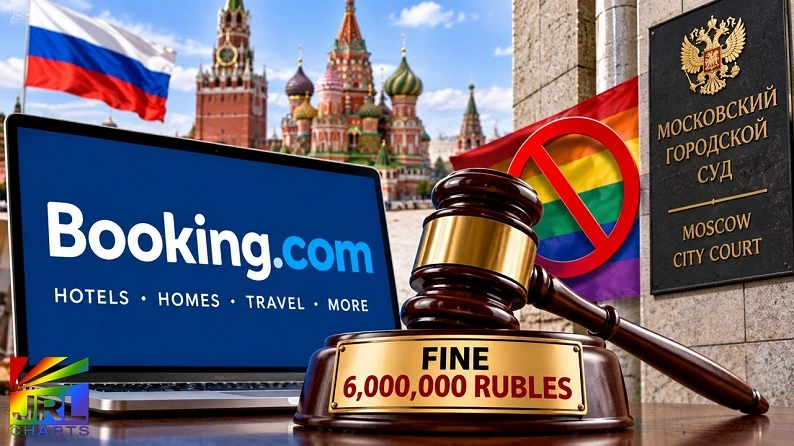
MOSCOW, RUSSIA — (September 13, 2026) — Russia’s widening campaign against LGBTQ visibility has reached one of the world’s largest online travel platforms, with a Moscow court imposing 6 million rubles in combined fines against Booking.com under laws regulating LGBTQ-related content and prohibited information.
Moscow’s Tagansky District Court found Booking.com B.V. responsible for two administrative violations, according to Russian legal news agency RAPSI and Interfax.
Related LGBT Business Finance News on JRL CHARTS:
• Ukraine Porn Legalization Push Could Open the Door for Gay Adult Industry
• Paris Homophobic Attack Leaves LGBTQ Rights Leader Pierre Picavet Seriously Injured
• Suspect in Berlin Pride Terror Attack Shot Dead During Police Operation
• Berlin Pride Horror: Van Slams Into LGBTQ+ Parade, Leaving One Dead
• Germany’s Gay Conservative Leader Jens Spahn Resigns Over Surrogacy Scandal
• Polish President Karol Nawrocki Vetoes Civil Partnerships Bill in Blow to LGBTQ Rights
One 3-million-ruble penalty was imposed under Article 6.21 of Russia’s administrative code, which prohibits what the government defines as propaganda promoting “nontraditional sexual relations,” gender transition or rejecting childbirth.
A second 3-million-ruble fine concerned Booking.com’s alleged failure to remove information that Russian authorities considered prohibited.
The combined penalty is equivalent to roughly $70,000, depending on exchange rates.
Pride Month Hotel Newsletter Reportedly Triggered Case
Ukrainian outlet United24 Media reported that the dispute involved information distributed to Booking.com’s foreign hotel partners concerning accommodations for LGBTQ travelers around Pride Month events.
According to that account, Booking.com maintained that the material had been removed in March, while Russian authorities alleged prohibited information remained accessible.
Russian court reporting independently confirms the two convictions and 6-million-ruble total, although the publicly available court accounts reviewed by JRL CHARTS do not provide the same detailed description of the newsletter.
The distinction matters because the Booking.com ruling represents more than another financial penalty against a foreign technology company. It demonstrates how Russia’s expanding restrictions on LGBTQ-related information can potentially reach international companies communicating about LGBTQ customers and travel.
Russia’s LGBT Propaganda Laws Have Expanded Dramatically
Russia’s restrictions began more narrowly in 2013, when legislation prohibited distributing what the government termed propaganda of “nontraditional sexual relations” to minors.
The legal framework expanded significantly in 2022, extending restrictions on positive or neutral representations of LGBTQ relationships across public media, advertising, entertainment and online content regardless of the audience’s age.
Then came an even more consequential development.
In November 2023, Russia’s Supreme Court designated what authorities called the “international LGBT movement” an extremist organization, dramatically increasing the potential legal consequences surrounding LGBTQ advocacy, organizations, symbols and public expression.
Those measures have subsequently been used against individuals, publishers, entertainment platforms, businesses and LGBTQ organizations. Human Rights Watch has documented fines, prosecutions and enforcement actions involving bookstores, streaming platforms, social-media users and venues.
2026 Crackdown Reaches Entertainment and Publishing
The Booking.com ruling joins an expanding list of LGBTQ-related enforcement actions during 2026.
In April, a Russian news organization was fined 500,000 rubles after publishing a review discussing the popularity of the gay hockey drama Heated Rivalry. Mediazona reported that the article itself had already been removed when authorities pursued the case.
Amnesty International has documented additional 2026 penalties against streaming services and journalists, along with enforcement targeting LGBTQ-themed literature and publishing. The organization says authorities are increasingly using censorship, administrative penalties and extremism legislation against LGBTQ expression and institutions.
The consequences have moved beyond fines.
In June, a Russian court sentenced the owner and two employees of the LGBTQ-oriented Pose nightclub in Orenburg to prison terms following prosecution under the government’s extremism framework.
Russian LGBT Network Shuts Down After Extremist Designation
The escalating legal environment also contributed to the end of one of Russia’s most established LGBTQ advocacy organizations.
The Russian LGBT Network, established in 2006, announced in August that it was shutting down after being designated an extremist organization earlier in the year.
The organization said continuing its previous public activities could expose activists, supporters and people receiving assistance to additional legal risks.
For two decades, the network had supported LGBTQ people across Russia and became internationally known for assisting people facing persecution in Chechnya.
Its closure illustrated how Russia’s LGBTQ restrictions have evolved from controlling particular forms of public expression into a broader legal environment affecting organizations, media, cultural institutions and businesses.
Booking.com Fine Extends Crackdown Into International Travel
The Booking.com decision adds another dimension.
This time, Russian enforcement has reached a major international travel company rather than a domestic activist, publisher, nightclub or streaming platform.
Russian courts have previously imposed substantial penalties against international technology companies over content and compliance requirements. Interfax notes that Google, Telegram, Amazon, Twitter/X, TikTok, Wikimedia, Twitch and other platforms have faced Russian legal action in recent years.
For Booking.com, the immediate consequence is a 6-million-ruble penalty.
For Russia’s LGBTQ community and international businesses operating around the Russian market, however, the case provides another indication of just how broadly the country’s restrictions on LGBTQ-related information can now be applied.
JRL CHARTS LGBT Politics Europe continues tracking Russia LGBT laws, LGBTQ censorship and government actions affecting LGBTQ people, organizations and international companies operating across the region.
His reporting focuses on federal court rulings, legislative developments, international human rights issues, and government actions impacting LGBTQ communities worldwide.
With nearly two decades of experience, Goldberg is recognized for his balanced analysis, investigative insight, and commitment to accurate, fact-based journalism that informs readers on the political forces shaping equality and justice.
- Oil Prices Explode to $117 a Barrel as Iran War Sends Shockwaves Through U.S. Economy - October 23, 2026
- Lindsey Graham Accused of Paying 3 Male Escorts — One Claims He Was 17 - October 22, 2026
- LGBTQ Nonprofit Makes $3 Million Move to Transform Downtown Buffalo - October 21, 2026