By: Paul Goldberg — Senior Correspondent | LGBT Politics USA
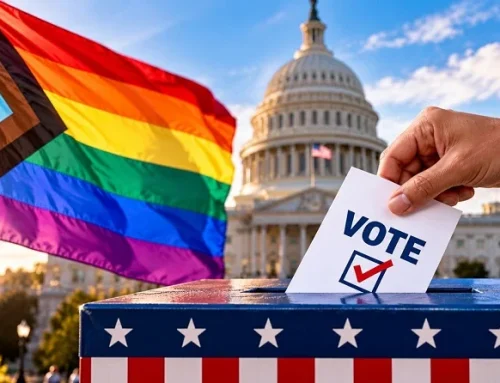
WASHINGTON, D.C. — (September 6, 2026) — President Donald Trump’s administration has raced back to the U.S. Supreme Court seeking permission to enforce controversial new restrictions on mail-in ballots ahead of the November midterm elections — and an overlooked group could have particularly high stakes in the fight: LGBTQ Americans living with disabilities.
The administration filed a new emergency application Sunday asking the nation’s highest court to lift a lower-court injunction blocking new U.S. Postal Service requirements governing election mail.
Now Trending on LGBT Business and Politics News on JRL CHARTS:
• Maria Bartiromo OUT at Fox News in Shocking Effective-Immediately Exit
• America’s Job Market Just Got Worse — And Higher Interest Rates Could Be Next
• Wall Street Shrugs, But LGBT Businesses Could Feel the Pain as Bond Yields Surge
• Democrats Blow Up the 2028 Presidential Map as DNC Rewrites Road to White House
• America’s ‘Golden Age’? U.S. Job Growth Since January 2025 Tells a Different Story
• Millions of Working Americans Are Going Hungry—and Nobody Is Talking About It
• Review More in LGBT Business and Politics News
The filing marks the third time the Trump administration has asked the Supreme Court to intervene in this particular mail-ballot battle, as states have already begun sending ballots for the November 3 midterm elections.
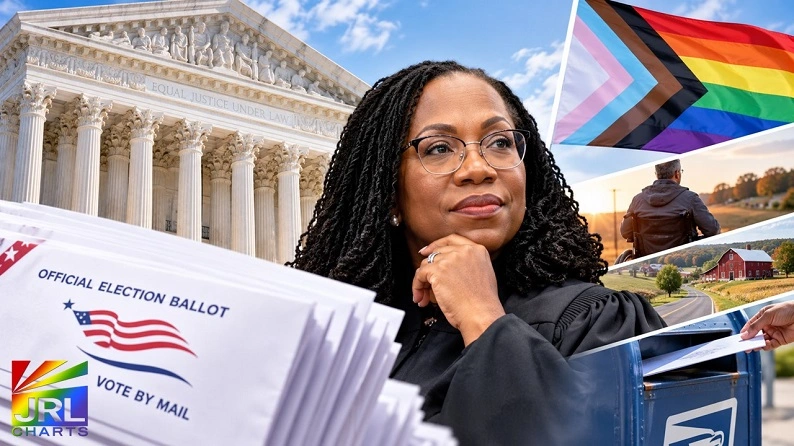
And the administration’s latest request has landed initially with Justice Ketanji Brown Jackson, who has already issued a deadline for opponents to respond — and who sharply criticized the Court’s handling of an earlier phase of the same dispute.
While the legal fight applies to voters regardless of sexual orientation or gender identity, federal voting data and LGBTQ demographic research reveal an important intersection receiving considerably less attention:
LGBTQ Americans experience disproportionately high rates of disability, while Americans with disabilities are significantly more likely to vote by mail.
Trump Administration Returns to Supreme Court for Third Time
At the center of the dispute is a new Postal Service rule implementing provisions stemming from an executive order Trump signed in March.
The rule requires states to provide the Postal Service with information identifying mail-ballot recipients and requires outbound and return ballot envelopes to meet new standards, including unique tracking barcodes.
Under the rule, ballot mail that fails to comply with the new requirements could be refused by the Postal Service and returned to election officials.
U.S. District Judge Indira Talwani in Massachusetts blocked enforcement of the requirements for the November election, finding that the challengers were likely to prevail in their arguments against the new system.
The Trump administration disputes those arguments.
Solicitor General D. John Sauer has argued that the federal government possesses authority to regulate use of the federal mail system and that the Postal Service requirements regulate the mail rather than determine voter eligibility.
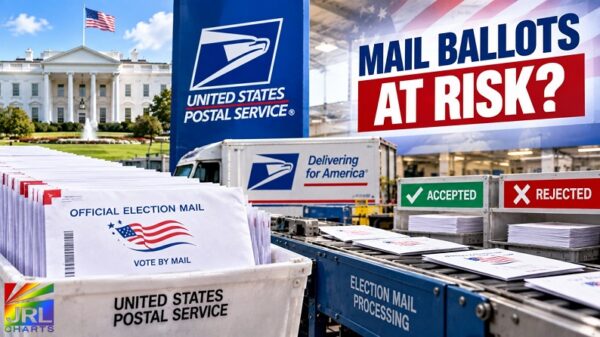
Postmaster General David Steiner says USPS can securely implement the administration’s election-mail requirements as opponents challenge the restrictions in court.
Postmaster General David Steiner says USPS can securely implement the administration’s election-mail requirements as opponents challenge the restrictions in court.The administration also contends that continuing the injunction as states begin distributing ballots could itself produce confusion.
North Carolina has already begun mailing ballots. Alabama is scheduled to begin September 9, with additional states following shortly afterward.
“Once those ballot envelopes enter the mailstream, there is no retrieving them,” Sauer told the Supreme Court in the administration’s latest filing.
The administration wants the restrictions allowed to take effect immediately.
Opponents, including Democratic-led states and voting-rights organizations, argue that the requirements are unconstitutional, interfere with states’ authority over elections and could jeopardize otherwise valid ballots with insufficient time remaining for election officials to overhaul their systems.
Justice Ketanji Brown Jackson Takes Center Stage
The latest emergency application has initially landed before Supreme Court Justice Ketanji Brown Jackson, who handles emergency matters arising from the Boston-based U.S. Court of Appeals for the First Circuit.
Jackson on Sunday gave the states and voting-rights organizations challenging the restrictions until Wednesday to respond to the Trump administration’s latest request.
Her assignment puts Jackson at the center of the immediate procedural battle, but it does not mean she alone will ultimately determine whether Trump’s restrictions take effect.
As circuit justice, Jackson handles emergency applications originating from the First Circuit and can refer the administration’s request to the full Supreme Court.
What makes Jackson’s involvement especially noteworthy is that this isn’t her first encounter with Trump’s mail-voting order.
When the Supreme Court considered an earlier challenge in August, its majority allowed implementation of portions of Trump’s executive order to proceed after concluding that the states challenging it had brought their case prematurely.
Jackson strongly disagreed.
She wrote the dissent, joined by Justices Sonia Sotomayor and Elena Kagan, arguing that the Constitution assigns administration of federal elections primarily to the states and sharply criticizing the Court for allowing implementation to proceed so close to the midterms.
Jackson called the conduct contemplated by the administration “patently unlawful” and warned that the Court’s decision risked injecting additional uncertainty into the approaching election.
Importantly, that earlier Supreme Court ruling did not establish that Trump’s mail-ballot restrictions themselves are constitutional.
Nor does Jackson’s earlier dissent determine how the Court will resolve the administration’s latest emergency application.
But it provides an unusually clear window into her previous assessment of the constitutional questions surrounding the president’s attempt to reshape mail-ballot procedures.
Now, with an actual Postal Service rule issued and another lower-court injunction in place, the controversy has returned to the Supreme Court — and to Jackson’s chambers.
The Overlooked LGBTQ Disability Factor
Lost amid the constitutional showdown is another question:
Who relies most heavily on the voting method at the center of the fight?
There is currently no comprehensive federal dataset measuring how many LGBTQ Americans vote by mail specifically because of illness or disability.
But several major datasets reveal a striking overlap.
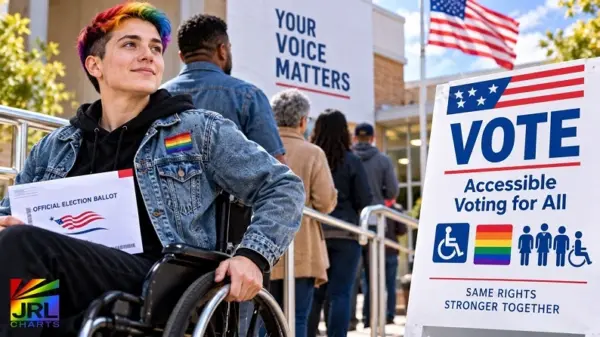
Voting accessibility carries particular significance for LGBTQ Americans with disabilities, who are part of a population that uses mail voting at higher rates.
Research from the Williams Institute at UCLA School of Law has found that LGBTQ adults are considerably more likely to report living with disabilities than non-LGBTQ adults.
One major analysis found approximately 35% of lesbian and bisexual women and 35% of transgender adults lived with a disability, along with approximately 28% of cisgender gay and bisexual men.
That compared with approximately 24% of cisgender heterosexual women and 19% of cisgender heterosexual men.
More recent federal Household Pulse Survey data analyzed by the Williams Institute showed a similar disparity: approximately 21% of LGBT adults reported a disability compared with 13% of non-LGBT adults.
Among transgender adults, the figure climbed to approximately 38%.
Those numbers become particularly significant when combined with national voting data.
Disabled Americans Are More Likely to Vote by Mail
An analysis of the 2024 Current Population Survey Voting and Registration Supplement shows that Americans with disabilities were substantially more likely than those without disabilities to vote through the mail before Election Day.
Approximately 35.5% of voters with disabilities voted by mail before Election Day in 2024, compared with 26% of voters without disabilities.
That means disabled voters were roughly 37% more likely proportionally to use that method of voting.
The numbers represent millions of ballots.
Approximately 7.1 million Americans with disabilities voted by mail before Election Day in 2024.
The pattern isn’t confined to one election.
Research conducted by Rutgers University for the U.S. Election Assistance Commission found that 38.9% of voters with disabilities voted by mail during the 2022 midterms, compared with 30.9% of voters without disabilities.
Researchers found that some voters used mail ballots specifically because their disabilities made voting at a polling location more difficult.
Voters with mobility impairments were particularly likely to report using mail voting.
Illness and Disability Can Determine Whether Someone Votes at All
Perhaps one of the most revealing statistics comes from Americans who were registered to vote but ultimately did not cast a ballot.
Among registered voters with disabilities who did not vote in the 2024 presidential election, 36.1% cited illness or disability as the reason.
Among registered non-disabled voters who failed to cast ballots, only 7.5% cited illness or disability.
Transportation presents another obstacle.
Approximately 5.2% of registered disabled nonvoters cited transportation problems, compared with 1.6% of their counterparts without disabilities.
Those figures demonstrate why voting accessibility isn’t merely a matter of convenience for some Americans.
For voters with mobility limitations, chronic health problems or other disabilities, the ability to receive and return a ballot without traveling to a polling place can remove a substantial barrier to participating in an election.
Voting in Person Can Present Additional Barriers
Election Assistance Commission research has documented a sizable accessibility gap at physical polling locations.
During the 2022 elections, approximately 20% of voters with disabilities reported difficulty voting in person, compared with just 6% of voters without disabilities.
Reported problems included waiting in lines, reading or seeing ballots, writing on ballots and physically entering polling locations.
Researchers found that increased use of mail voting among people with more significant disabilities accounted for part of the improvement in polling-place difficulties recorded over the previous decade.
That doesn’t mean mail voting is universally easier for every disabled voter.
Voters with visual or cognitive disabilities can encounter accessibility problems with paper ballots as well.
But the research demonstrates that for a substantial segment of America’s disabled population, mail voting provides an important alternative to barriers encountered at traditional polling locations.
LGBTQ America Extends Far Beyond Major Cities
The potential implications also extend beyond major LGBTQ population centers such as New York, Los Angeles, San Francisco and Chicago.
LGBTQ Americans live throughout rural America.
Williams Institute research has estimated that approximately 11.7% of LGBT adults live in rural communities.
Separate Williams Institute population estimates put the LGBT adult population nationwide at approximately 13.9 million.
Rural residence by itself does not establish dependence on mail voting. National election data show significant differences in mail-ballot use based on state law, geography, demographics and election year.
But distance, transportation and access to services can compound existing obstacles for voters who also have disabilities.
That distinction matters.
There currently isn’t sufficient national evidence to conclude that rural LGBTQ Americans as a group disproportionately vote by mail.
There is, however, strong evidence establishing that LGBTQ Americans disproportionately experience disabilities and that Americans with disabilities disproportionately use mail ballots.
What the Data Does — and Doesn’t — Prove About LGBTQ Voters
There is an important limitation to the numbers.
No national study reviewed by JRL CHARTS establishes what percentage of LGBTQ voters specifically use mail ballots because they are disabled, chronically ill, unable to travel or living in rural communities.
It would therefore be inaccurate to claim that Trump’s Postal Service rule has already been proven to disproportionately affect LGBTQ voters.
What the existing evidence establishes is an intersection of populations that deserves attention as the Supreme Court considers the administration’s request:
LGBTQ Americans have higher documented rates of disability.
Voters with disabilities use mail ballots at higher rates.
Millions of disabled Americans cast ballots through the mail.
Illness and disability remain major reasons registered disabled Americans fail to vote at all.
And LGBTQ Americans aren’t confined to large metropolitan areas where transportation and polling locations may be more readily available.
Whether the Trump administration’s rule would ultimately prevent significant numbers of those voters from casting ballots remains disputed and may depend heavily on how the requirements are implemented.
Supreme Court Faces a Rapidly Closing Election Calendar
The timing adds another dimension to the case.
The administration’s Sunday filing represents the third request for Supreme Court intervention in this particular mail-ballot dispute.
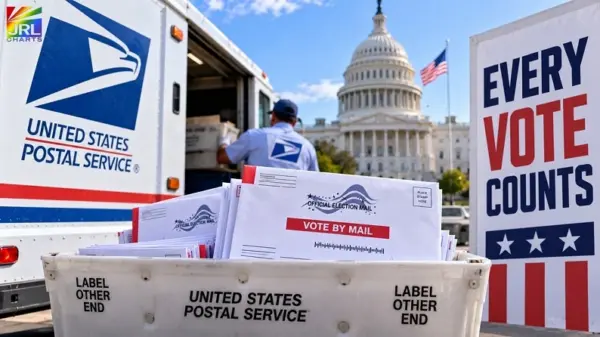
Millions of mail ballots are expected to move through the U.S. Postal Service as states prepare for the November 2026 midterm elections.
Unlike the Court’s regular merits docket — where cases generally receive months of briefing followed by oral arguments — emergency applications can move extraordinarily quickly.
And this dispute is unfolding against an election calendar that won’t wait for the courts.
North Carolina has already begun sending ballots.
Alabama is expected to begin September 9.
At least five additional states are expected to begin mailing ballots during the week of September 13.
Every passing day therefore increases the number of ballot envelopes already entering the postal system under procedures that states established before the administration’s new requirements.
Supreme Court Decision Could Come Quickly
The immediate future of the Postal Service restrictions now rests with the Supreme Court.
Justice Jackson has given opponents until Wednesday to respond to the Trump administration’s emergency request.
After those arguments are submitted, the Court could move rapidly.
If the justices grant the administration’s request, USPS could begin implementing the new ballot requirements as election offices nationwide prepare millions of ballots.
If the Court leaves Talwani’s injunction intact, the restrictions would remain blocked for the November 3 election while litigation over their legality continues.
For disabled voters — including the disproportionately large share of LGBTQ Americans living with disabilities — the stakes extend beyond the mechanics of how an envelope is processed.
For some Americans, access to a mail ballot can help determine whether they are able to participate in the democratic process at all.
And with millions of ballots preparing to enter the mail, the Supreme Court’s next move could come within days.
Stay with JRL CHARTS LGBT Politics USA for continuing coverage of the Supreme Court, voting rights and the political battles shaping LGBTQ America ahead of the 2026 midterm elections.
His reporting focuses on federal court rulings, legislative developments, international human rights issues, and government actions impacting LGBTQ communities worldwide.
With nearly two decades of experience, Goldberg is recognized for his balanced analysis, investigative insight, and commitment to accurate, fact-based journalism that informs readers on the political forces shaping equality and justice.
- Bank of America Faces Historic $1.2B Reckoning as Q3 Profits Plunge 17% - October 17, 2026
- CVS Hit with $315 Million Opioid Settlement — What LGBTQ+ and Cancer Patients Need to Know - October 17, 2026
- LGBTQ+ Support Vanishes from Alabama University Website as Scholarship Questions Mount - October 17, 2026