By: Paul Goldberg – Senior Correspondent | LGBT Business Finance News
LAS VEGAS, NV — (August 21, 2026) — Wall Street may be taking another surge in Treasury yields largely in stride, but for LGBT-owned businesses across the United States, persistently high borrowing costs could carry consequences far beyond the trading floor.
From financing inventory and managing revolving credit to funding expansion, equipment and everyday operations, the cost and availability of capital remain critical issues for small and midsize businesses.
That makes the renewed rise in Treasury yields more than another Wall Street story.
It could become a Main Street business story — including for America’s growing network of LGBTQ-owned enterprises.
Now Trending on LGBT Business Finance News on JRL CHARTS:
• XVideos Scores Major Section 230 Victory as 9th Circuit Rejects FOSTA Challenge
• JustFor.fans Scores Major WIPO Victory as Panel Orders Rival Domain Transferred
• Aylo Moves to Settle Pornhub Class Actions With $120 Million Fund and New Safeguards
• Former Wells Fargo VP Alleges Age, Race and LGBTQ Discrimination After 39-Year Career
• Millions of Working Americans Are Going Hungry—and Nobody Is Talking About It
• LGBTQ Business Owners Join Growing Coalition Against Bank Account Closures
Treasury Yields Climb Back Toward Painful Levels
U.S. government bond yields moved higher again Friday, largely erasing the relief that followed the Treasury Department’s surprise intervention earlier this week.
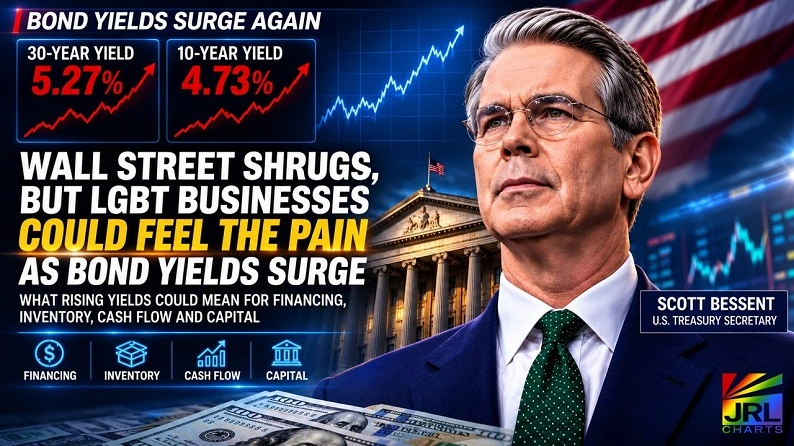
The 30-year Treasury yield climbed to approximately 5.27%, while the benchmark 10-year yield reached roughly 4.73%. The rebound came despite Treasury Secretary Scott Bessent’s effort to increase government purchases of longer-dated Treasury securities.
On Wednesday, the Treasury announced that it would at least double the size of certain buyback operations covering 10- to 30-year securities from $2 billion to at least $4 billion per operation. The expanded program is scheduled to run from September 9 through November 4.
The initial announcement brought yields down, but much of that decline proved short-lived.
Investors continue to wrestle with inflation concerns, federal borrowing requirements, elevated oil prices and a national debt that recently crossed $40 trillion.
For business owners, the important question isn’t simply what happens to Treasury bonds next.
It’s what happens to the cost of money.
Why LGBT Businesses Should Be Watching
Treasury yields do not directly determine every small-business loan rate. However, elevated market interest rates contribute to a financial environment in which borrowing can remain expensive, affecting everything from corporate debt to commercial financing.
That matters particularly for small and midsize companies that depend on outside capital.
The Federal Reserve reported in July that small-business financing conditions remained somewhat restrictive, with loan originations declining somewhat while business credit-card borrowing increased during the first half of 2026.
Even more noteworthy, the Fed said increasing revolving balances on small-business credit cards — typically a high-cost source of financing — suggest that some businesses have been having difficulty obtaining traditional bank loans or credit lines.
There is no evidence establishing that LGBTQ-owned companies as a group are being affected more severely than other small businesses.
But LGBT enterprises operate within the same credit markets — making today’s financing environment highly relevant to owners deciding whether to borrow, expand or conserve cash.
The National LGBTQ+ & Allied Chamber of Commerce, commonly known as NGLCC, maintains a nationwide network focused on expanding economic opportunity and business growth for LGBTQ-owned and allied small and midsize enterprises.
Inventory Becomes More Expensive When Money Is Expensive
The effects can become especially visible for retailers, wholesalers and distributors.
Businesses frequently purchase merchandise weeks or months before that inventory produces revenue.
When inventory is purchased through a revolving credit line, business credit card or other financing arrangement, higher interest expenses can increase the effective cost of keeping products sitting on warehouse shelves.
That creates a difficult equation.
Businesses need enough inventory to satisfy customers, but carrying too much inventory can lock valuable cash into merchandise while financing expenses continue accumulating.
For LGBT-owned retailers and suppliers already managing payroll, rent, insurance, freight and other operating expenses, inventory management can therefore become as much a cash-flow decision as a merchandising decision.
Cash Flow Could Become the Bigger Story
A business doesn’t necessarily have to be unprofitable to experience financial pressure.
Timing matters.
Suppliers may require payment before customers generate sufficient revenue. Commercial clients may pay invoices 30, 60 or even 90 days later. Payroll and rent, meanwhile, don’t wait.
Working capital traditionally bridges that gap.
When affordable bank financing becomes harder to obtain, companies may increasingly turn to higher-cost alternatives.
That is precisely why the Federal Reserve’s observation about increasing small-business credit-card borrowing deserves attention.
For JRL CHARTS, cash flow will be one of the most important indicators to watch across LGBT businesses throughout the remainder of 2026.
Expansion Decisions Could Be Next
Higher financing costs can also change whether a planned investment makes financial sense.
An LGBT-owned retailer considering another location, a distributor planning warehouse expansion, a restaurant financing renovations or a professional-services company purchasing new equipment must eventually calculate whether the expected return justifies the cost of capital.
As financing becomes more expensive, some businesses may postpone investments, reduce their size or finance them internally.
Others may decide not to proceed at all.
That can eventually flow into hiring, commercial real estate, equipment purchases and supplier orders.
Treasury and Federal Reserve Appear to Be Pulling Different Levers
The current bond-market environment is further complicated by differences between Treasury intervention and Federal Reserve policy.
Treasury is attempting to improve market functioning and counter some of the pressure on longer-term government securities through larger buybacks.
Yet higher market yields themselves tighten financial conditions by increasing borrowing costs throughout parts of the economy.
The Treasury’s intervention has so far produced only temporary relief, with bond investors quickly pushing long-term yields higher again.
That leaves businesses facing an uncomfortable question:
How long will expensive capital remain part of the operating environment?
JRL CHARTS Launches LGBT Business Economy Watch
Beginning with today’s bond-market developments, JRL CHARTS LGBT Business Finance News will expand its coverage of the economy through the perspective of LGBT-owned businesses.
Our LGBT Business Economy Watch will follow four critical areas:
Financing and Capital — Business lending conditions, interest rates, credit availability and the cost of expansion.
Inventory — The cost of financing merchandise, wholesale pricing, supply chains and inventory management.
Cash Flow — Working-capital pressures, revolving credit, operating expenses and the ability of businesses to finance day-to-day operations.
Business Growth — Hiring, expansion, capital investment and confidence among LGBT-owned enterprises.
Whenever possible, JRL CHARTS will combine national economic indicators with information from LGBTQ business organizations, business owners, retailers, distributors and other industry participants.
The goal isn’t to manufacture an LGBT angle around Wall Street.
It’s to answer a much more practical question:
When America’s financial markets change, what does it actually mean for LGBT businesses trying to operate, finance inventory, make payroll and grow?
With the 30-year Treasury yield once again approaching the 5.3% level that rattled markets earlier this week, that question could become increasingly important during the remainder of 2026.
JRL CHARTS LGBT Business Finance News will continue tracking the markets, financing conditions and economic forces shaping the future of LGBT-owned businesses across America.
His reporting focuses on federal court rulings, legislative developments, international human rights issues, and government actions impacting LGBTQ communities worldwide.
With nearly two decades of experience, Goldberg is recognized for his balanced analysis, investigative insight, and commitment to accurate, fact-based journalism that informs readers on the political forces shaping equality and justice.
- LGBTQ Nonprofit Makes $3 Million Move to Transform Downtown Buffalo - October 21, 2026
- Supreme Court Blocks Trump’s Transgender Prison Care Ban in Major Legal Setback - October 21, 2026
- UNC Settles 18 Trump Administration Probes as Race and DEI Rules Face New Scrutiny - October 19, 2026