By: Paul Goldberg – Senior Correspondent | LGBT Politics USA | Election 2026
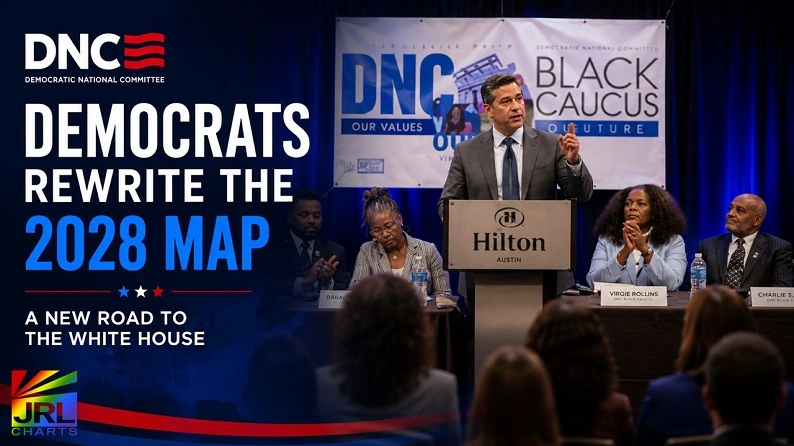
AUSTIN, TX — (August 15, 2026) — The Democratic Party just dramatically changed the road to its next presidential nominee. In a major shakeup ahead of the 2028 presidential election, Democratic leaders have approved a new primary strategy designed to change which voters get the earliest opportunity to shape the race for the White House.
Democratic National Committee members voted Saturday to approve a revamped 2028 presidential primary calendar that pushes South Carolina to the front of the presidential nominating battle, sidelines Iowa from its once-dominant position and gives several of the party’s more racially diverse constituencies an earlier opportunity to shape the race.
Now Trending on LGBTQ Politics News on JRL CHARTS:
• Judge Hands Trump Major Win in Minnesota Transgender Title IX Battle
• HRC Launches $15M Campaign to Defend LGBTQ+ Rights in 2026 Midterms
• America’s ‘Golden Age’? U.S. Job Growth Since January 2025 Tells a Different Story
• Watch: Anti-Trump “Had Enough?” Ad Sparks Political Firestorm in Election 2026
• Millions of Working Americans Are Going Hungry—and Nobody Is Talking About It
• Democrats Enter 2026 Midterms With Momentum — But LGBTQ Civil Rights Are Now on the Ballot
• Review More in LGBTQ Politics News Exclusively on JRL CHARTS
The decision creates a rapid six-state sprint leading into Super Tuesday — and could force every Democrat considering a 2028 White House campaign to rethink where they build organizations, spend money and assemble their winning coalition.
Under the newly approved calendar, Democrats are scheduled to begin voting in:
- South Carolina — January 22
- Nevada — February 1
- New Hampshire — February 8
- New Mexico — February 15
- Michigan — February 22
- Virginia — February 29
The six contests would unfold in little more than five weeks before the presidential campaign reaches Super Tuesday.
DNC Replaces the Old Presidential Playbook
For decades, presidential hopefuls knew the ritual.
Campaign relentlessly through Iowa. Survive New Hampshire. Build momentum. Then take the campaign national.
That Democratic playbook is effectively gone.
South Carolina will now become the opening test, putting candidates before an electorate where Black voters play a major role in Democratic politics.
Nevada immediately follows, bringing Latino voters, organized labor and working-class voters into the opening stages of the nomination fight.
New Mexico further expands Latino representation in the early window, while Michigan introduces a major industrial battleground with powerful labor constituencies and a diverse Democratic electorate.
Virginia adds another large and politically varied state before Super Tuesday.
The DNC argues that collectively those states provide a much broader test of presidential candidates than the party’s traditional reliance on Iowa and New Hampshire.
Ken Martin Says Candidates Will Have to Earn the Nomination
DNC Chair Ken Martin has described the new group of early states as representative of the Democratic coalition and argued that the calendar should force presidential contenders to compete for support across different regions, demographics, generations and economic backgrounds.
The objective is larger than determining who can survive a presidential primary.
Democrats want an early calendar capable of testing whether candidates can build the type of broad coalition required to ultimately win the White House.
That means a 2028 contender could need to demonstrate appeal among Southern Black Democrats in South Carolina before pivoting almost immediately toward Nevada’s Latino and union voters.
Within weeks, that same campaign could face voters in New Hampshire, New Mexico, Michigan and Virginia.
There will be little time for a struggling candidate to recover.
Iowa’s Era at the Front Is Over
Perhaps no state loses more influence under the new Democratic system than Iowa.
The Iowa caucuses once represented one of the most important rituals in American presidential politics, capable of transforming little-known candidates into national contenders virtually overnight.
But Democrats began moving away from Iowa following the disastrous reporting and technical problems surrounding the party’s 2020 caucuses.
The 2028 calendar makes that break considerably harder to reverse.
Iowa Democratic Party leaders objected to the decision, arguing that removing the state from the early window leaves significant portions of the country outside the opening nomination process while Republicans can continue using Iowa as a nationally televised presidential proving ground.
The dispute may not end with Saturday’s vote.
National Democrats have strengthened penalties aimed at state parties and presidential candidates that participate in unsanctioned early contests, increasing the potential consequences of states attempting to defy the approved calendar.
New Hampshire Could Become the DNC’s Bigger Headache
Iowa isn’t the only potential problem.
New Hampshire has a state law requiring its presidential primary to be held before similar contests elsewhere.
That requirement collides directly with the Democratic calendar placing New Hampshire third — after South Carolina and Nevada.
And because Republicans control New Hampshire’s state government, national Democrats cannot simply expect lawmakers to rewrite state law to accommodate the DNC.
One possible solution is a party-administered Democratic contest on the February 8 date established by the national party.
But New Hampshire Democratic leaders have already expressed disappointment with the calendar, leaving another potentially messy fight unresolved nearly a year and a half before the first scheduled votes.
Black and Latino Voters Move Toward the Center of the 2028 Race
The demographic implications of the calendar may prove far more consequential than the dispute over which state gets bragging rights for voting first.
Democrats are deliberately moving voters who represent critical components of their national coalition closer to the beginning of the presidential selection process.
South Carolina places Black Democratic voters at center stage immediately.
Nevada and New Mexico elevate Latino voters much earlier.
Nevada and Michigan also put organized labor and working-class constituencies into strategically important positions.
That comes as both major political parties continue battling over demographic groups whose voting behavior has become increasingly competitive.
The result is a presidential calendar that isn’t simply about diversity.
It is also about electoral strategy.
The 2026 Midterms Could Shape the 2028 Primary Before It Begins
There is another important piece of the puzzle: Election 2026.
Two states on the new early presidential calendar — Nevada and Michigan — are major political battlegrounds.
What happens in November 2026 could therefore provide presidential hopefuls with an early roadmap showing which messages, coalitions and campaign strategies are working before the 2028 field fully takes shape.
Michigan will be especially closely watched as Democrats and Republicans fight over one of the nation’s most consequential Senate contests.
The results could influence how future presidential candidates approach labor, working-class voters, suburban communities and the ideological divisions developing within the Democratic coalition.
In other words, the 2028 Democratic presidential primary may begin taking shape long before anyone casts a presidential ballot.
The Calendar Could Reshape the Democratic Field
The consequences for prospective presidential candidates are enormous.
Candidates can no longer build campaigns primarily around performing well in Iowa and New Hampshire before attempting to expand their coalition.
They will need political organizations capable of operating across radically different electorates almost immediately.
A candidate who performs strongly among Black Democrats in South Carolina could suddenly enter Nevada with momentum.
Another candidate could recover in Nevada or New Hampshire.
But with another primary arriving roughly every week, there will be little breathing room.
Money, staffing, endorsements and grassroots organizations will likely need to be established across multiple states well before January 2028.
And that means the invisible presidential primary — the battle for donors, operatives, endorsements and political infrastructure — could accelerate considerably after the 2026 midterm elections.
One Major Detail Still Isn’t Settled
Saturday’s DNC vote establishes the party’s intended order, but it does not make every logistical question disappear.
Individual states must still complete the legal or party processes necessary to hold their contests on the designated dates.
New Hampshire’s state law remains a significant complication.
Republicans also have not finalized their own 2028 presidential calendar.
But for Democrats, the political message coming out of Austin is unmistakable.
The days when Iowa and New Hampshire automatically controlled the opening conversation of a Democratic presidential campaign are over.
The party wants its next nominee tested immediately among Black voters in the South, Latino voters in the West and Southwest, organized labor, working-class voters and electorates across several distinct regions of the country.
The first Democratic presidential ballots won’t be cast until January 2028.
The battle to win them may have just begun.
JRL CHARTS LGBT Politics USA | Election 2026 will continue tracking the political battles, emerging candidates and shifting voter coalitions shaping the 2026 midterms — and the rapidly developing road to the 2028 presidential election.

His reporting focuses on federal court rulings, legislative developments, international human rights issues, and government actions impacting LGBTQ communities worldwide.
With nearly two decades of experience, Goldberg is recognized for his balanced analysis, investigative insight, and commitment to accurate, fact-based journalism that informs readers on the political forces shaping equality and justice.
- Meta Paid 29 Anti-LGBTQ Accounts as 2026 Midterm Misinformation Spreads - October 14, 2026
- Orbán’s Anti-LGBTQ Legacy Crumbles as Hungary Votes 139–51 for Change - October 13, 2026
- Japan Faces a $101.5 Billion LGBTQ Equality Problem, Economic Study Warns - October 12, 2026