By: Paul Goldberg — Senior Correspondent | LGBT Business Finance News
WASHINGTON, D.C. — (August 28, 2026) — Americans searching for work are confronting an uncomfortable economic combination: The United States created even fewer jobs than previously estimated during the year ending in March 2026, while the Federal Reserve is simultaneously signaling that stubborn inflation could require higher interest rates.
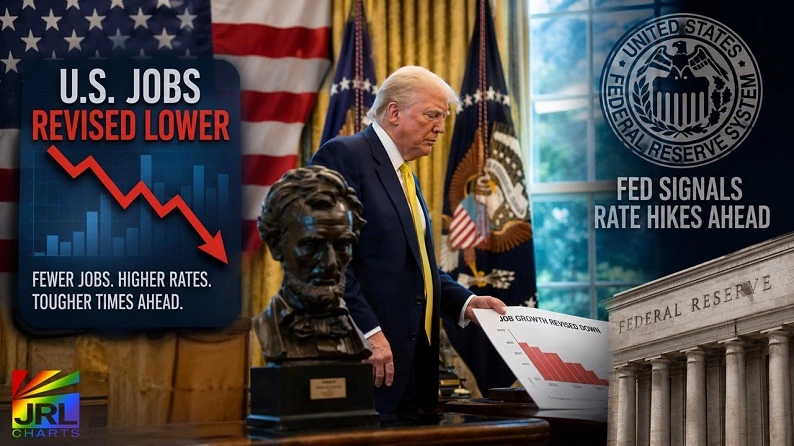
New preliminary benchmark data released Friday by the U.S. Bureau of Labor Statistics shows total nonfarm employment in March 2026 was 79,000 jobs lower than previously estimated, a 0.1% downward revision.
Now Trending on LGBT Business and Politics News on JRL CHARTS:
• Wall Street Shrugs, But LGBT Businesses Could Feel the Pain as Bond Yields Surge
• Democrats Blow Up the 2028 Presidential Map as DNC Rewrites Road to White House
• HRC Launches $15M Campaign to Defend LGBTQ+ Rights in 2026 Midterms
• America’s ‘Golden Age’? U.S. Job Growth Since January 2025 Tells a Different Story
• Millions of Working Americans Are Going Hungry—and Nobody Is Talking About It
• Review More in LGBT Business and Politics News
That reduces what had already been extraordinarily weak employment growth between March 2025 and March 2026.
Previous estimates indicated the economy added only about 273,000 jobs during the entire 12-month period. Applying the preliminary revision puts that increase at just under 200,000 jobs.
For American workers, the numbers reinforce an increasingly familiar problem: Companies aren’t necessarily conducting massive layoffs, but they aren’t doing much hiring either.
America’s “Low-Hire, Low-Fire” Economy
Economists have increasingly characterized the U.S. labor market as “low hire, low fire” — an environment where employers retain much of their existing workforce while remaining reluctant to add new employees.
That may provide stability for Americans who already have jobs, but it creates a much more difficult environment for people trying to find one.
Recent college graduates, workers attempting to change careers and unemployed Americans can find themselves competing for a limited number of openings as businesses become increasingly cautious about expanding payrolls.
The sluggish hiring environment first began emerging during the final year of the Biden administration and has continued under President Donald Trump.
Friday’s preliminary benchmark revision does not fundamentally change that picture. Instead, it provides additional evidence that employment growth was slightly weaker than previously believed.
Why the Government Revised the Jobs Numbers
The BLS produces its closely watched monthly employment report using surveys of businesses and government agencies. Those reports provide policymakers, businesses and investors with timely information, but they are still estimates.
Once a year, the agency compares those estimates against much broader employment records.
The benchmark process relies heavily on the Quarterly Census of Employment and Wages, which is based primarily on state unemployment-insurance tax records filed by employers. Those records provide a considerably broader picture of employment than the monthly survey.
According to the BLS, the preliminary benchmark revision lowered total nonfarm employment by 79,000 jobs, while estimated private-sector employment was revised downward by a substantially larger 178,000 jobs.
Government employment, meanwhile, was revised upward by 99,000.
The final benchmark revision will be incorporated into the government’s official employment estimates in February 2027.
Jobs Revisions Became a Political Flashpoint
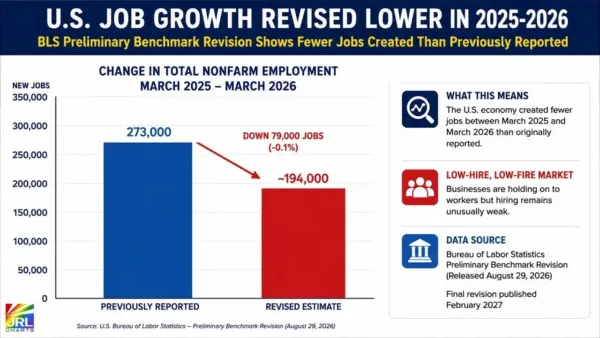
BLS preliminary benchmark data lowered estimated U.S. job growth by 79,000 jobs for the March 2025 to March 2026 period. Chart: JRL CHARTS
Normally, an annual statistical revision from the Bureau of Labor Statistics would attract relatively little attention outside financial markets and economic circles.
That changed after unusually large downward revisions in previous years became intensely political.
President Trump fired the BLS commissioner in August 2025 following disappointing employment figures and accused the agency, without providing evidence, of manipulating jobs data to benefit Democrats.
Brett Matsumoto, Trump’s nominee to lead the agency, took office earlier this month.
Friday’s revision is significantly smaller than some of the enormous revisions that fueled the previous controversy. The BLS notes that annual benchmark revisions during the past decade have had an average absolute change of approximately 0.2% of total nonfarm employment. Friday’s preliminary adjustment was 0.1%.
But the revision arrives at a particularly sensitive moment for the American economy.
Now the Federal Reserve Is Warning About Inflation
Just hours before the latest BLS figures landed, Federal Reserve Chairman Kevin Warsh delivered another warning from the Jackson Hole Economic Policy Symposium: Inflation remains too high.
Warsh said the Fed’s preferred 12-month Personal Consumption Expenditures inflation measure is running at 3.7%, considerably above the central bank’s firm 2% target.
The six-month measure is even hotter at 4.1%.
Warsh stopped short of announcing that the Federal Reserve will raise rates at its next meeting. But his message was unmistakably hawkish.
The chairman emphasized that short-term interest rates remain the Federal Reserve’s primary weapon for achieving price stability and said policymakers must be confident that underlying inflation is moving toward the 2% objective at a sufficient pace.
If it isn’t, Warsh said, the Fed still has “work to do.”
Financial markets quickly interpreted those comments as increasing the possibility of another interest-rate hike.
Higher Rates Would Bring Another Cost for Americans
That possibility creates an uncomfortable economic contradiction.
The Federal Reserve raises interest rates to reduce demand throughout the economy and ultimately bring inflation under control. But higher rates also make borrowing more expensive.
Consumers can feel the effects through credit cards, auto financing and other variable-rate borrowing, while businesses face higher financing costs when investing or expanding.
Housing affordability can also remain under pressure when broader borrowing costs stay elevated.
For businesses already reluctant to hire, another increase in financing costs could provide one more reason to postpone expansion, capital investment or additional payroll.
That means the Federal Reserve faces a difficult balancing act: bring inflation back toward 2% without unnecessarily damaging an already sluggish hiring environment.
Weak Hiring Meets Stubborn Inflation
Warsh nevertheless presented a considerably stronger assessment of the overall economy than the employment revision alone might suggest.
He pointed to a historically low 4.1% unemployment rate, low unemployment claims, rapidly growing business investment and strong corporate profits as evidence of economic resilience.
The Fed chairman also argued that slower labor-force growth naturally means fewer monthly job gains are required to maintain full employment.
But that macroeconomic assessment may feel very different to an American actually trying to land a new job.
An economy can simultaneously maintain a low unemployment rate and produce relatively few new opportunities for workers seeking employment.
And that is increasingly the economic divide confronting the country.
The United States isn’t experiencing the massive job destruction normally associated with a recession. Instead, workers are confronting a labor market that appears largely frozen in place — while consumers continue dealing with inflation running well above the Federal Reserve’s target.
If interest rates ultimately have to move higher to control those prices, Americans could find themselves caught between a labor market that is difficult to enter and borrowing costs that become even harder to afford.
For households already stretched by years of elevated prices, that is hardly an encouraging economic combination.
Stay with JRL CHARTS LGBT Business Finance News for continuing coverage of the U.S. economy, Federal Reserve policy, inflation, employment and the financial issues impacting American consumers and businesses.
His reporting focuses on federal court rulings, legislative developments, international human rights issues, and government actions impacting LGBTQ communities worldwide.
With nearly two decades of experience, Goldberg is recognized for his balanced analysis, investigative insight, and commitment to accurate, fact-based journalism that informs readers on the political forces shaping equality and justice.
- Federal Watchdog Drops $78 Million Bombshell on Trump’s Healthcare Funding Cuts - October 7, 2026
- NYC Puts $8.9 Million Behind Trans Youth Care After Major Hospitals Back Away - October 6, 2026
- Bronx Anti-LGBTQ Attack Leads to Arrest — But Police Say a Second Suspect Is Still Out There - October 5, 2026