By: Paul Goldberg – Senior Correspondent | LGBT Business Finance News
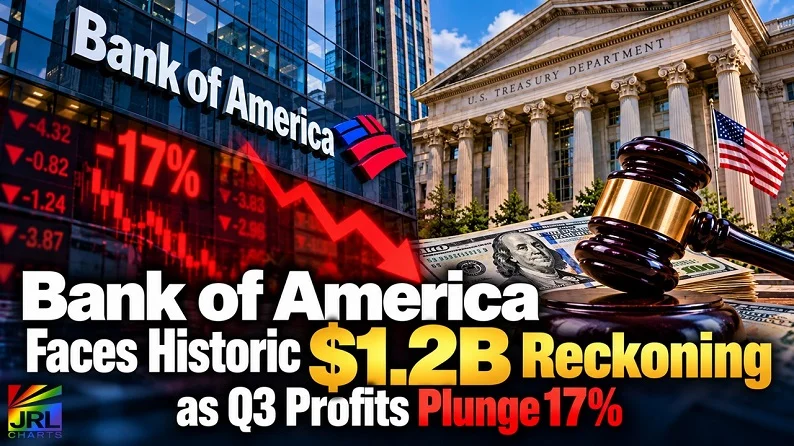
NEW YORK, NY — (October 17, 2026) — Bank of America Corporation (NYSE: BAC) is facing a historic $1.2 billion federal regulatory penalty after U.S. Treasury officials uncovered major anti-money laundering and sanctions compliance failures, dealing another blow to the banking giant as its third-quarter profits plunged 17%.
The October 13 enforcement announcement came just one day before the banking giant reported a 17% decline in third-quarter net income, with the regulatory settlement significantly affecting its earnings.
Trending LGBTQ Business and Politics News on JRL CHARTS:
• CVS Hit with $315 Million Opioid Settlement — What LGBTQ+ and Cancer Patients Need to Know
• GameStop Hit With Federal Lawsuit After Gay Employee Reports Threats — Then Gets Fired
• Meta Paid 29 Anti-LGBTQ Accounts as 2026 Midterm Misinformation Spreads
• LGBTQ Voters Are Fired Up for the 2026 Midterms — HRC Survey Reveals 87% Plan to Vote
• TikTok Coughs Up $400M to Settle DOJ Children’s Privacy Lawsuit
• Review More in LGBTQ Business and Politics News on JRL CHARTS
The action ranks as the third-largest penalty in Treasury Department history and includes the largest civil money penalty ever assessed by the Office of the Comptroller of the Currency.
Treasury Uncovers More Than $5 Billion in Suspicious Banking Activity
According to federal regulators, Bank of America failed to report more than $5 billion in suspicious transactions to the Financial Crimes Enforcement Network (FinCEN) in a timely manner.
More than $1 billion of those transactions involved potential national security and other priority illicit-finance risks, including activity associated with suspected Chinese money laundering networks, fraud and possible trade-based money laundering along the U.S. southwest border.
Federal investigators found significant weaknesses in the bank’s transaction monitoring, customer due diligence and suspicious activity reporting systems.
As part of its FinCEN resolution, Bank of America admitted to willfully violating the Bank Secrecy Act, including failures to maintain an adequate anti-money laundering compliance program and submit required Suspicious Activity Reports.
Importantly, a suspicious transaction is not automatically proof that a customer committed a crime.
Federal Regulators Announce Historic Penalties
The coordinated Treasury enforcement action involved three federal agencies:
• FinCEN: A $1.2 billion anti-money laundering penalty.
• Office of the Comptroller of the Currency: A $750 million penalty addressing deficiencies in the bank’s compliance program.
• Office of Foreign Assets Control: An approximately $11.6 million settlement concerning 475 apparent sanctions violations.
The agencies coordinated their enforcement actions, meaning the individual assessments should not be added together as independent, cumulative amounts.
The sanctions-related findings involved transactions connected to restrictions targeting Russia, Belarus, Iran, Burma, Somalia, narcotics trafficking and global terrorism.
Treasury Secretary Scott Bessent warned that compliance failures at a major financial institution can create risks extending throughout the U.S. financial system.
Bank of America Q3 Earnings Fall 17%
The regulatory action coincided with disappointing third-quarter financial results released October 14.
Bank of America reported $6.9 billion in net income, down from approximately $8.3 billion during the same quarter in 2025.
Reported earnings declined to $0.91 per diluted share, while revenue increased 3% to $30 billion.
The bank’s $1.2 billion regulatory settlement charge reduced quarterly earnings by approximately $0.17 per share.
Excluding that charge, adjusted net income reached approximately $8.1 billion, or $1.08 per share.
Other financial highlights included:
• Net interest income increased 8% to $16.4 billion, or $16.6 billion on a fully taxable-equivalent basis.
• Sales and trading revenue declined 5% to $5.1 billion.
• Fixed-income, currencies and commodities trading revenue fell 17%.
• The company returned approximately $8.3 billion to shareholders through dividends and stock repurchases.
The results reflected continuing growth in lending and deposits alongside weaker trading performance and increased regulatory expenses.
What Does This Mean for LGBT-Owned Businesses?
Although the Treasury enforcement action does not identify LGBT-owned businesses as victims or suggest that they were specifically targeted, the case highlights broader financial accountability concerns relevant to entrepreneurs and commercial banking customers.
LGBTQ-owned companies, like other small businesses, depend on reliable financial institutions for payroll processing, business accounts, credit facilities, merchant payments and supplier transactions.
For business owners, effective anti-money laundering controls can help protect the integrity of financial transactions and reduce exposure to illicit financial activity.
However, businesses also benefit when compliance systems are accurate, transparent and appropriately calibrated, minimizing unnecessary payment disruptions or administrative burdens.
There is currently no verified evidence that the Bank of America settlement has caused widespread banking restrictions, account closures or payment interruptions for LGBTQ-owned businesses.
The larger lesson is the importance of sound financial governance across institutions serving American businesses.
Bank of America Faces Additional Compliance Oversight
The FinCEN resolution requires Bank of America to work with an independent third party to identify previously undetected suspicious transactions.
The bank must also undergo independent reviews of its transaction monitoring, customer due diligence, foreign correspondent banking oversight and related data governance systems.
Bank of America has stated that it has invested heavily in financial crime prevention technology and personnel and remains committed to addressing regulatory concerns.
The bank continues operating while implementing its compliance improvements.
Banking Accountability Remains a National Business Priority
The historic enforcement action underscores the financial and reputational consequences of failing to maintain effective safeguards against money laundering and sanctions violations.
For American entrepreneurs, including LGBTQ-owned businesses, confidence in the banking system depends on responsible financial oversight, reliable transaction processing and consistent regulatory compliance.
As Bank of America moves forward with its remediation obligations, federal regulators and financial markets will continue evaluating its progress.
JRL CHARTS LGBT Business Finance News continues delivering authoritative business finance reporting, banking industry developments and economic news affecting entrepreneurs and the broader LGBTQ business community.
His reporting focuses on federal court rulings, legislative developments, international human rights issues, and government actions impacting LGBTQ communities worldwide.
With nearly two decades of experience, Goldberg is recognized for his balanced analysis, investigative insight, and commitment to accurate, fact-based journalism that informs readers on the political forces shaping equality and justice.
- Bank of America Faces Historic $1.2B Reckoning as Q3 Profits Plunge 17% - October 17, 2026
- CVS Hit with $315 Million Opioid Settlement — What LGBTQ+ and Cancer Patients Need to Know - October 17, 2026
- LGBTQ+ Support Vanishes from Alabama University Website as Scholarship Questions Mount - October 17, 2026