By: Paul Goldberg – Senior Correspondent | LGBT Politics USA
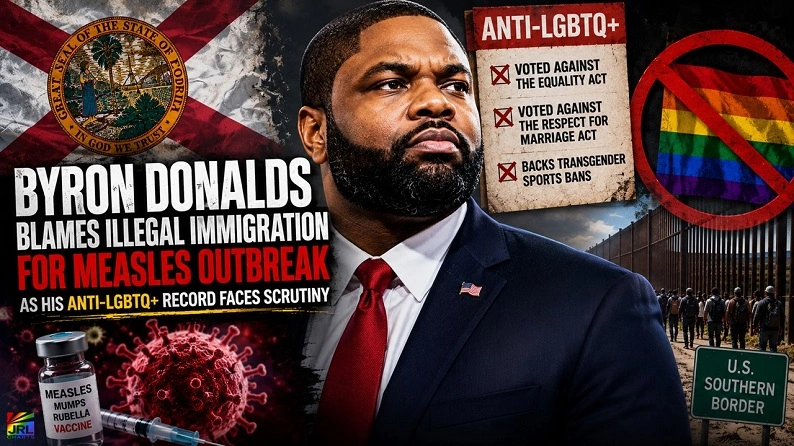
TALLAHASSEE, FL — (August 23, 2026) — Republican Florida gubernatorial candidate Byron Donalds is drawing scrutiny after blaming recent measles outbreaks on “rampant illegal immigration” when pressed Sunday about Florida’s declining childhood vaccination rates — a claim that puts the congressman at odds with public-health data pointing to falling immunization coverage as a major vulnerability behind the disease’s resurgence.
Now Trending on LGBTQ Politics News on JRL CHARTS:
• Torrey Pines High School Hit With Federal Lawsuit Over Pro-Trump ‘LGBT’ Poster
• AIPAC Spent $30 Million Trying to Stop Abdul El-Sayed — Now Mike Rogers Doesn’t Want Its Help
• Log Cabin Republicans Drop the ‘T’ as Group Refocuses on LGB Advocacy
• Democrats Blow Up the 2028 Presidential Map as DNC Rewrites Road to White House
• HRC Launches $15M Campaign to Defend LGBTQ+ Rights in 2026 Midterms
• Review More in LGBTQ Politics News Exclusively on JRL CHARTS
Donalds made the assertion during an August 23 appearance on CBS News’ Face the Nation, where host Margaret Brennan asked whether his message to Florida parents was to vaccinate their children against measles.
His answer was no.
Instead, Donalds redirected the conversation toward immigration.
“My message to Floridians and, quite frankly, to Americans is, the reason why we have seen a measles outbreak in certain parts of the country is because of rampant illegal immigration into the United States from the previous administration,” Donalds said.
Brennan immediately pressed him: “What evidence do you have of that?”
The exchange puts fresh attention on Donalds’ approach to public health as he campaigns to become Florida’s next governor. It also comes as LGBTQ+ Floridians examine a congressional voting record that has repeatedly placed Donalds against federal LGBTQ+ civil-rights protections.
Donalds Points to Immigration — Florida Data Point Somewhere Else
Donalds cited outbreaks in El Paso, Texas, Southwest Florida and elsewhere while arguing that people who entered the country illegally may not have followed established vaccination schedules.
“You can’t have an entire segment of people, more than 10 million, come into your country without that vaccination schedule,” Donalds told Brennan. “That’s how you end up having some of these outbreaks.”
But Donalds did not provide evidence during the interview establishing that undocumented immigrants were responsible for Florida’s measles cases.
Meanwhile, Florida has a documented vaccination problem of its own.
Nearly 6% of Florida kindergartners had exemptions from one or more required vaccines during the 2025-26 school year, according to recently released CDC data.
Florida’s vaccination coverage has also been moving in the wrong direction.
Coverage for major childhood vaccines including MMR, polio, DTaP and varicella among Florida kindergartners fell from at least 93.5% during the 2019-20 school year to 88.1% in 2023-24.
That matters because measles is extraordinarily contagious and public-health authorities generally cite approximately 95% vaccination coverage as necessary to prevent sustained community transmission.
America’s Measles Problem Is Growing
The United States has recorded a substantial resurgence of a disease once declared eliminated from continuous domestic transmission.
According to the Centers for Disease Control and Prevention, 2,371 confirmed measles cases had been reported nationwide in 2026 as of July 30.
That already exceeds the total number of confirmed cases recorded during all of 2025.
The overwhelming scientific consensus remains that maintaining high vaccination coverage is the country’s strongest defense against measles outbreaks.
International travel can introduce measles into the United States. An infected traveler — whether an American returning home, a foreign visitor or a migrant — can carry the virus across an international border.
But importing a measles case and sustaining a measles outbreak are two different issues.
When the virus reaches a community with sufficiently high vaccination coverage, its opportunities to spread are dramatically reduced. When it enters pockets of under-vaccinated people, outbreaks can expand.
That makes Florida’s declining vaccination coverage impossible to ignore when examining Donalds’ claim.
Donalds’ ‘Rampant’ Immigration Argument Meets Today’s Border Numbers
Donalds specifically blamed immigration from the Biden administration for creating conditions behind current outbreaks.
Millions of migrants did enter or attempt to enter the United States during the Biden years, and border encounters reached historically high levels during that period.
But describing today’s southern border as experiencing “rampant illegal immigration” clashes with the dramatic change reflected in current federal enforcement statistics.
U.S. Customs and Border Protection reported that Border Patrol recorded 9,295 apprehensions along the Southwest border in July 2026.
According to CBP, that was 94% below the monthly average recorded during the Biden administration.
The agency also reported 15 consecutive months with zero Border Patrol releases into the United States.
Unauthorized border crossings have not literally disappeared, but federal statistics show they have fallen enormously from their previous highs.
That leaves Donalds with a basic evidentiary problem: blaming illegal immigration for a measles outbreak requires more than demonstrating that immigration occurred.
It requires evidence connecting those migrants to the outbreak being discussed.
During his CBS interview, Donalds did not provide that evidence.
Donalds Stops Short of Endorsing MMR Vaccination
The exchange became even more notable because Brennan repeatedly tried to return Donalds to the vaccination question.
After Donalds argued that immigrants without proper vaccinations were contributing to outbreaks, Brennan asked whether that meant he wanted people vaccinated.
Donalds again pivoted toward immigration and health-care costs.
The contradiction is difficult to miss.
Donalds argued that people entering America without receiving established vaccines could create a public-health problem — while declining to simply tell Florida parents to vaccinate their children against measles when directly asked.
Donalds has not, however, committed to eliminating Florida’s MMR or polio vaccine requirements if elected governor.
Asked about those policies Sunday, he said his administration would need to “study” the issue and work with the Florida Legislature before making final decisions.
Byron Donalds’ LGBTQ+ Record Comes Into Focus
Public health isn’t the only area where Donalds’ record is likely to receive increased scrutiny during the race for governor.
For LGBTQ+ Floridians, Donalds has already accumulated years of congressional votes providing clues about how he approaches LGBTQ+ civil rights.
Donalds voted against the Equality Act in 2021.
The legislation sought to expand federal civil-rights protections covering sexual orientation and gender identity in areas including employment, housing, education and public accommodations.
Donalds argued that the measure threatened religious liberty and parental rights.
But his opposition did not end there.
Donalds Voted Against Federal Same-Sex Marriage Protections
In 2022, Donalds also voted against the Respect for Marriage Act, landmark federal legislation protecting recognition of legally performed same-sex and interracial marriages.
The House initially passed the legislation 267-157.
After Senate amendments, the House approved the final legislation in December by a 258-169 vote before it became law.
Donalds voted against the legislation.
For LGBTQ+ voters, that vote remains particularly significant because the Respect for Marriage Act wasn’t simply a symbolic resolution.
It created federal statutory protections requiring recognition of marriages legally performed in the United States, providing an additional layer of protection for same-sex married couples following years of legal and political battles over marriage equality.
Donalds Has Also Backed Restrictions Affecting Transgender Americans
Donalds’ record extends beyond marriage and nondiscrimination protections.
He has supported Republican legislation restricting transgender participation in women’s and girls’ sports and has aligned himself with broader conservative efforts challenging federal policies protecting transgender Americans.
The Human Rights Campaign’s congressional scorecards reflect that record.
HRC awarded Donalds a 0 out of 100 score during the 117th Congress, placing him among lawmakers with the weakest voting records on legislation the organization identified as important to LGBTQ+ Americans.
That record provides an important preview for LGBTQ+ Floridians evaluating what a Donalds administration could mean.
Florida’s Next LGBTQ+ Political Battle?
The stakes are particularly significant in Florida.
Under Gov. Ron DeSantis, the state became a national testing ground for conservative policies involving LGBTQ+ classroom instruction, transgender health care, school policies, drag performances, diversity programs and corporate responses to LGBTQ+ legislation.
Donalds has built his political identity as a staunch Trump ally and conservative Republican rather than presenting himself as a break from that movement.
His congressional votes on LGBTQ+ issues reinforce that positioning.
For LGBTQ+ Floridians, therefore, the question isn’t simply what Donalds says during a gubernatorial campaign.
It is what he has already done when given the power to vote.
The Record Matters
Donalds’ Face the Nation appearance ultimately brought two parts of his political record together.
On public health, he blamed “rampant illegal immigration” for measles outbreaks while declining to directly encourage Florida parents to vaccinate their children — even as Florida’s childhood vaccination coverage has fallen and vaccine exemptions have risen.
On LGBTQ+ civil rights, his congressional record includes opposition to the Equality Act, opposition to federal marriage protections and support for legislation restricting transgender participation in sports.
Those are not predictions about what Byron Donalds might believe.
They are documented positions and votes.
And as Donalds campaigns for control of the Florida governor’s mansion, voters — particularly LGBTQ+ Floridians — will have an opportunity to decide what that record could mean for the future direction of the Sunshine State.
Stay with JRL CHARTS LGBT Politics USA for continuing coverage of Byron Donalds, the Florida Governor Election 2026, LGBTQ+ civil rights and the political battles shaping the future of the Sunshine State.
His reporting focuses on federal court rulings, legislative developments, international human rights issues, and government actions impacting LGBTQ communities worldwide.
With nearly two decades of experience, Goldberg is recognized for his balanced analysis, investigative insight, and commitment to accurate, fact-based journalism that informs readers on the political forces shaping equality and justice.
- Cape Town Pride 2027 Goes BIG With 24 Days of LGBTQ Celebrations! - October 24, 2026
- LGBTQ Rights on the Line in 7 States as 2026 Midterm Elections Near - October 24, 2026
- Gay Dad Cleared After Punching MAGA Influencer Who Targeted His Family - October 24, 2026