By: Paul Goldberg – Senior Correspondent | LGBT Politics USA
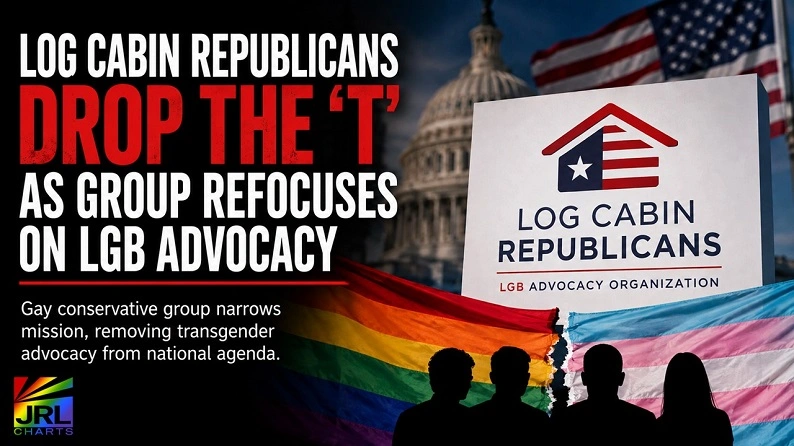
WASHINGTON, D.C. — (August 20, 2026) — Log Cabin Republicans has formally narrowed its national advocacy mission, declaring that the influential gay conservative organization will now focus specifically on lesbian, gay and bisexual issues rather than transgender advocacy.
The decision represents a significant shift for an organization that has spent more than a decade formally including transgender people under its LGBT mission.
Now Trending on LGBTQ Politics News on JRL CHARTS:
• Transgender Suspect Sentenced to 73 Months in Scott Bessent Assassination Plot
• Democrats Blow Up the 2028 Presidential Map as DNC Rewrites Road to White House
• HRC Launches $15M Campaign to Defend LGBTQ+ Rights in 2026 Midterms
• America’s ‘Golden Age’? U.S. Job Growth Since January 2025 Tells a Different Story
• Millions of Working Americans Are Going Hungry—and Nobody Is Talking About It
• Review More in LGBTQ Politics News Exclusively on JRL CHARTS
Log Cabin Republicans President Ross Hemminger announced the change Thursday in a Townhall column titled “Log Cabin Republicans Renews Its National Advocacy Focus.”
Hemminger said the organization’s board voted, following discussions with members, to concentrate its national advocacy on issues involving sexual orientation and conservative principles.
The result, in Hemminger’s own description, is an “LGB advocacy organization.”
The change does not prohibit transgender conservatives from joining Log Cabin Republicans. Hemminger stressed that membership remains open to conservatives generally and that individual chapters may continue operating in ways they believe best serve their members.
The significance lies instead in what the national organization will advocate for — and what it apparently no longer considers part of its core mission.
Log Cabin Republicans Reverses Its 2015 Expansion
The move reverses a decision made by the Log Cabin Republicans board in 2015 to formally add transgender people to the organization’s mission.
Hemminger said that decision was originally based on the conservative principle that adults should be able to pursue their lives without unnecessary government interference, provided doing so did not infringe upon the rights of others.
Eleven years later, the organization’s leadership says it has reached a different conclusion about where its advocacy should be concentrated.
Hemminger argued that contemporary transgender advocacy has become disproportionately focused on minors, schools, women’s sports and gender-affirming healthcare for young people.
He cited those issues as reasons LCR believes transgender activism has moved beyond the organization’s traditional emphasis on limited government, individual freedom and equal protection.
The column consequently places Log Cabin Republicans substantially closer to the wider Republican debate over transgender policies that has reshaped state and federal politics in recent years.
Transgender Rights Extend Far Beyond Youth Policies
Hemminger’s characterization of transgender advocacy, however, leaves out several major policy battles involving transgender adults.
Transgender rights organizations have fought government policies involving identification documents and gender markers, access to public accommodations, military service, healthcare, employment protections and participation in public life.
Those disputes raise their own questions about the limited-government philosophy Hemminger says remains central to Log Cabin Republicans.
The organization says its renewed priorities will instead include issues involving same-sex marriage, adoption, military service, nondiscrimination and religious liberty.
For LCR, those issues represent areas where the organization believes conservative principles and protections for gay and lesbian Americans can coexist.
Gender-Affirming Care Remains at Center of Political Fight
Hemminger also criticized gender-affirming healthcare for minors, describing some treatments as irreversible and raising concerns about parental involvement.
Gender-affirming healthcare for adolescents remains one of the country’s most intensely disputed LGBT policy issues.
Major medical organizations have historically supported access to developmentally appropriate gender-affirming healthcare while emphasizing clinical assessment and involvement of patients and families. Laws governing minors’ consent, parental involvement and confidentiality can also differ by jurisdiction.
The broader political battle has expanded well beyond healthcare.
State and federal policymakers have pursued measures involving transgender participation in sports, restroom access, school policies, military service and government recognition of gender identity.
Those conflicts have increasingly placed transgender Americans at the center of the national culture-war debate.
Human Rights Campaign Responds
The Human Rights Campaign sharply criticized Log Cabin Republicans’ decision.
HRC spokesperson Delphine Luneau told LGBTQ Nation that dividing lesbian, gay and bisexual people from transgender people serves political forces seeking to weaken the broader LGBTQ+ movement.
According to Luneau, sacrificing the interests of one segment of the community in hopes of protecting another has historically failed.
The response illustrates the dramatically different approaches now emerging among national LGBT political organizations.
While organizations such as the Human Rights Campaign continue advocating under a broad LGBTQ+ coalition, Log Cabin Republicans is explicitly separating its national advocacy around sexual orientation from issues centered on gender identity.
LCR’s Complicated History With Transgender Issues
Thursday’s announcement also formalizes tensions that have existed inside Log Cabin Republicans for years.
Former LCR President Charles Moran previously criticized the Human Rights Campaign over transgender healthcare for minors, transgender participation in women’s sports and discussions involving gender identity in schools.
Moran also advised Florida lawmakers involved with the state’s controversial Parental Rights in Education legislation, commonly known by opponents as the “Don’t Say Gay” law.
At other times, however, Log Cabin Republicans opposed restrictions affecting transgender students and proposed alternative policies intended to accommodate transgender students while preserving flexibility for local school districts.
That record left the organization occupying an increasingly difficult position as transgender policy became one of the Republican Party’s most prominent social issues.
Log Cabin Republicans Enter a New Political Era
The latest decision eliminates much of that ambiguity.
Log Cabin Republicans is approaching its 50th anniversary with leadership openly defining the national organization around LGB advocacy and conservative values.
The organization argues that returning to issues involving sexual orientation represents a return to its founding mission rather than a retreat from equality.
Critics see something very different: the deliberate separation of transgender Americans from a political movement that once formally claimed to advocate for the broader LGBT community.
Either way, the significance of Thursday’s announcement extends beyond organizational terminology.
At a time when transgender rights remain among the most contentious issues in American politics, one of the country’s most prominent gay Republican organizations has drawn a clear boundary around its national mission.
For Log Cabin Republicans, the “T” is no longer part of that advocacy agenda.
JRL CHARTS LGBT Politics USA will continue tracking the political fallout surrounding Log Cabin Republicans’ new LGB-focused mission and the rapidly evolving national battle over transgender rights.
His reporting focuses on federal court rulings, legislative developments, international human rights issues, and government actions impacting LGBTQ communities worldwide.
With nearly two decades of experience, Goldberg is recognized for his balanced analysis, investigative insight, and commitment to accurate, fact-based journalism that informs readers on the political forces shaping equality and justice.
- Oil Prices Explode to $117 a Barrel as Iran War Sends Shockwaves Through U.S. Economy - October 23, 2026
- Lindsey Graham Accused of Paying 3 Male Escorts — One Claims He Was 17 - October 22, 2026
- LGBTQ Nonprofit Makes $3 Million Move to Transform Downtown Buffalo - October 21, 2026