By: Paul Goldberg – Senior Correspondent | LGBT Politics USA
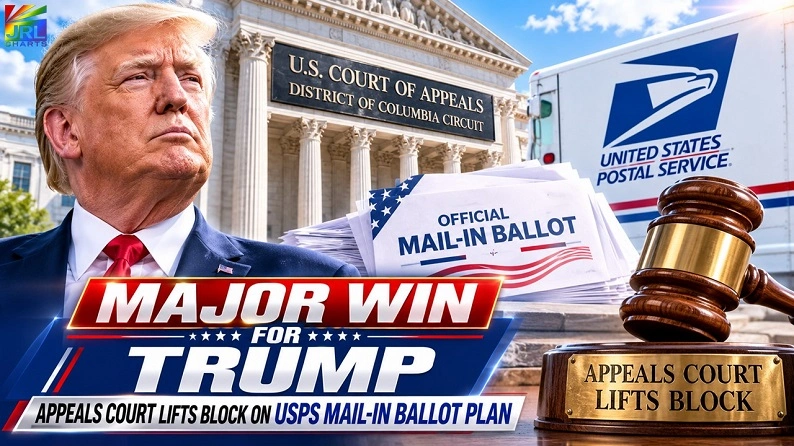
WASHINGTON, D.C. — (July 17, 2026) — In a significant legal victory for President Donald Trump, the U.S. Court of Appeals for the District of Columbia Circuit on Friday temporarily lifted a lower court injunction that had blocked the U.S. Postal Service (USPS) from advancing a controversial proposal tied to mail-in voting procedures ahead of the 2026 midterm elections.
The appellate court issued a stay of U.S. District Judge Emmet Sullivan’s July 1 injunction while the underlying litigation proceeds, allowing USPS to continue developing its proposed rule. The three-judge panel concluded that the legal challenge brought by the National Association for the Advancement of Colored People (NAACP) was likely premature because the proposal had not yet become a final agency rule.
Now Trending on LGBT Business, Finance and Politics News on JRL CHARTS
• Federal Judge Voids Trump-IRS Settlement That Created Controversial Weaponization Fund
• LGBTQ Consumers Shift Spending Away from Target, Walmart and Amazon
• Trump Targets New York Times in New Lawsuit as War on DEI Programs Intensifies
• Trump Scores Key Court Victory as Mail-In Ballot Restrictions Move Forward
• Federal Court Drops Explosive Ruling on Alabama GOP Congressional Map
• Millions of Working Americans Are Going Hungry—and Nobody Is Talking About It
• Get the Latest In LGBT Politics News on JRL CHARTS
Trump’s Executive Order Drives USPS Proposal
The legal dispute stems from President Trump’s March 31 executive order titled “Ensuring Citizenship Verification and Integrity in Federal Elections.” The order directs federal agencies to assist states in verifying voter citizenship through federal databases and encourages stricter standards governing mail-in voting.
As part of that effort, USPS proposed requiring participating states to:
- Provide lists of eligible mail-in voters.
- Adopt USPS-approved ballot formatting and barcode standards.
- Meet enhanced ballot tracking requirements before election mail would be handled under the new procedures.
Supporters of the proposal argue the measures are intended to improve election administration, voter verification, and ballot tracking. Opponents contend the requirements could create additional barriers for states that rely heavily on mail voting and could affect voter access if implemented.
NAACP Challenge Remains Active
The NAACP sued USPS after arguing the proposal violated a 2021 settlement requiring the Postal Service to take “extraordinary measures” to ensure timely ballot delivery through future federal elections.
Judge Emmet Sullivan agreed with that argument earlier this month, issuing an injunction that temporarily blocked USPS from implementing the proposal while litigation continued.
Friday’s appellate decision does not resolve the underlying lawsuit. Instead, it pauses Sullivan’s injunction, allowing USPS to continue its rulemaking process while the courts consider the merits of the case. The appeals court also indicated that judicial review may not yet be appropriate because the proposal has not been finalized.
Election Policy Battle Intensifies
The decision arrives as election administration continues to be one of the nation’s most closely watched legal issues ahead of the November 2026 midterm elections.
Trump has repeatedly urged Congress to approve additional election integrity measures, including legislation that would require proof of citizenship for voter registration, establish voter identification requirements, and tighten standards governing mail-in voting. Those proposals remain the subject of ongoing political and legal debate.
Several lawsuits challenging different portions of the administration’s election-related executive order are still pending in federal courts, meaning additional rulings are expected in the months leading up to Election Day.
Stay with JRL CHARTS LGBT Politics for continuing coverage of U.S. election law, federal court decisions, LGBTQ policy developments, and the political stories shaping the 2026 election cycle.
His reporting focuses on federal court rulings, legislative developments, international human rights issues, and government actions impacting LGBTQ communities worldwide.
With nearly two decades of experience, Goldberg is recognized for his balanced analysis, investigative insight, and commitment to accurate, fact-based journalism that informs readers on the political forces shaping equality and justice.