By: Paul Goldberg – Senior Correspondent | LGBT Business Finance News
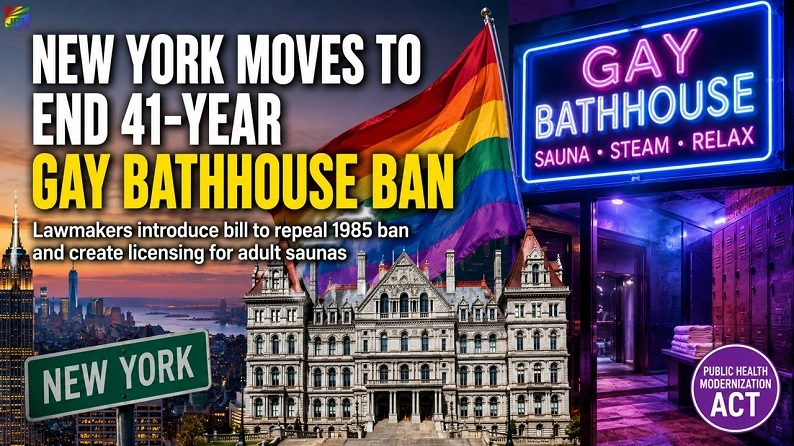
NEW YORK, NY — (August 6, 2026) — More than four decades after New York adopted emergency regulations that effectively shut down gay bathhouses during the height of the AIDS crisis, state lawmakers are moving to bring that era of public health policy to an end.
New legislation would repeal New York’s longstanding prohibition on adult saunas and replace it with a modern licensing framework, potentially clearing the way for legally regulated gay bathhouses to operate in the state once again.
The proposal comes as lawmakers and public health experts increasingly question whether restrictions enacted during the darkest years of the AIDS epidemic still make sense in an era transformed by HIV testing, highly effective treatment and prevention tools including PrEP.
Now Trending on LGBT Politics News on JRL CHARTS:
• Minneapolis Moves to Repeal 1988 Gay Bathhouse Ban Amid Culture-War Attacks
• Education Department Drops LGBTQ+ Student Data From Civil Rights Survey
• Global HIV Funding Plunges After Trump Aid Cuts, New Reports Warn
• EEOC Moves to End 60 Years of Workplace Diversity Data Collection
• Project 2025 Already 50% Complete: Inside Trump’s Plan Reshaping America
• From Sandy Hook to Voting Rights: How Conservative Courts Are Rewriting U.S Laws
New York’s Gay Bathhouse Ban Dates Back to 1985
New York adopted health regulations prohibiting adult saunas in 1985, when fear surrounding HIV/AIDS was at its peak and effective treatments were still years away.
New York City relied on those regulations the following year to close the city’s gay bathhouses.
The crackdown was controversial even at the time.
Despite opposition from some gay rights advocates and business owners, then-Mayor Ed Koch directed city health inspectors to enforce the regulations, including through undercover inspections.
What began as an emergency response to a devastating public health crisis ultimately remained embedded in New York policy for more than four decades.
Now lawmakers say the science—and the law—need to catch up.
Public Health Modernization Act Targets Decades-Old Restrictions
State Sen. Erik Bottcher and Assemblymember Tony Simone are backing legislation known as the Public Health Modernization Act, which would repeal the existing restrictions and establish a licensing framework for adult saunas.
Bottcher argues that an emergency provision created during the AIDS crisis should not have become permanent public health policy.
“That provision was put into effect at the height of AIDS panic in 1985 and those kind of emergency measures are not supposed to become permanent public health policy,” Bottcher said. “The landscape around HIV and AIDS science has changed. Treatment has changed. Prevention has changed. Our laws need to change, too.”
That changing medical landscape is central to the push for reform.
HIV testing is widely available, antiretroviral medications have transformed HIV from a frequently fatal diagnosis into a manageable chronic condition for people with access to treatment, and PrEP has become a highly effective tool for preventing HIV acquisition.
Public health understanding of HIV transmission has also advanced dramatically since the regulations were enacted.
Could Gay Bathhouses Become Public Health Partners?
Supporters of the legislation aren’t simply arguing that New York should permit gay bathhouses again.
They contend that properly regulated venues could actually provide public health officials and healthcare organizations with another opportunity to reach people with HIV prevention information, testing resources and other services.
Dr. Demetre Daskalakis, Chief Medical Officer at Callen-Lorde, has supported the modernization effort and pointed to his own experience working in these environments.
“My own work in these venues has shown that they can also be powerful environments for health outreach and prevention,” Daskalakis said. “By bringing people together rather than pushing them into less visible settings, we create opportunities to build trust and deliver services that improve health outcomes.”
That argument represents a striking reversal from the philosophy behind the original restrictions.
Rather than assuming closing gay bathhouses automatically improves public health, supporters of reform argue that regulated venues could create opportunities for education, prevention and healthcare outreach that are much harder to provide when activity is pushed into private or less visible settings.
Minneapolis Already Made the Historic Move
New York would not be alone in reconsidering AIDS-era restrictions on gay bathhouses.
Earlier this year, Minneapolis moved to legalize gay bathhouses after nearly four decades, repealing its own 38-year-old prohibition and reopening the door for licensed establishments.
As JRL CHARTS reported in April, Minneapolis officials revisited restrictions originally adopted during the AIDS crisis and determined that advances in HIV prevention, treatment and modern public health practices had fundamentally changed the justification for maintaining the ban.
The Minneapolis decision quickly became an important precedent for other cities and states still operating under policies created during the epidemic.
Now New York could become the next major jurisdiction to follow that path.
For advocates of reform, the two developments point toward a broader reassessment of whether emergency AIDS-era laws should remain on the books when the science that originally shaped those policies has changed dramatically.
HIV Prevention Has Changed Dramatically Since 1985
The numbers also illustrate just how much New York’s HIV landscape has changed.
New HIV diagnoses in New York City have fallen by more than 70% since 2001, although the city still reported 1,791 new diagnoses in 2024.
Public health experts continue to emphasize that HIV has not disappeared and that disparities remain, particularly among communities experiencing barriers to healthcare, housing instability and inconsistent access to prevention services.
Those continuing challenges are part of the argument supporters are making for regulation rather than prohibition.
A licensed gay bathhouse could potentially operate under established health standards while partnering with community organizations and healthcare providers to promote HIV and STI testing, PrEP awareness and other prevention resources.
From Prohibition to Regulation
The debate unfolding in New York is therefore about considerably more than whether gay bathhouses should return.
It raises a larger question about how governments should treat public health restrictions created during an emergency once medicine, science and society have fundamentally changed.
The Public Health Modernization Act would move New York away from outright prohibition and toward regulated operation—potentially allowing businesses to legally enter a market that has effectively been closed for more than 40 years.
That also makes the legislation an LGBTQ+ business issue.
Legalization could eventually create opportunities for new hospitality and wellness businesses, commercial leases, employment and investment while subjecting operators to whatever licensing and public health requirements New York ultimately establishes.
For New York’s gay community, however, the debate also carries enormous historical weight.
Gay bathhouses were once an established part of urban gay culture before the AIDS epidemic transformed both the community and the government’s approach to these venues.
More than four decades later, lawmakers are now asking whether regulations born during one of the most devastating periods in LGBTQ+ history should continue governing New York in 2026.
Minneapolis has already answered that question.
New York may be next.
Stay with JRL CHARTS for continuing coverage of LGBTQ+ business, public health and legislative developments shaping gay communities across the United States.
His reporting focuses on federal court rulings, legislative developments, international human rights issues, and government actions impacting LGBTQ communities worldwide.
With nearly two decades of experience, Goldberg is recognized for his balanced analysis, investigative insight, and commitment to accurate, fact-based journalism that informs readers on the political forces shaping equality and justice.
- Japan Faces a $101.5 Billion LGBTQ Equality Problem, Economic Study Warns - October 12, 2026
- Alito Says Gay Marriage Is Safe — But Didn’t They Say That About Roe v. Wade? - October 12, 2026
- Feds Raid Ilhan Omar’s Home — She Fires Back at Trump: ‘I Will Not Be Silenced’ - October 12, 2026