By: Paul Goldberg – Senior Correspondent | LGBT Politics USA
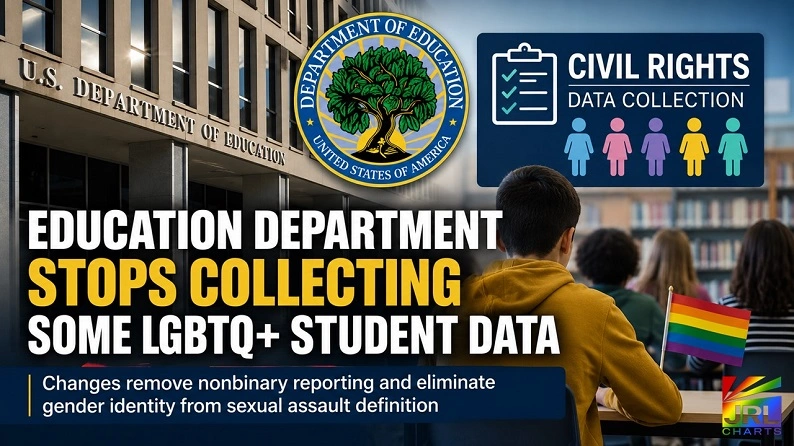
WASHINGTON, D.C. — (July 31, 2026) — The U.S. Department of Education will no longer collect several categories of LGBTQ+ student information as part of its Civil Rights Data Collection (CRDC), ending the federal reporting of nonbinary student enrollment and removing references to gender identity from portions of the nationwide education survey.
The revisions, approved by the Office of Management and Budget in July, will take effect for the 2025-26 Civil Rights Data Collection, a mandatory survey administered to every public school district in the United States. The survey has served as one of the federal government’s primary tools for monitoring civil rights compliance in public education for nearly six decades.
Now Trending on LGBT Politics News on JRL CHARTS:
• Global HIV Funding Plunges After Trump Aid Cuts, New Reports Warn
• GOP Rift Deepens as Cornyn Challenges Trump on PEPFAR AIDS Funding
• EEOC Moves to End 60 Years of Workplace Diversity Data Collection
• Project 2025 Already 50% Complete: Inside Trump’s Plan Reshaping America
• Judge Kacsmaryk Guts LGBTQ Job Protections in Texas Ruling
• From Sandy Hook to Voting Rights: How Conservative Courts Are Rewriting U.S Laws
Survey Removes Nonbinary Student Reporting
Among the most significant changes is the elimination of questions asking school districts to report how many students identify as nonbinary. The updated survey also removes questions concerning whether nonbinary students experienced harassment or bullying and whether districts maintain policies specifically prohibiting those forms of discrimination.
The Department also revised definitions related to sexual violence within the survey. Previous editions stated that rape and sexual assault could affect “all students, regardless of sex, or sexual orientation, or gender identity.” The updated language removes the reference to gender identity, stating only that “all students, regardless of sex, or sexual orientation can be victims of rape.”
Civil Rights Enforcement Tool Undergoes Major Changes
The Office for Civil Rights (OCR) has historically used CRDC data to investigate discrimination complaints, conduct compliance reviews, and provide policy guidance to school districts. LGBTQ+-related questions were introduced during the Biden administration to better understand school climate and student safety.
Education policy experts say the removal of those questions may reduce the amount of nationally available data concerning LGBTQ+ students.
Seth Galanter, Senior Fellow at the Edley Center on Law & Democracy and former Deputy Assistant Secretary in the Department of Education’s Office for Civil Rights, said the previous reporting requirements represented an important first step toward understanding the experiences of nonbinary students.
“It was a toehold into getting a sense of what this population looked like for the first time, and the hope obviously would have been that we would be able to spot trends as more school districts started reporting this data.”
Galanter explained that while districts were not required to begin collecting new information solely for the federal survey, those already tracking nonbinary enrollment had an opportunity to report those figures nationally.
“In fact, one of the spurs for OCR collecting the data in the first place was school districts contacting OCR and saying, ‘You ask us to say how many students are male, how many students are female, but we’ve got this nonbinary population and we don’t know what box to put them in.’ And so this was an attempt to address the evolution of data at the local level and make it visible at the federal level.”
More Than 1,800 School Districts Reported Nonbinary Students
According to Galanter’s review of the most recent publicly available CRDC data from the 2021-22 school year, more than 1,800 school districts across 39 states and the District of Columbia reported enrolling at least one nonbinary student.
Those districts collectively reported 13,660 nonbinary students attending approximately 5,200 schools. Researchers note those figures likely represent only a portion of the total student population because not every district collected or reported the information.
Separate estimates from the Williams Institute at UCLA School of Law suggest approximately 724,000 transgender youth ages 13 to 17 live in the United States, including many who identify as nonbinary.
Education Department Explains Decision
In its response to public comments, the Department stated that continuing the nonbinary reporting category would not align with how most local education agencies currently maintain student records.
The Department wrote:
“OCR determined that its costs outweighed its benefits.”
It further explained:
“The decision to retire the nonbinary category reflects OCR’s effort to design the CRDC to be compatible with LEAs’ reporting and recordkeeping practices, the vast majority of which use two values for recording student sex.”
The revised Civil Rights Data Collection will remain in effect for the 2025-26 school year, while additional changes for future reporting cycles are expected to be announced later.
For continuing coverage of LGBTQ+ policy, education, civil rights, and federal government developments, follow JRL CHARTS, your trusted source for LGBT Politics USA and breaking LGBTQ+ news.
His reporting focuses on federal court rulings, legislative developments, international human rights issues, and government actions impacting LGBTQ communities worldwide.
With nearly two decades of experience, Goldberg is recognized for his balanced analysis, investigative insight, and commitment to accurate, fact-based journalism that informs readers on the political forces shaping equality and justice.
- LGBTQ Nonprofit Makes $3 Million Move to Transform Downtown Buffalo - October 21, 2026
- Supreme Court Blocks Trump’s Transgender Prison Care Ban in Major Legal Setback - October 21, 2026
- UNC Settles 18 Trump Administration Probes as Race and DEI Rules Face New Scrutiny - October 19, 2026