By: Paul Goldberg – Senior Correspondent | LGBT International News
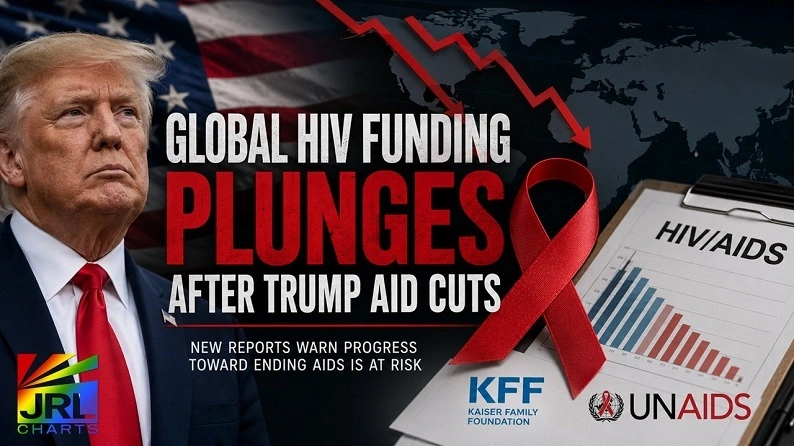
WASHINGTON, D.C. — (July 27, 2026) — The global fight against HIV/AIDS suffered its most significant financial setback in nearly two decades after new reports from the Kaiser Family Foundation (KFF) and the Joint United Nations Programme on HIV/AIDS (UNAIDS) revealed that international funding sharply declined in 2025.
Released during the International AIDS Conference, the reports conclude that the dramatic reduction in donor support has placed decades of progress at risk and weakened efforts to achieve the United Nations’ goal of ending AIDS as a public health threat by 2030.
Now Trending on LGBT Politics News on JRL CHARTS:
• GOP Rift Deepens as Cornyn Challenges Trump on PEPFAR AIDS Funding
• EEOC Moves to End 60 Years of Workplace Diversity Data Collection
• Project 2025 Already 50% Complete: Inside Trump’s Plan Reshaping America
• Judge Kacsmaryk Guts LGBTQ Job Protections in Texas Ruling
• Appeals Court Hands Trump Major Win in USPS Mail-In Ballot Fight
• From Sandy Hook to Voting Rights: How Conservative Courts Are Rewriting U.S Laws
The findings point to one overwhelming factor behind the decline: a steep reduction in United States funding following major policy changes implemented under President Donald Trump’s America First Global Health Strategy.
Historic Funding Decline Raises Global Concerns
According to the KFF analysis, donor government funding for HIV programs in low- and middle-income countries fell by $2.1 billion in 2025, reducing total international support from $8.3 billion in 2024 to $6.2 billion in 2025.
The 25 percent decline represents the largest single-year drop since global HIV donor funding began expanding and marks the lowest funding level recorded since 2007.
Researchers note that nearly all of the decline resulted from reduced U.S. disbursements after the administration scaled back international health assistance programs and eliminated several long-standing global initiatives.
Trump Administration Reshapes U.S. Global Health Strategy
The reductions stem from the Trump administration’s decision to transition away from what officials described as open-ended foreign assistance commitments.
Under the administration’s America First Global Health Strategy, the United States significantly reduced funding for overseas HIV initiatives while freezing and canceling numerous international health projects. The Trump administration also eliminated the U.S. Agency for International Development (USAID) and ended U.S. financial support for UNAIDS.
Federal projections estimate the strategy could reduce U.S. global health spending by approximately $7.3 billion over the next five years.
Despite the reductions, the United States remained the world’s largest government donor for HIV programs in 2025, contributing $4.6 billion, or roughly 74 percent of all donor government funding, according to the KFF report.
France ranked as the second-largest contributor, providing approximately $280 million, while funding from most other donor nations remained largely unchanged compared with the previous year.
UNAIDS Warns Progress Could Reverse
A separate report released by UNAIDS warns that declining investments in HIV prevention, treatment access, and community-based services could trigger a renewed expansion of the epidemic in many vulnerable regions.
The agency cautioned that without sustained financial commitments, countries may struggle to maintain lifesaving treatment programs, expand testing, or support prevention initiatives that have dramatically reduced infections over the past two decades.
“The era of relying on international aid is over,” said Winnie Byanyima, Executive Director of UNAIDS.
“Countries cannot wait and they cannot go backwards. The world must urgently fix the broken financial system and accelerate debt restructuring so that governments can invest in what matters most—the health, education and futures of their people.”
Experts Say Transition Was Too Abrupt
Jennifer Kates, Director of the Global Health and Public Policy Program at KFF and one of the report’s authors, acknowledged that U.S. support was never intended to continue indefinitely.
However, she said the rapid pace of funding reductions created a significant shock to the global HIV response.
Kates also noted there is currently little evidence that other donor governments are preparing to replace the billions of dollars withdrawn by the United States, leaving substantial uncertainty over future HIV prevention and treatment programs.
Meanwhile, Congress has continued appropriating funding for several HIV initiatives, meaning additional resources remain authorized. Whether those appropriated funds will ultimately be distributed by the administration remains unclear.
International HIV Response Faces Critical Test
Public health experts say the reports underscore a pivotal moment for the international HIV response. While medical advances have transformed HIV into a manageable chronic condition for millions, maintaining those gains depends heavily on stable investments in prevention, treatment, education, and community health infrastructure.
Without additional financial commitments from donor governments or expanded domestic investment by affected countries, both KFF and UNAIDS warn that progress achieved over the past two decades could slow or even reverse.
For many health organizations, the challenge now shifts from responding to declining resources toward developing sustainable funding models capable of supporting the global goal of ending AIDS as a public health threat by 2030.
For the complete findings, readers can review the latest reports published by KFF and UNAIDS, both released during the International AIDS Conference.
Stay with JRL CHARTS LGBT Politics News for continuing coverage of U.S. healthcare policy, LGBTQ rights, HIV prevention, and the political decisions shaping global public health.
His reporting focuses on federal court rulings, legislative developments, international human rights issues, and government actions impacting LGBTQ communities worldwide.
With nearly two decades of experience, Goldberg is recognized for his balanced analysis, investigative insight, and commitment to accurate, fact-based journalism that informs readers on the political forces shaping equality and justice.
- Welker Corners Treasury Secretary Bessent Over Trump Economy: “636 Days” - October 18, 2026
- Wall Street Gets Hammered as AI Stocks Tumble and Oil Prices Surge — LGBTQ Businesses Brace for Fallout - October 18, 2026
- Bank of America Faces Historic $1.2B Reckoning as Q3 Profits Plunge 17% - October 17, 2026