By: Paul Goldberg – Senior Correspondent | JRL CHARTS LGBT Politics USA
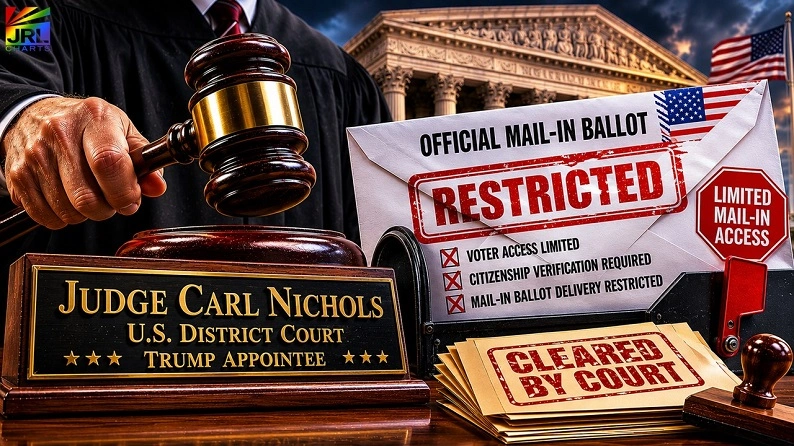
WASHINGTON, D.C. — (May 28, 2026) — Another federal court ruling is fueling a growing national battle over voting rights after a Trump-appointed judge cleared the way Thursday for President Donald Trump’s controversial executive order tightening restrictions on mail-in ballots ahead of the 2026 midterm elections.
U.S. District Judge Carl Nichols ruled that legal challenges brought by Democratic organizations against Trump’s March executive order were unlikely to succeed, allowing the administration’s election integrity initiative to move forward while additional lawsuits continue through the courts.
Trending President Donald Trump News Coverage on JRL CHARTS
• DOJ Targets Trump Accuser E. Jean Carroll In His Quest for Retribution Campaign
• REPORT: DHS Paid Massive Markups on Warehouses Linked to Trump Investors
• How Can A President Get Away With This? CNN Reports DOJ Deal Blocks IRS Probes
• Trump IRS Lawsuit Deal Could Funnel $1.7B to Allies, Jan. 6 Capitol Riot Defendants
• US Strikes Southern Iran as Tehran Rushes to Qatar for Emergency Talks
The lawsuit was filed by the Democratic Senatorial Campaign Committee, the NAACP, and the League of United Latin American Citizens, all of whom argued the order could improperly expand federal control over voter eligibility systems and create barriers for lawful voters.
Trump’s Executive Order Targets Mail-In Ballot Oversight
President Donald Trump signed the executive order in March as part of a broader Republican-led push focused on election security and voter eligibility verification ahead of the 2026 election cycle.
The order directs federal agencies to help establish a citizenship-based database of eligible voters using existing federal data and instructs the U.S. Postal Service to only deliver mail-in ballots to individuals appearing on approved state voter rolls.
Republicans argue the measure is designed to strengthen election integrity and prevent non-citizens from improperly accessing federal elections. Critics, however, warn the policy could create administrative errors that disproportionately impact minority communities, low-income voters, students, military personnel overseas, and LGBTQ Americans who frequently rely on vote-by-mail access.
Judge Rejects Privacy Act Concerns
In his ruling, Judge Nichols stated that the plaintiffs failed to show sufficient evidence that the executive order would directly harm voters or violate federal privacy protections.
Nichols wrote that the claims relied on what he described as a “highly attenuated chain of possibilities,” particularly regarding concerns that Democratic voters could be incorrectly removed from citizenship verification systems at higher rates than Republicans.
The court also dismissed arguments that the order automatically violates the Privacy Act merely by allowing federal agencies to share existing citizenship and residency data internally between government departments.
However, Nichols acknowledged the legal challenge could become stronger if the federal government eventually creates what he described as a “purely intra-federal government list” of eligible voters.
Voting Rights Groups Warn of Broader Election Impact
Civil rights organizations opposing the order say the ruling represents another escalation in the national fight over voting access ahead of the midterms.
LGBTQ advocacy groups and voting rights activists have increasingly expressed concern over state and federal election restrictions that could complicate absentee and mail-in voting access for transgender Americans, college students, disabled voters, and citizens living temporarily outside their registered voting districts.
Election law experts also note that the legal battle surrounding Trump’s executive order is far from over.
Next week, U.S. District Judge Indira Talwani, an appointee of former President Barack Obama, is expected to hear a separate legal challenge filed by Democratic-led states in Boston seeking to block enforcement of the mail-in ballot restrictions.
Trump Pushes SAVE Act Ahead of Midterms
The ruling arrives as Trump and congressional Republicans continue pushing the proposed SAVE Act — legislation that would require proof of citizenship for voter registration nationwide.
Supporters argue the legislation would modernize voter verification systems and reduce election fraud risks. Opponents warn the proposal could create new barriers for millions of Americans who lack immediate access to citizenship documentation.
Ironically, critics quickly pointed out that Trump himself voted by mail earlier this year during Florida’s special election cycle, a detail that immediately resurfaced across social media following Thursday’s ruling.
With control of Congress at stake in 2026, the growing legal fight over mail-in voting restrictions is expected to remain one of the most politically explosive election battles in America heading into the midterms.
For continuing coverage on voting rights, election law battles, and LGBT Politics USA, stay with JRL CHARTS — where politics, policy, and LGBTQ America intersect.
Editorial Illustration by JRL CHARTS Network – LGBT Politics
His reporting focuses on federal court rulings, legislative developments, international human rights issues, and government actions impacting LGBTQ communities worldwide.
With nearly two decades of experience, Goldberg is recognized for his balanced analysis, investigative insight, and commitment to accurate, fact-based journalism that informs readers on the political forces shaping equality and justice.
- Supreme Court Blocks Trump’s Transgender Prison Care Ban in Major Legal Setback - October 21, 2026
- UNC Settles 18 Trump Administration Probes as Race and DEI Rules Face New Scrutiny - October 19, 2026
- Catholic Relief Services Loses Major LGBTQ Benefits Battle in Federal Appeals Court - October 19, 2026