By: Paul Goldberg – Senior Correspondent | LGBT Politics USA
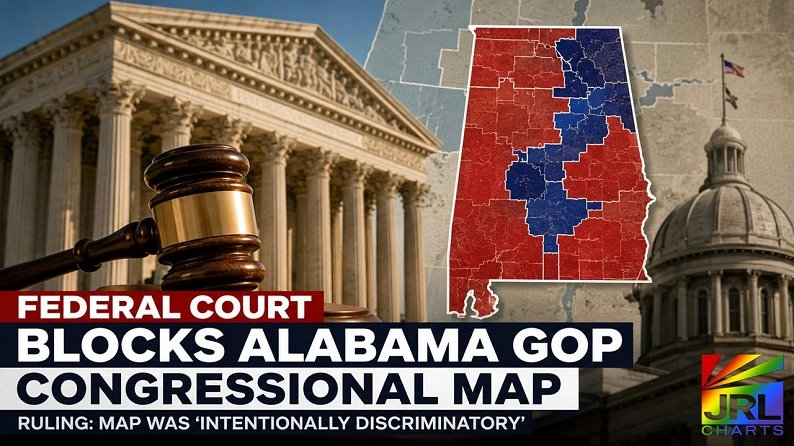
MONTGOMERY, AL — (May 26, 2026) — A federal three-judge panel — including two judges appointed by President Donald Trump — delivered a major legal setback to Alabama Republicans on Tuesday after ruling that the state’s congressional redistricting map was “intentionally discriminatory” against Black voters in violation of the U.S. Constitution.
The ruling arrives as voting rights battles intensify nationwide ahead of the 2026 midterm elections, with multiple states facing legal scrutiny over newly redrawn congressional districts and accusations of racial or partisan gerrymandering.
Trending GOP Voting Rights Battles on JRL CHARTS
• Conservative-Packed Missouri Supreme Court Hands GOP Gerrymandering Victory
• Missouri Age Verification Bill Surges Forward After Unanimous Senate Vote
• Dems’ DAs Warn Trump Allies: Federal Agents at Polling Sites Could Face Prosecution
• Trump Warns Republicans: “Democrats Will Win Everything” Without SAVE Act
• Get the Latest LGBT Politics USA News Coverage on JRL CHARTS
Civil rights advocates say the outcome could also carry broader implications for LGBTQ voters in Alabama, particularly LGBTQ people of color living in historically marginalized communities across the state’s Black Belt region where access to political representation, healthcare resources, anti-discrimination protections and voting access remain ongoing concerns.
Federal Court Rejects Alabama’s 2023 Congressional Map
The case centers on a congressional map approved by Alabama Republicans in 2023 that reduced the number of majority-minority congressional districts from two to one.
In a sweeping 102-page opinion, Circuit Judge Stanley Marcus of the Eleventh Circuit Court of Appeals, along with District Judges Anna M. Manasco and Terry F. Moorer of the Northern District of Alabama, ruled that the map violated the Fourteenth Amendment.
Both Manasco and Moorer were appointed by Trump.
The judges stated they conducted a fresh review of the evidence after the U.S. Supreme Court’s recent ruling in Louisiana v. Callais, which addressed the constitutional limits surrounding race-based redistricting under the Voting Rights Act.
The court wrote that Alabama’s congressional plan was tainted by “intentional race-based discrimination,” concluding:
“The undisputed evidence left us in no doubt that Alabama’s legislatively enacted plan (the “2023 Plan”) intentionally discriminated based on race in violation of the Constitution.”
The judges further determined that Alabama lawmakers knowingly diluted Black voting power by refusing to create an additional district that would provide Black voters a meaningful opportunity to elect representatives of their choice.
Court Rejects Alabama’s Partisan Defense
Alabama officials argued the districts were drawn for partisan political reasons rather than racial motivations. The court rejected that defense after what it described as an exhaustive review of the evidence.
“We reject in the strongest possible terms the State’s attempt to finish its intentional decision to dilute minority votes with a veneer of legislative regularity,” the judges wrote.
The ruling continued:
“Further, the Legislature well knew what dilutive mechanisms would prevent Black voters in Alabama’s Black Belt and Gulf Coast communities from having any opportunity to elect representatives of their choice, and the Legislature employed precisely those mechanisms. The Legislature also took a series of highly unusual steps along the way. Those unprecedented steps culminated in the enactment of novel legislative findings (“the 2023 legislative findings”) that departed sharply from the Legislature’s norms and made it impossible not only to remediate the vote dilution we identified, but also to respect the longstanding community of interest the Legislature identified in Alabama’s Black Belt. These events, along with legislators’ contemporaneous statements about race, support only one inference: the purpose of the 2023 Plan was to distribute Black voters across districts to dilute their votes, at least in part because they are Black.”
The panel also dismissed arguments that changing district maps so close to the 2026 elections would create administrative problems, ruling instead that blocking the disputed map would actually improve election stability.
LGBTQ Advocates Continue Raising Concerns in Alabama
While the case primarily centers on race and voting rights, LGBTQ civil rights organizations have repeatedly warned that restrictive voting policies and district manipulation can disproportionately impact LGBTQ communities, particularly Black LGBTQ residents and younger voters concentrated in urban areas such as Birmingham, Montgomery and Mobile.
Alabama has remained one of the most politically divisive states for LGBTQ residents in recent years, with ongoing battles involving:
- transgender healthcare restrictions
- public education policies
- drag performance legislation
- anti-discrimination protections
- and access to inclusive healthcare services.
Advocacy groups argue that weakened minority representation can also reduce legislative attention toward LGBTQ equality issues, especially for marginalized communities already facing barriers tied to race, income and healthcare access.
NAACP Applauds Federal Court Decision
The NAACP issued a forceful statement praising the ruling and condemning Alabama’s redistricting effort.
“We applaud the Federal Court’s ruling today, preserving Black representation. Redrawing maps to silence the voices of entire communities cannot be tolerated. It goes against the very values of democracy that our ancestors fought and died for,” said NAACP President Derrick Johnson. “Throughout history, Alabama fought to preserve slavery, resisted the Supreme Court’s ruling to desegregate schools, and violently oppressed and silenced Black people — from arresting Rosa Parks after she refused to give up her seat on the bus, beating John Lewis’ skull on the Edmund Pettus Bridge, jailing Dr. Martin Luther King, Jr. repeatedly, and unleashing dogs on peaceful protesters. This attempt to redistrict is a continuation of Alabama’s gruesome and bloody history. Our NAACP chapters in Alabama mobilized to reject this map, and we will continue to fight across the country to protect our voice. Today’s ruling is good news, but we know it is not the end of this fight.”
Hours after the decision was released, Alabama officials formally appealed the ruling to the U.S. Supreme Court, setting the stage for another major legal showdown over voting rights and congressional redistricting ahead of the 2026 elections.
The federal court also ordered expedited proceedings moving forward, with the case expected to continue beyond the November elections.
Readers can review the federal court ruling directly here:
For the latest LGBT Politics USA, Voting Rights, Constitutional Law and LGBTQ Civil Rights coverage, stay connected to JRL CHARTS LGBT Politics.
His reporting focuses on federal court rulings, legislative developments, international human rights issues, and government actions impacting LGBTQ communities worldwide.
With nearly two decades of experience, Goldberg is recognized for his balanced analysis, investigative insight, and commitment to accurate, fact-based journalism that informs readers on the political forces shaping equality and justice.
- GameStop Hit With Federal Lawsuit After Gay Employee Reports Threats — Then Gets Fired - October 16, 2026
- Meta Paid 29 Anti-LGBTQ Accounts as 2026 Midterm Misinformation Spreads - October 14, 2026
- Orbán’s Anti-LGBTQ Legacy Crumbles as Hungary Votes 139–51 for Change - October 13, 2026