By: Paul Goldberg – Senior Correspondent | LGBT Politics USA
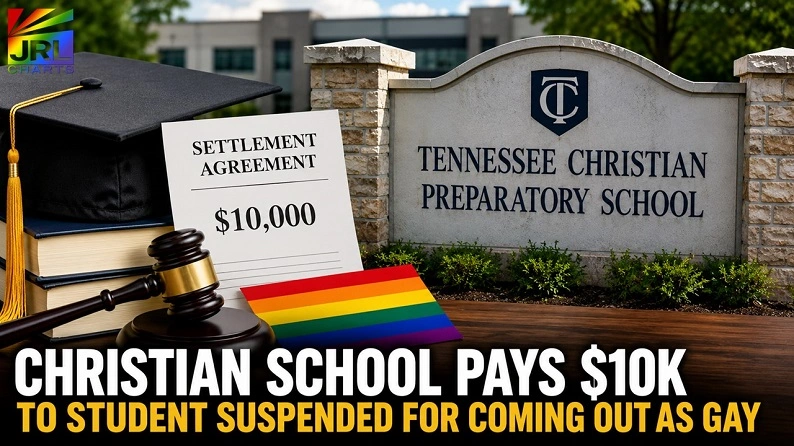
CLEVELAND, TN — (June 24, 2026) — A Tennessee Christian school has agreed to pay $10,000 to settle a legal fight brought by a former student who alleged she was suspended, barred from graduation, and threatened with harm to her college prospects after she came out as gay on social media.
The settlement resolves a lawsuit filed by Morgan Armstrong, a graduating senior at Tennessee Christian Preparatory School in Cleveland, Tennessee. A final judgment entered Monday ends the case, which drew national attention after Armstrong accused school officials of punishing her for publicly sharing that she was in a same-sex relationship.
Now Trending on LGBT Business Finance News on JRL CHARTS:
• LGBTQ Consumers Shift Spending Away from Target, Walmart and Amazon
• Millions of Working Americans Are Going Hungry—and Nobody Is Talking About It
• LGBTQ Business Owners Join Growing Coalition Against Bank Account Closures
• China’s Rising Yuan Could Hit LGBTQ Businesses Worldwide
According to the complaint, Armstrong posted about her relationship online in spring 2025. Days later, she was allegedly called into a meeting with school administrators and informed that she would be suspended, banned from school events—including graduation—and could face further consequences if there was any online criticism of the school. Armstrong also alleged the school threatened to withhold her diploma and make disparaging comments to prospective colleges and universities.
The settlement reportedly includes a $10,000 payment and rescinds Armstrong’s suspension, while also preventing the school from making negative comments about her to colleges. Public reports on the final judgment indicate both sides agreed to resolve the dispute without admitting the other’s claims.
School Maintains It Disciplined Student for Policy Violations, Not Sexual Orientation
Tennessee Christian Preparatory School has denied that Armstrong was punished because she is gay. In statements reported by local media, the school said the Armstrong family and the school disagreed over the extent to which she violated school policies and that both sides chose to move forward without further public comment.
The school has previously argued that Armstrong’s discipline stemmed from policy violations unrelated to her sexual orientation, citing concerns that included attendance, tardiness, academic issues, and alleged enrollment-payment disputes. Armstrong’s lawsuit, however, argued that the punishment imposed on her was far more severe than what the school’s own disciplinary policy allowed for a first-time social media infraction.
Lawsuit Framed the Discipline as Anti-LGBTQ Retaliation
Armstrong’s legal team said the case was about far more than one graduation ceremony. The complaint alleged that school officials targeted Armstrong after she made a public post identifying herself as gay and sharing her relationship online, then used school discipline to isolate and punish her during the final days of her senior year.
Attorney Daniel Horwitz, who represented Armstrong and her family, said the outcome sends a broader message about how schools should treat LGBTQ students.
“School is a place where every student is entitled to feel welcome, accepted, and supported,” Horwitz said in a statement reported after the settlement. “It is not a place where any administrator should feel comfortable disciplining or threatening kids for being gay.”
Armstrong previously defended her decision to share her relationship publicly, telling The Washington Post that straight students routinely post photos with their partners without punishment.
“Everyone else gets to post their boyfriend or girlfriend,” Armstrong said. “So just because I have a girlfriend and I’m a girl, why does that mean that I shouldn’t be able to?”
Why the Case Matters for LGBTQ Student Rights
While the settlement does not create new legal precedent, the case lands at a time when LGBTQ students in religious-school settings continue to face uneven protections. Private religious schools often argue they have broad discretion to enforce conduct codes rooted in faith-based standards, while civil-rights advocates say those policies are increasingly being used to target students for sexual orientation or gender identity.
That tension has become a recurring flashpoint in Tennessee and other conservative-led states, where LGBTQ rights battles increasingly play out through school policies, curriculum fights, athletics rules, and disputes over student speech. Armstrong’s case illustrates how those conflicts can move beyond politics and into the day-to-day lives of students facing graduation, college admissions, and public stigma.
For JRL CHARTS readers covering LGBT politics, the significance here is not the dollar amount of the settlement—it is the fact that a student who says she was punished for coming out forced a private Christian school into a court-approved resolution that included compensation, reversal of her suspension, and protections against retaliatory contact with colleges.
The Bottom Line
The $10,000 settlement closes a legal battle that put Tennessee Christian Preparatory School under national scrutiny and turned one student’s graduation dispute into a broader fight over LGBTQ student rights in faith-based education. For advocates, the case is another reminder that coming out can still carry real academic and emotional risks for queer students—especially in environments where school discipline, religion, and LGBTQ visibility collide.
For more coverage of LGBTQ civil rights battles, school policy fights, and legal developments shaping the community nationwide, stay with JRL CHARTS LGBT Politics USA.

His reporting focuses on federal court rulings, legislative developments, international human rights issues, and government actions impacting LGBTQ communities worldwide.
With nearly two decades of experience, Goldberg is recognized for his balanced analysis, investigative insight, and commitment to accurate, fact-based journalism that informs readers on the political forces shaping equality and justice.
- Cape Town Pride 2027 Goes BIG With 24 Days of LGBTQ Celebrations! - October 24, 2026
- LGBTQ Rights on the Line in 7 States as 2026 Midterm Elections Near - October 24, 2026
- Gay Dad Cleared After Punching MAGA Influencer Who Targeted His Family - October 24, 2026