By: Paul Goldberg – Senior Correspondent | LGBT Business Finance News
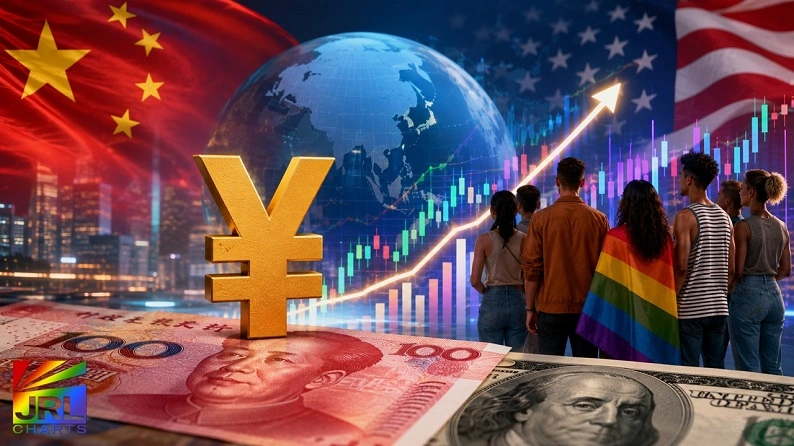
LAS VEGAS, NV — (May 25, 2026) — China’s yuan climbed to its strongest level against the U.S. dollar in more than three years this week as investors reacted to possible de-escalation in the Iran conflict and renewed optimism surrounding shipping access through the Strait of Hormuz.
But beyond Wall Street and traditional financial headlines, economists and international trade analysts say the currency movement could have growing implications for LGBTQ-owned businesses and the expanding global “Pink Economy” — a sector that major LGBTQ media outlets rarely examine from a serious financial perspective.
Now Trending on LGBT Business Finance News on JRL CHARTS:
• FTC Warns Platforms: New Federal Takedown Law Takes Effect May 19
• Project 2025 Already 50% Complete: Inside Trump’s Plan Reshaping America
• U.S. Banking Rule Ends ‘Reputational Risk’ Barrier, Expands Access for Legal Businesses
• Inflation EXPLODES to 3.8% as Iran War Drives Prices Higher, Wages Fall Behind
• LGBTQ Corporate Participation Plunges 65% in 2026 as DEI Retreat Reshapes Business Landscape
According to Reuters, the yuan’s continued rise has been fueled by strong Chinese exports, improving investor confidence, and expectations that trade tensions between China and the United States could stabilize further in the months ahead.
While most media coverage has focused on oil markets and geopolitics, JRL CHARTS Business Finance News has identified another important angle: the increasingly global nature of LGBTQ consumer commerce and its growing dependence on international supply chains tied directly to China’s economy.
The Growing Power of the Global “Pink Economy”
China’s LGBTQ consumer market has quietly become one of the largest in the world. Previous economic estimates placed China’s LGBTQ purchasing power near $300 billion annually, driven largely by younger urban consumers and digital commerce growth.
That purchasing power now intersects with industries heavily connected to LGBTQ audiences worldwide, including:
- fashion and apparel
- sexual wellness products
- LGBTQ streaming platforms
- travel and tourism
- nightlife and entertainment
- influencer marketing
- cosmetics and skincare
- Pride merchandise manufacturing
Many of those industries rely heavily on Chinese manufacturing, packaging, logistics, e-commerce infrastructure, or digital advertising systems.
Why the Yuan Matters to LGBTQ-Owned Businesses
A stronger yuan can increase costs for American and European LGBTQ-focused brands that import goods or rely on Chinese manufacturing partners.
That includes:
- Pride merchandise companies
- LGBTQ fashion labels
- sexual wellness brands
- independent creators
- online retail shops
- subscription-box businesses
- LGBTQ tourism campaigns
For businesses operating on narrow profit margins, currency fluctuations can quickly affect:
- manufacturing costs
- shipping expenses
- retail pricing
- ad budgets
- sponsorship campaigns
- influencer partnerships
At the same time, Chinese companies selling internationally gain additional purchasing power and stronger global trade leverage when the yuan strengthens against the dollar.
China’s Expanding Global Trade Influence
China remains the world’s largest manufacturing power and one of the most influential global trading economies. Beijing has also continued expanding efforts to internationalize the yuan and reduce dependence on the U.S. dollar in global trade settlements.
Reuters recently reported that several major global investment banks have upgraded their yuan forecasts amid China’s export resilience and growing trade influence.
Analysts say those shifts could accelerate long-term changes in international commerce — including how LGBTQ-focused businesses conduct cross-border trade and global marketing campaigns.
A Financial Story LGBTQ Media Rarely Covers
While major LGBTQ publications often focus on politics, entertainment, or social issues, few outlets analyze how global financial systems, currency markets, and international trade directly affect LGBTQ entrepreneurs and businesses worldwide.
That gap is becoming increasingly important as LGBTQ consumer spending evolves into a multi-trillion-dollar global marketplace connected to international supply chains, digital commerce, and geopolitical risk.
With China’s yuan continuing to strengthen and global markets reacting to instability in the Middle East, experts warn that further currency swings could reshape costs, investment patterns, and expansion opportunities for LGBTQ-focused brands throughout 2026.
For LGBTQ-owned businesses operating internationally, the message is becoming clear: currency wars and global finance are no longer abstract economic stories — they are now directly tied to the future of the global LGBTQ marketplace.
Stay with JRL CHARTS Business Finance News for continuing coverage on global markets, international currency movements, geopolitical finance, China-U.S. economic tensions, and the financial impact of worldwide conflicts shaping the global economy in 2026.
His reporting focuses on federal court rulings, legislative developments, international human rights issues, and government actions impacting LGBTQ communities worldwide.
With nearly two decades of experience, Goldberg is recognized for his balanced analysis, investigative insight, and commitment to accurate, fact-based journalism that informs readers on the political forces shaping equality and justice.
- Meta Paid 29 Anti-LGBTQ Accounts as 2026 Midterm Misinformation Spreads - October 14, 2026
- Orbán’s Anti-LGBTQ Legacy Crumbles as Hungary Votes 139–51 for Change - October 13, 2026
- Japan Faces a $101.5 Billion LGBTQ Equality Problem, Economic Study Warns - October 12, 2026