By: Paul Goldberg – Senior Correspondent | LGBT Politics Africa
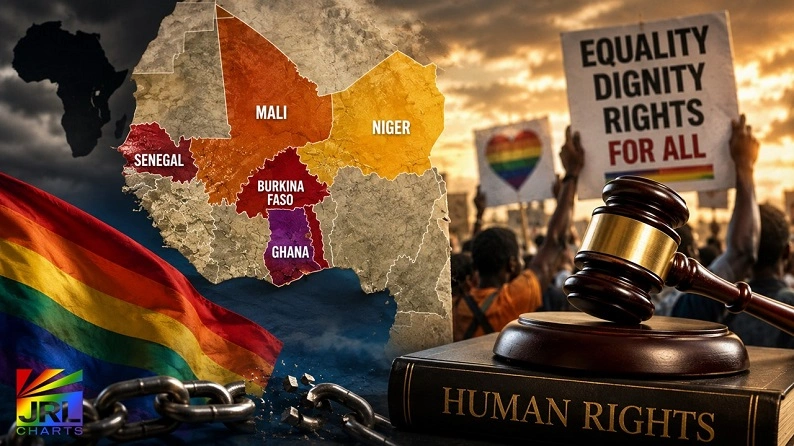
WEST AFRICA — (August 2, 2026) — Human rights organizations and LGBTQ+ advocates are raising fresh concerns over an accelerating wave of anti-LGBTQ+ legislation across West Africa, warning that governments are increasingly using sexual orientation and gender identity as political flashpoints while expanding criminal penalties against LGBTQ+ communities.
Several countries have introduced or strengthened laws over the past two years, with activists describing the trend as one of the region’s most significant setbacks for LGBTQ+ rights in decades. The growing legislative movement comes amid broader political instability, military rule in several nations, and increasing influence from conservative organizations promoting traditional family policies.
Related LGBT Politics Africa News on JRL CHARTS:
• Kenya Court Jails Attackers of Gay Men in Rare LGBTQ Justice Victory
• Kenya Turns on LGBTQ Refugees: Queer Ugandans No Longer Safe in East Africa
• Uganda Gay Rights Activist Steven Kabuye Stabbed in Stomach
• Kenya Supreme Court Rules in Favor of LGBT NGO
• Kenyan LGBTQ Activist Edwin Chiloba Smothered to Death
• Get the Latest in LGBT Politics USA Exclusively on JRL CHARTS
Multiple Nations Tighten Restrictions
Senegal became the latest country to strengthen its laws after lawmakers approved legislation in March that doubles the maximum prison sentence for same-sex relations to ten years while also criminalizing the promotion of homosexuality.
Earlier this year, Niger enacted legislation criminalizing same-sex sexual relations for the first time in the country’s history. Mali and Burkina Faso also introduced new laws banning same-sex relationships during the past two years, with all three countries currently governed by military administrations.
Meanwhile, Ghana’s Parliament approved legislation in June expanding criminal penalties related to LGBTQ+ activities. Although the measure still requires presidential approval before becoming law, it represents the latest version of legislation first introduced in 2021.
Activists Cite Political Opportunism
Regional LGBTQ+ advocates argue that many governments are using LGBTQ+ issues to consolidate political support during periods of economic uncertainty and political instability.
Anthony Oluoch of Pan Africa ILGA said several governments have framed the legislation around religious values, national sovereignty, or the protection of traditional family structures.
Human rights defenders working inside Burkina Faso told international media that LGBTQ+ individuals have increasingly become convenient political targets, arguing that marginalized communities are often blamed to strengthen public support for ruling governments.
Human Rights Concerns Continue to Grow
Advocates say the impact has extended far beyond legislative chambers.
Community organizations report that arrests, intimidation, online surveillance, and social media entrapment have increased in several countries. Healthcare workers serving LGBTQ+ populations have also reported greater difficulty providing HIV prevention services, particularly for men who have sex with men and transgender women—groups that continue to experience disproportionately higher HIV prevalence across parts of West Africa.
Rights organizations also warn that fear of prosecution has forced some LGBTQ+ individuals to flee neighboring countries, although many later returned because of financial hardship and limited asylum options.
International Influence Under Scrutiny
Researchers and advocacy organizations also point to the growing role of international conservative organizations participating in regional conferences promoting family values legislation.
Recent parliamentary gatherings have included discussions surrounding the proposed African Charter on Family Sovereignty and Values, a draft framework supporting traditional definitions of gender, expanded parental rights, and opposition to abortion and comprehensive sexuality education.
Some academic researchers argue that international advocacy networks have played an influential role in shaping portions of recent anti-LGBTQ+ legislation adopted or proposed across several African countries.
A Region at a Crossroads
Human rights organizations caution that continued expansion of anti-LGBTQ+ laws could significantly affect healthcare delivery, freedom of expression, and civil liberties throughout West Africa.
While supporters argue the legislation reflects national sovereignty and cultural values, LGBTQ+ advocacy groups warn that harsher criminal penalties risk increasing discrimination, reducing access to healthcare services, and driving vulnerable communities further underground.
As additional legislative proposals continue moving through parliaments across the region, international human rights organizations say West Africa remains at the center of one of the world’s fastest-changing landscapes for LGBTQ+ legal protections.
Stay with JRL CHARTS LGBTQ Politics Africa for trusted reporting on LGBTQ+ rights, human rights legislation, government policy, and political developments shaping communities across the African continent.
His reporting focuses on federal court rulings, legislative developments, international human rights issues, and government actions impacting LGBTQ communities worldwide.
With nearly two decades of experience, Goldberg is recognized for his balanced analysis, investigative insight, and commitment to accurate, fact-based journalism that informs readers on the political forces shaping equality and justice.
- NYC Puts $8.9 Million Behind Trans Youth Care After Major Hospitals Back Away - October 6, 2026
- Bronx Anti-LGBTQ Attack Leads to Arrest — But Police Say a Second Suspect Is Still Out There - October 5, 2026
- Pete Buttigieg Hits 6 States for Democrats as the 2028 Question Gets Louder - October 5, 2026