By: Paul Goldberg — Senior Correspondent | LGBTQ News
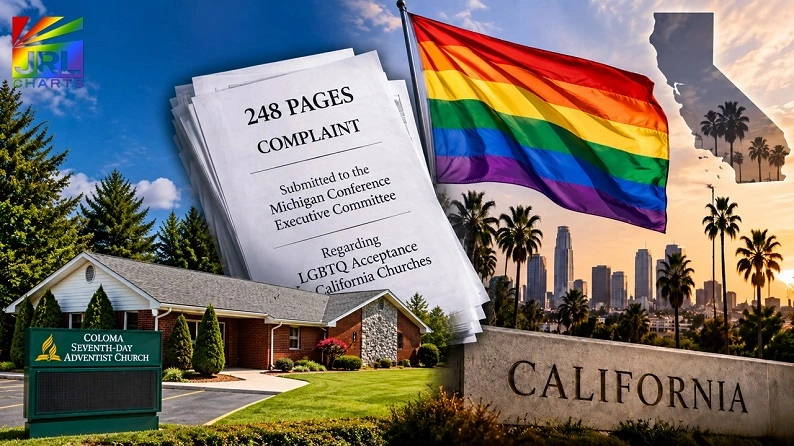
COLOMA, MI — (September 17, 2026) — A small Seventh-day Adventist congregation in rural Michigan is escalating an internal denominational battle over LGBTQ inclusion, submitting an extraordinary 248-page complaint targeting church leaders and institutions more than 1,800 miles away in Southern California.
The complaint from the Coloma Seventh-day Adventist Church asks the Michigan Conference Executive Committee to formally act on its allegations and forward the matter to the denomination’s North American Division Executive Committee.
Trending LGBTQ Politics & Business News on JRL CHARTS:
• Southlake City Council Unanimously Rejects Permit for LGBTQ Pride Festival
• Texas A&M Slashes LGBTQ, Race and Climate Courses From Core Curriculum
• KIPP Nashville Removes LGBTQ Books After Teacher Challenges Same-Sex Marriage Curriculum
• Divide and Conquer: How the Transgender Culture War Is Fracturing LGBT Political Power
• America’s Job Market Just Got Worse — And Higher Interest Rates Could Be Next
• Review More in LGBTQ Business and Politics News on JRL CHARTS
At the center of the dispute are LGBTQ-inclusive practices associated with the Southern California Conference, Glendale City Church, the Southeastern California Conference and La Sierra University.
The lengthy filing argues that those practices represent a sustained departure from established Seventh-day Adventist standards and calls for institutional accountability.
Retired Gay Pastor Leif Lind Becomes Major Focus
A significant portion of the complaint focuses on Leif Lind, the now-retired married gay pastor whose decades-long relationship with Glendale City Church has attracted attention within Adventist circles.
Lind came out as gay in 1996 and lost his denominational employment, according to an extensive April 2026 interview published by Spectrum. He subsequently found a ministerial home at Glendale City Church, where his unusual path back into Adventist ministry became part of a larger debate over LGBTQ people within the denomination.
The Coloma filing reportedly documents Lind’s history in painstaking detail, incorporating church bulletins, photographs, archived articles and other materials.
Lind said the scope of the documentation surprised him.
“It’s almost uncanny the detail that this document has put together.”
He estimated that roughly 60% of the material concerns him, Glendale City Church and the Southern California Conference, with much of the remainder addressing La Sierra University Church and the Southeastern California Conference.
Lind described himself as more “disgusted” and “astounded” by the undertaking than worried about it.
La Sierra University’s LGBTQ Programs Also Targeted
The complaint extends beyond Lind and Glendale.
It challenges LGBTQ accommodations associated with La Sierra University and La Sierra University Church, including a Kinship Sabbath School class and a private “Lavender Graduation” recognizing LGBTQ students.
The filing also names several current and former church officials while arguing that what it considers denominational violations were not isolated incidents but part of a continuing institutional pattern.
Among those identified are Southern California Conference President John Cress, Executive Secretary Danny Chan, Los Angeles Regional Director Brett Poynter and former La Sierra University Church pastor Chris Oberg.
The complaint contends that the documented practices conflict with Seventh-day Adventist standards and warrant consideration by the North American Division Executive Committee.
Why the Dispute Cuts Deep Inside the Adventist Church
The controversy exposes a longstanding tension inside Seventh-day Adventism between its formal teachings on sexuality and the approaches taken by some individual congregations, pastors and institutions.
The denomination’s official statement says sexual intimacy belongs within marriage between a man and a woman and states its opposition to homosexual relationships. Separate church guidelines call upon congregations and denominational organizations to uphold those teachings in membership, employment, education and marriage practices.
At the same time, those same denominational guidelines explicitly state that every person, regardless of sexual orientation, deserves “respect and dignity,” while another official statement says LGBTQ people should not be singled out for scorn, derision or abuse.
That combination has left considerable room for conflict over what pastoral welcome, institutional accommodation and LGBTQ inclusion should look like in practice.
LGBTQ Adventist Leader Responds
Floyd Pönitz, president of Seventh-day Adventist Kinship International, responded to the complaint by arguing that LGBTQ Adventists continue to seek belonging within the denomination rather than exclusion from it.
Pönitz said the document illustrates what he views as a longstanding difficulty among some congregations in accepting people whose identities or lives differ from their own.
He contrasted Coloma’s effort with the work of Lind, Oberg and California church leaders who, in his view, have attempted to create more welcoming spaces for LGBTQ Adventists.
SDA Kinship describes its mission as providing community for LGBTQ Adventists and former Adventists. In a message published in August, Pönitz wrote that the organization seeks to provide LGBTQ people with connection and belonging and highlighted supportive pastors as part of that effort.
A 248-Page Record Built to Survive
Perhaps the most unusual feature of the Coloma 248-page complaint is its sheer size.
Approximately 230 pages reportedly consist of supporting material, including archived content from Adventist publications such as Adventist Today and Spectrum. The filing says the material was preserved because online sources can subsequently be changed, moved, restricted or deleted.
Annotations and highlighted passages were also included to direct reviewers toward portions the complainants consider significant.
That transforms what might otherwise have been a congregational objection into an extensive documentary record intended for review at progressively higher levels of Adventist governance.
What happens next will depend on how church bodies respond to the complaint and whether it ultimately reaches the North American Division Executive Committee.
For LGBTQ Adventists, however, the dispute is also another chapter in a much broader denominational argument: how a church with formally conservative teachings on sexuality handles congregations and institutions choosing more LGBTQ-inclusive approaches in everyday ministry.
Stay with JRL CHARTS LGBTQ News for continuing coverage of LGBTQ faith, equality and the institutions shaping the lives of LGBTQ communities across America.
His reporting focuses on federal court rulings, legislative developments, international human rights issues, and government actions impacting LGBTQ communities worldwide.
With nearly two decades of experience, Goldberg is recognized for his balanced analysis, investigative insight, and commitment to accurate, fact-based journalism that informs readers on the political forces shaping equality and justice.
- Federal Watchdog Drops $78 Million Bombshell on Trump’s Healthcare Funding Cuts - October 7, 2026
- NYC Puts $8.9 Million Behind Trans Youth Care After Major Hospitals Back Away - October 6, 2026
- Bronx Anti-LGBTQ Attack Leads to Arrest — But Police Say a Second Suspect Is Still Out There - October 5, 2026