By Paul Goldberg — Senior Correspondent | LGBT Business Finance News
NEW YORK, NY — (November 22, 2026) — Wall Street has entered dangerous territory as the S&P 500 officially plunged into a stock market correction, sending shockwaves through retirement portfolios, investment accounts and business finances across the United States.
For millions of LGBTQ Americans who participate in the financial markets, the latest downturn represents more than another turbulent trading week. It raises questions about retirement security, investment diversification, technology stock valuations and the financial resilience of LGBTQ-owned businesses.
Trending LGBTQ Business Finance News on JRL CHARTS:
• Anthropic’s $1.5 Trillion IPO Shakes Wall Street — What LGBTQ Businesses Need to Know
• Bessent Forces AI Chip Crackdown as Trump Cabinet Feud Explodes Over China
• Wall Street Sinks as Inflation Shock Sends Treasury Yields Toward 5%
• Cedars-Sinai Takes Aim at LGBTQ Smoking Crisis With The Quit Alliance
• Google’s AI Gamble: Can Gemini Save Search Without Destroying Its Cash Machine?
• LGBTQ Funding Crisis Deepens as 36% of Surveyed Groups Warn They Could Close Within a Year
• Get the Latest in LGBT Business Finance News on JRL CHARTS
The S&P 500 closed Friday, November 20, at 6,910.39, falling approximately 3.7% during the session and finishing 11.6% below its October 6 record closing high of 7,818.93.
The Dow Jones Industrial Average, Nasdaq Composite and Russell 2000 also finished in correction territory, underscoring how rapidly selling pressure has spread across the American stock market.
AP News+2
Wall Street’s AI Boom Faces Its Biggest Reckoning
The dramatic reversal follows months of investor enthusiasm surrounding artificial intelligence, semiconductor manufacturing and technology companies expected to benefit from enormous spending on AI infrastructure.
But that enthusiasm has increasingly collided with difficult questions about profitability, corporate borrowing, rising costs and whether projected AI revenues can justify the valuations investors have assigned to the sector.
Technology heavyweight Nvidia suffered another devastating trading session Friday, falling approximately 14%, while semiconductor companies including Advanced Micro Devices, Broadcom and Micron Technology experienced double-digit declines.
The Nasdaq Composite dropped approximately 5.3% on Friday, wiping out its gains for 2026 and delivering its worst weekly performance since March 2020.
Even the highly anticipated public-market debut of artificial intelligence company Anthropic failed to restore confidence. Its shares retreated sharply following their initial surge, adding to concerns that investor enthusiasm for AI-related companies may have outpaced their near-term earnings potential.
For LGBTQ investors with significant exposure to technology-heavy index funds, individual AI stocks or growth-oriented retirement investments, the selloff demonstrates how quickly concentrated positions can lose value.
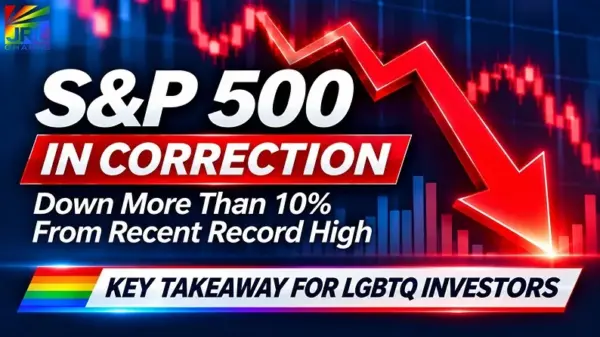
The S&P 500 enters correction territory as Wall Street volatility raises concerns about retirement savings, investment portfolios and financial security for LGBTQ investors. Illustration: JRL CHARTS Network.
Millions of LGBTQ Americans Have a Financial Stake in Wall Street
The LGBTQ investment community represents a substantial, though frequently overlooked, segment of the American financial marketplace.
Research from Morgan Stanley has highlighted growing demand for financial products that address LGBTQ equity, inclusion and long-term wealth creation.
Based on an estimated 20 million to 21 million LGBTQ adults in the United States, illustrative participation scenarios suggest that approximately 8.8 million to 12.2 million could have exposure to equities through brokerage accounts, retirement plans or other investment vehicles.
Those figures are population-based estimates, not a verified count of LGBTQ stockholders. They combine different participation assumptions and should not be interpreted as evidence that LGBTQ investors own a particular percentage of the U.S. stock market.
Nevertheless, the broader financial implications are significant.
LGBTQ investors may hold equities through employer-sponsored 401(k) plans, individual retirement accounts, mutual funds, exchange-traded funds and independently managed brokerage portfolios.
That means a correction in the S&P 500 can affect households that have never purchased an individual share of stock.
LGBTQ Business Owners Face a Different Financial Challenge
For LGBTQ entrepreneurs, a declining stock market can create risks extending beyond personal investment portfolios.
The National LGBT Chamber of Commerce (NGLCC) has estimated that approximately 1.4 million LGBTQ-owned businesses operate across the United States.
Using that business-owner population as a starting point, a hypothetical 44% to 65% investment participation range would imply roughly 616,000 to 910,000 LGBTQ business owners with some form of stock market exposure.
That range is an illustrative calculation rather than a directly measured statistic.
For entrepreneurs who hold personal investments while simultaneously financing business operations, market volatility can complicate decisions involving expansion, hiring, equipment purchases and working capital.
A sustained decline in household investment wealth may also influence consumer confidence and discretionary spending, particularly in industries dependent on customers’ willingness to make nonessential purchases.
However, a stock market correction does not automatically translate into declining business revenue.
The economic consequences depend on whether falling equity prices are accompanied by weaker employment, tighter credit conditions or a broader slowdown in consumer spending.
For LGBTQ-owned businesses, maintaining sufficient operating liquidity remains a separate financial consideration from managing long-term investment assets.
Why the Correction Matters for LGBTQ Retirement Planning
One of the most consequential aspects of the downturn involves retirement savings.
Many Americans participate in the stock market indirectly through employer-sponsored retirement programs, often holding diversified funds with substantial allocations to large U.S. companies.
The S&P 500 is a major benchmark for those investments.
When the index declines, investors holding funds that track it generally experience corresponding market losses, subject to fees, distributions and differences in fund structure.
The impact can vary dramatically depending on an investor’s age, asset allocation and anticipated retirement date.
Younger investors with decades before retirement may have more time to recover from market declines. Investors approaching retirement can face greater risks if they must sell assets during a downturn to meet living expenses.
For LGBTQ households, retirement planning may also involve considerations surrounding family structure, survivor benefits, estate planning and access to employer-sponsored financial programs.
These factors make personalized financial planning particularly important during periods of elevated market volatility.
Morgan Stanley Research Reveals Strong Demand for LGBTQ-Aligned Investments
The financial priorities of LGBTQ investors are not limited to portfolio performance.
A Morgan Stanley Institute for Sustainable Investing study found that 86% of surveyed LGBTQ investors expressed interest in opportunities supporting LGBTQ equity and inclusion.
The research also identified significant interest among younger investors and households with LGBTQ family members.
Importantly, the 86% figure measures interest in investment opportunities, not the percentage of LGBTQ investors who currently own ESG funds or actively screen every investment for corporate inclusion policies.
The findings suggest that investment firms have an opportunity to develop financial products that combine traditional performance objectives with corporate accountability, workplace inclusion and representation.
But the current market correction also reinforces an important distinction: a company’s LGBTQ-inclusive policies do not guarantee financial stability or protection from falling stock prices.
Values-aligned investing still requires scrutiny of valuations, diversification, operating performance and investment risk.
Correction or Bear Market? What Happens Next
Wall Street generally defines a stock market correction as a decline of at least 10% from a recent peak.
A bear market typically begins when an index falls 20% or more from its previous high.
The distinction matters because corrections are relatively common features of financial markets and do not necessarily signal an approaching recession.
Historical market research shows that some corrections are followed by recoveries, while others deepen into prolonged bear markets.
The Associated Press reported that among 25 historical corrections since 1946 that did not develop into bear markets, the S&P 500 declined an average of approximately 14.1% before reaching its low.
But historical averages cannot establish how the current downturn will unfold.
Investors are now confronting several unresolved questions, including whether AI companies can deliver sufficient earnings growth, whether interest rates will remain elevated and whether corporate investment spending will slow.
Those developments could influence market direction well beyond the technology sector.
What LGBTQ Investors Should Watch as Markets Reopen
With U.S. financial markets scheduled to reopen Monday, November 23, investors face another potentially volatile trading week.
Several financial indicators deserve particular attention:
-
Technology concentration: Whether selling pressure continues across AI companies, semiconductor manufacturers and technology-focused funds.
-
Federal Reserve policy: How inflation, interest-rate expectations and economic data influence investment valuations.
-
Retirement portfolio diversification: Whether investment allocations remain consistent with individual risk tolerance and time horizons.
-
Business liquidity: Whether LGBTQ entrepreneurs have adequate cash reserves without relying on the sale of volatile investments.
-
Corporate earnings: Whether technology companies can demonstrate financial returns sufficient to justify continued AI infrastructure spending.
Investors should distinguish between short-term market movements and changes in their personal financial circumstances. A correction alone does not establish that selling investments, buying additional shares or changing retirement allocations is appropriate for everyone.
The Bigger Picture: LGBTQ Wealth Creation Cannot Depend on Wall Street Optimism Alone
The current market downturn illustrates a fundamental reality of long-term wealth creation: financial security requires more than participating in a rising stock market.
For LGBTQ households and business owners, that may mean balancing investment growth with accessible savings, responsible debt management, insurance protection and retirement planning.
The broader challenge for financial institutions is equally important.
As LGBTQ investors seek greater representation in wealth management and financial products, investment firms must recognize that inclusion and sound financial stewardship are complementary responsibilities.
LGBTQ investors deserve access to the same rigorous research, transparent risk disclosures and long-term financial opportunities available to every other segment of the market.
Wall Street’s latest correction is a reminder that market optimism can disappear quickly.
But the financial decisions made during periods of uncertainty can carry consequences long after the headlines fade.
JRL CHARTS LGBT Business Finance News will continue monitoring Wall Street volatility, artificial intelligence valuations and the financial developments shaping LGBTQ investors, entrepreneurs and retirement portfolios across the United States.
His reporting focuses on federal court rulings, legislative developments, international human rights issues, and government actions impacting LGBTQ communities worldwide.
With nearly two decades of experience, Goldberg is recognized for his balanced analysis, investigative insight, and commitment to accurate, fact-based journalism that informs readers on the political forces shaping equality and justice.
- S&P 500 Plunges 11.6% From Record High as LGBTQ Investors Face Wall Street Reckoning - November 22, 2026
- Wall Street Bloodbath: Nasdaq Erases 2026 Gains as Healthcare Stocks Plunge - November 20, 2026
- Federal Judge Sanctions DOJ Attorney in Explosive LGBTQ Iranian Asylum Case - November 20, 2026