By: Paul Goldberg – Senior Correspondent | LGBT Business Finance News
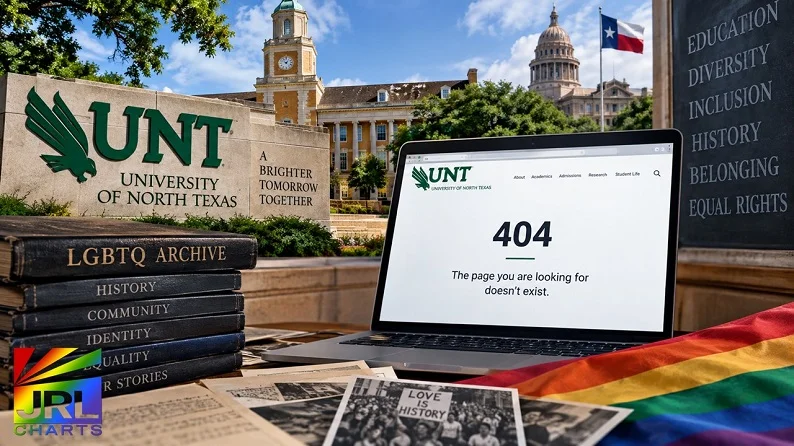
DENTON, TX — (September 22, 2026) — The University of North Texas has removed a webpage dedicated to its LGBTQ archive following public attacks from Republican Texas State Rep. Brian Harrison, escalating concerns over the treatment of LGBTQ history and academic freedom at public universities across Texas.
The important distinction is that the historical collection itself does not appear to have been eliminated.
The webpage disappeared. The archive, according to the latest available information, remains.
Harrison drew attention to the UNT archive Friday on X, posting screenshots and characterizing the university’s LGBTQ materials as “TRANSGENDER INDOCTRINATION.” By Saturday, he was pointing followers to a 404 error where the archive webpage had previously appeared and celebrating the development as another political victory.
Trending LGBTQ Politics & Business News on JRL CHARTS:
• SC Holds Back Grants From Only Two Arts Groups — Both Are LGBTQ+
• Michigan Church Targets LGBTQ Acceptance in California With Massive 248-Page Complaint
• Southlake City Council Unanimously Rejects Permit for LGBTQ Pride Festival
• Texas A&M Slashes LGBTQ, Race and Climate Courses From Core Curriculum
• Review More in LGBTQ Business and Politics News on JRL CHARTS
Harrison subsequently called for UNT to go considerably further, writing that the university “must end the program, not just a website.”
UNT officials had not publicly explained the removal as of the latest reporting.
LGBTQ History Remains Inside UNT’s Collection
The distinction between removing a webpage and eliminating an archive matters.
UNT’s LGBTQ collection contains more than 15,000 items documenting LGBTQ people and organizations throughout the region, including manuscripts, photographs, correspondence and newspaper clippings.
Steve Atkinson, founding board member and president of The Dallas Way, which has contributed historical material to the collection, said the archival holdings remain at the university and that he had received no information suggesting otherwise.
“All it is is history — period,” Atkinson said while rejecting accusations that maintaining LGBTQ historical materials constitutes indoctrination.
That distinction also raises a larger question: What is the role of a public university archive if political pressure can determine which portions of its history receive public visibility?
JRL CHARTS: LGBTQ History Is American History
JRL CHARTS condemns the removal of educational access to LGBTQ history in response to political pressure.
That is the editorial position of this network.
Documenting LGBTQ Americans, their organizations, political movements, families, struggles and contributions is not synonymous with requiring students to adopt a particular political viewpoint.
It is documenting history.
How can Americans be expected to understand LGBTQ people — a population that is part of American society — if educational institutions become increasingly reluctant to make information about that population available?
Removing a webpage does not erase the documents sitting inside an archive. But reducing the visibility and accessibility of historical information can make that history more difficult for students, researchers, journalists and members of the public to discover.
Libraries and archives exist in part because history is often complicated, controversial and uncomfortable. Preserving that history allows future generations to examine primary evidence and reach their own conclusions.
Education should provide people with that opportunity.
Harrison Calls UNT Action a Conservative Victory
Harrison has made no secret of his objectives.
The Republican legislator said in a statement that he had done more than other Texas officials to combat taxpayer-funded DEI and what he calls transgender indoctrination, describing UNT’s action as his latest “conservative victory.”
He argued that taxpayer-funded universities should concentrate on workforce development and said people interested in transgender literature should pay for that education themselves.
Harrison has also publicly taken credit for influencing other Texas universities.
In previous disputes, he criticized LGBTQ-related coursework at Texas State University and pushed Texas A&M over gender-related academic programs and course content.
The UNT controversy therefore isn’t occurring in isolation.
Texas Universities Face Expanding Political Oversight
Texas lawmakers have substantially increased state oversight of public higher education.
Senate Bill 37, enacted in 2025, expanded the authority of university governing boards over academic programs and curricula. Supporters describe the changes as necessary accountability for taxpayer-supported institutions and a means of ensuring universities concentrate on academically and economically valuable programs.
Critics argue the new structure has enabled political appointees to interfere with academic decisions traditionally entrusted to universities and faculty.
Those competing interpretations are already being tested beyond UNT.
Texas Tech University System officials conducted a systemwide review of course content involving sexual orientation, gender identity and other subjects. According to the university system, more than 14,000 courses were examined, 1,403 were initially identified as potentially containing relevant material, and fewer than 60 ultimately were recommended for modification following formal review.
Faculty accounts paint a different picture of the policy’s broader effects. A Texas Tech Faculty Senate survey found professors reported changing, or being asked to change, material in 277 courses.
Legal Challenges Are Already Underway
The developing legal battle over Texas higher education could ultimately be more consequential than the disappearance of any single university webpage.
The American Association of University Professors and Texas AAUP-AFT filed a federal lawsuit against Texas Tech University System Chancellor Brandon Creighton and members of its Board of Regents in July 2026.
Represented by Lambda Legal, the NAACP Legal Defense Fund and Davis Wright Tremaine, the plaintiffs argue that Texas Tech’s course-content policies violate the First Amendment through viewpoint discrimination and restrictions on academic speech. They also raise Fourteenth Amendment claims.
The plaintiffs have asked a federal court for a preliminary injunction blocking enforcement while the litigation proceeds.
Texas Tech maintains that its policies are lawful and comply with state and federal requirements.
The Texas Tech litigation does not currently constitute a lawsuit against UNT over removal of its LGBTQ archive webpage. Nor does the existence of that case establish that UNT’s decision was unconstitutional.
But the litigation demonstrates that restrictions involving LGBTQ-related academic material at Texas public universities are already producing constitutional challenges.
Free-speech advocates have argued that the legal issues become particularly significant when government institutions move beyond administrative DEI programs and begin regulating what professors may teach or what librarians may maintain in public collections.
Could UNT’s Decision Be Challenged?
Potential legal remedies would depend heavily on what UNT actually did, why it did it and whether access to the underlying materials was restricted.
A public university is a government institution, meaning First Amendment principles can become relevant when government officials discriminate against speech or viewpoints.
However, removing an informational university webpage is not automatically unconstitutional.
Any viable legal challenge would depend on facts including whether the university acted because of a particular viewpoint, whether students or faculty suffered a legally cognizable injury, whether access to public records or archival material was restricted, and what authority university officials exercised when making the decision.
That makes UNT’s silence particularly important.
Without an explanation from the university, it remains unclear whether the webpage was removed temporarily, permanently, for administrative reasons or specifically because of Harrison’s criticism.
As of September 22, 2026, JRL CHARTS found no announced federal lawsuit specifically challenging UNT’s removal of the LGBTQ archive webpage.
There are nevertheless several avenues through which the controversy could continue: university faculty or students could challenge future restrictions that affect protected speech or academic activity; civil-liberties organizations could examine whether broader policies create actionable First Amendment issues; university governance bodies could seek restoration of public access; and lawmakers could face public scrutiny over future attempts to formally restrict library or archival collections.
The existing Texas Tech litigation will also provide an important legal test of how far public-university administrators can go when regulating instruction involving sexual orientation, gender identity and race.
The Archive Matters Beyond Politics
Willow Jordan, a UNT history major and executive board member of the university’s GLAD LGBTQ student organization, emphasized another consequence of restricting historical material: the potential loss of people’s connection to the past.
“Primary documents are the, as is in the name, primary connection we have to the past,” Jordan said.
That gets to the heart of why archives matter.
An archive does not require visitors to agree with the people whose history it preserves. It provides evidence that those people existed, organized, communicated, struggled, celebrated and participated in society.
A university can maintain Methodist history without requiring students to become Methodists. It can preserve political archives without requiring students to adopt those political beliefs.
And it can document LGBTQ history without requiring anyone to become LGBTQ or embrace a particular ideology.
History does not cease being history because someone finds its subject politically objectionable.
For now, UNT’s LGBTQ materials apparently remain preserved.
The question is whether the webpage that helped students, researchers and the public find that history will return — and whether political pressure on Texas universities will increasingly determine which parts of American history remain easiest to see.
JRL CHARTS LGBT Politics News will continue monitoring the University of North Texas LGBTQ archive controversy, the ongoing federal challenges to Texas higher-education restrictions and their impact on LGBTQ history, academic freedom and access to information.
His reporting focuses on federal court rulings, legislative developments, international human rights issues, and government actions impacting LGBTQ communities worldwide.
With nearly two decades of experience, Goldberg is recognized for his balanced analysis, investigative insight, and commitment to accurate, fact-based journalism that informs readers on the political forces shaping equality and justice.
- Japan Faces a $101.5 Billion LGBTQ Equality Problem, Economic Study Warns - October 12, 2026
- Alito Says Gay Marriage Is Safe — But Didn’t They Say That About Roe v. Wade? - October 12, 2026
- Feds Raid Ilhan Omar’s Home — She Fires Back at Trump: ‘I Will Not Be Silenced’ - October 12, 2026