By: Paul Goldberg – Senior Correspondent | LGBT Politics USA
WASHINGTON, D.C. — (September 26, 2026) — An expanding U.S. immigration policy is creating an extraordinary dilemma for some LGBTQ migrants: American immigration courts can determine that returning them to their home countries could threaten their lives or freedom — yet they may still be deported somewhere else.
That distinction has become increasingly consequential as the Trump administration expands the use of so-called third-country removals, sending migrants to nations where they are not citizens and, in some cases, have never lived.
Trending LGBTQ Business and Politics News on JRL CHARTS:
• Brent Crude Explodes Past $107 — So Why Is Cable News Barely Talking About It?
• UNT Deletes LGBTQ History Page After Texas Lawmaker Attack — But the Archive Isn’t Gone
• SC Holds Back Grants From Only Two Arts Groups — Both Are LGBTQ+
• Michigan Church Targets LGBTQ Acceptance in California With Massive 248-Page Complaint
• Review More in LGBTQ Business and Politics News on JRL CHARTS
One of the most striking cases involves a 28-year-old gay Turkish woman identified by CNN under the pseudonym Aylin.
According to CNN’s reporting, Aylin fled Turkey after receiving threats from a religious group and a close family member. After reaching the United States, an immigration judge granted her withholding of removal, determining that she could not be returned to Turkey because of the danger she faced.
She did not, however, receive asylum.
That difference left open another possibility under U.S. immigration law: deportation to a third country.
The Justice Department explains that withholding of removal prevents the government from returning a person to the country where their life or freedom would be threatened. It does not necessarily prevent removal to another country where the government determines that danger would not exist.
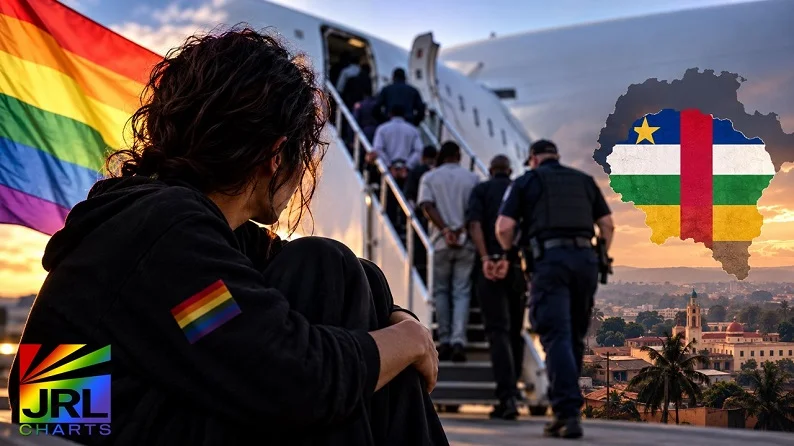
For Aylin, that country became the Central African Republic.
After approximately 18 months in U.S. detention, CNN reported that she was placed on a July deportation flight to the Central African Republic — a country she reportedly had never visited and initially did not even know was her destination.
Independent data supports the broader deportation operation surrounding her case.
Third Country Deportation Watch, a project from Human Rights First and Refugees International, says the Trump administration has established agreements or arrangements with at least 35 countries and, as of early September, had sent more than 25,000 people to 29 third countries.
The Central African Republic has become one of those destinations.
The tracker reports that 92 third-country nationals were transferred there aboard flights on June 12, July 31 and August 29. The July flight included migrants from countries ranging from Eritrea and Cuba to Somalia, Russia, Uzbekistan and Turkey.
LGBTQ Safety Becomes the Central Question
For LGBTQ migrants, the policy raises an additional question: What happens when the third country itself presents serious risks based on sexual orientation or gender identity?
The Central African Republic does not provide comprehensive legal protection against discrimination based on sexual orientation or gender identity.
U.S. State Department reporting has also documented laws penalizing public same-sex expressions of affection, while noting substantial social stigma surrounding LGBTQ people.
That means a gay migrant protected from return to one country can potentially find herself transported thousands of miles to another society where openly living as LGBTQ may carry its own risks.
Immigration advocates argue that this creates an especially precarious situation for people whose original claims for protection were based on their sexual orientation or gender identity.
The administration, meanwhile, has maintained that third-country removals are permissible under immigration law when migrants cannot be returned to their countries of origin and another country agrees to accept them.
Turkey Has Become More Dangerous for LGBTQ Activists
Aylin ultimately faced another wrenching decision.
CNN reported that after spending weeks in Bangui, she chose to return voluntarily to Turkey rather than remain indefinitely in the Central African Republic.
Her return comes as Turkey is experiencing one of its most extensive government operations against LGBTQ organizations in years.
In September, Turkish authorities launched coordinated raids involving LGBTQ rights organizations, activists, businesses and organizations supporting people living with HIV.
Human Rights Watch reported that at least 112 people were arrested during the operations and that 82 remained in detention under court orders as of September 18.
Turkish authorities say the investigations involve allegations including obscenity, prostitution-related offenses, drugs and violations of association laws. Government officials have framed the broader campaign around protecting children, public order and traditional family values.
Human-rights organizations strongly dispute that characterization and contend that LGBTQ civil society is being systematically targeted.
Same-sex relationships themselves remain legal in Turkey, but LGBTQ organizations have reported increasing restrictions on demonstrations, advocacy, online speech and public visibility.
For someone who originally convinced a U.S. immigration judge that returning to Turkey could place her in danger, the timing is difficult to ignore.
A Deportation System Expanding Around the World
Aylin’s case is part of something considerably larger.
Third Country Deportation Watch says the United States has created arrangements involving countries across Africa, Latin America, the Caribbean, Asia and Europe.
Those agreements vary considerably.
Some countries temporarily receive migrants while arrangements are made for their eventual return home. Others permit transferred migrants to pursue asylum. Still other arrangements have resulted in detention after arrival.
The Migration Policy Institute reported that by July 2026 the United States had reached at least 35 agreements involving third-country nationals, ranging from asylum cooperation agreements to temporary “deportation bridge” arrangements and incarceration agreements.
Supporters of expanded deportation authority argue that third-country removal gives the government another mechanism for enforcing final removal orders when migrants cannot be returned directly to their home countries.
Immigration and refugee-rights organizations counter that migrants may receive inadequate notice or opportunity to demonstrate that the proposed destination presents its own threat of persecution or torture.
For LGBTQ migrants, that question can become especially complicated
A country does not necessarily have to criminalize homosexuality outright for an LGBTQ person to face discrimination, violence, police harassment or severe social hostility there.
And winning protection from one dangerous destination does not necessarily mean winning permission to remain in America.
That is the legal gap into which migrants such as Aylin can fall.
She came to the United States asking for protection from the country she fled.
An American immigration court agreed that sending her back there could threaten her safety.
But that protection ultimately did not guarantee her a home in America.
It only prevented America from sending her back to that particular home.
JRL CHARTS – LGBT Politics USA continues tracking U.S. immigration policy and its impact on LGBTQ asylum seekers, refugees and migrants worldwide.

His reporting focuses on federal court rulings, legislative developments, international human rights issues, and government actions impacting LGBTQ communities worldwide.
With nearly two decades of experience, Goldberg is recognized for his balanced analysis, investigative insight, and commitment to accurate, fact-based journalism that informs readers on the political forces shaping equality and justice.
- Stocks Up 12%, Bonds Under Pressure — Morningstar Reveals Wall Street’s Growing Divide - October 26, 2026
- American Express Profits Surge 28% — Then Comes the 3,500 Job Cut Bombshell - October 26, 2026
- Jamie Dimon Sounds the Alarm: 5 Economic Threats That Could Shake America - October 25, 2026