By Paul Goldberg | Senior Correspondent – JRL CHARTS LGBT Politics USA
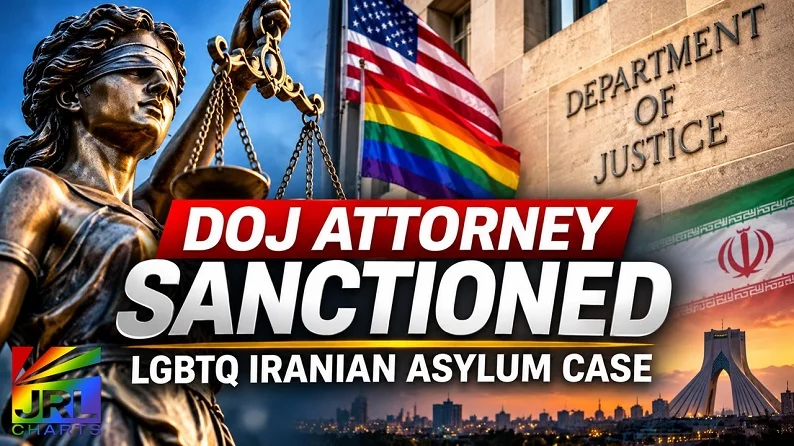
WASHINGTON, D.C. — (November 20, 2026) — A federal judge sanctioned a U.S. Department of Justice attorney for making unsupported allegations in a legal dispute involving an LGBTQ Iranian asylum seeker, exposing serious questions about government representations in federal court and the treatment of immigrants facing deportation to countries where homosexuality is criminalized.
The sanctions, imposed in October by U.S. District Judge Diane Humetawa, became the focus of a November 19 report from the American Immigration Council detailing the legal struggle of three LGBTQ Iranian nationals who fled persecution and sought protection in the United States.
Trending LGBT Politics USA News on JRL CHARTS:
• ACLU Warns Senate Permitting Bill Could Fast-Track ICE Detention Centers
• Can Religious Schools Reject LGBTQ Families and Still Get Taxpayer Money?
• America Granted Them Protection — Then Deported LGBTQ Migrants Somewhere Else
• DACA Renewals Stall as Trump Immigration Policy Leaves LGBTQ Dreamers in Limbo
• You Won’t Believe What Is Breaking Now on LGBTQ News
According to Rebekah Wolf, director of the Council’s Immigration Justice Campaign, the DOJ attorney made assertions suggesting that an immigration lawyer had misled U.S. Immigration and Customs Enforcement (ICE) about the status of a client’s deportation proceedings.
The allegation became a central issue when the asylum seeker’s legal team produced the original email, undermining the government’s characterization of the attorney’s communications.
Judge Humetawa subsequently sanctioned the government lawyer and ordered professional training addressing federal prosecutors’ responsibilities and the requirement to support factual assertions presented to courts.
Federal Judge Orders DOJ Attorney to Complete Professional Training
The sanctions stemmed from federal litigation involving an Iranian asylum seeker identified by the pseudonym Abed, whose attorneys challenged his continued immigration detention.
According to Wolf’s account, the government argued that Abed had interfered with ICE’s attempts to deport him, potentially affecting the legal analysis of how long he could remain detained.
The DOJ’s filing suggested that his attorney may have falsely informed immigration authorities that a deportation stay had already been granted.
However, the actual email submitted by the defense showed that Wolf had notified ICE of a pending appeal, without claiming that a judge had issued a stay.
The distinction was consequential because filing an appeal and obtaining a stay of removal are not the same legal action.
A pending appeal does not necessarily prevent deportation. A stay, when applicable, temporarily prohibits removal while the relevant proceedings continue.
The American Immigration Council reports that Judge Humetawa ordered the DOJ attorney to complete one hour of instruction addressing the special responsibilities of U.S. attorneys and another hour concerning evidentiary support for representations made in court.
The judge also ordered Abed released from detention.
LGBTQ Iranian Asylum Seekers Faced Deportation After Alleged Persecution
The federal dispute is part of a larger legal battle involving three LGBTQ Iranian nationals whose identities have been protected through pseudonyms.
According to their attorneys, Abed and Ali were arrested by Iranian morality police and accused of same-sex sexual activity.
The third individual, Zain, is a transgender man who had married Ali in Iran, where the relationship helped them present themselves publicly as a heterosexual couple to avoid persecution.
The three eventually fled Iran for Turkey, where they reportedly faced additional exposure and danger.
Their journey continued through Mexico, where their attorneys say they were kidnapped and assaulted before reaching the United States in January 2025.
The individuals sought asylum based on their experiences and fears of persecution if returned to Iran.
However, their immigration proceedings produced sharply different outcomes.
Zain received asylum, while Abed and Ali were initially ordered deported.
Immigration Court Proceedings Raise Due Process Questions
The American Immigration Council previously documented concerns about the immigration hearings involving Abed and Ali, particularly the handling of evidence and witness testimony.
Their attorneys maintain that both men identified witnesses who could corroborate their persecution claims, but those witnesses were not made available to testify from immigration detention.
Wolf also reported that an immigration judge questioned whether Ali’s experience constituted persecution based on sexual orientation, despite the criminal accusations he reportedly faced in Iran.
In Abed’s case, his attorneys identified another serious procedural concern: his removal order was allegedly altered after the hearing to characterize his asylum application as frivolous.
Such a designation can carry substantial immigration consequences, including restrictions on eligibility for future immigration benefits.
These allegations have raised questions about the fairness of the original proceedings. They should not, however, be confused with the narrower issue resolved by Judge Humetawa’s sanctions against the DOJ attorney.
The sanctions concerned unsupported representations in federal court, rather than a comprehensive judicial determination of every alleged irregularity in the earlier immigration hearings.
Deportation Flights to Iran Complicated the Legal Battle
The asylum seekers’ cases became particularly urgent after the United States resumed deportations to Iran.
According to the American Immigration Council, attorneys repeatedly intervened to prevent Abed and Ali from being placed on removal flights.
During one attempted deportation in December 2025, Wolf notified ICE that an appeal was pending in Abed’s case.
Abed was not placed on that flight.
Ali also remained behind because his deteriorating health reportedly prevented him from traveling to the airport.
The federal government later characterized Abed’s removal from the flight manifest as possible evidence that his attorney had obstructed deportation efforts.
That assertion ultimately became part of the dispute resulting in the sanctions.
The broader deportation issue has continued to attract legal scrutiny.
In separate litigation, the Iranian American Legal Defense Fund and Public Citizen Litigation Group challenged the Trump administration’s alleged disclosure of confidential asylum information to Iranian authorities.
The plaintiffs argue that such disclosures could expose asylum seekers, including LGBTQ individuals, political dissidents, and religious minorities, to retaliation.
On November 9, Public Citizen reported that 11 Iranian detainees had been removed from a planned deportation flight after attorneys alerted a federal court to concerns involving a previously imposed notice requirement.
That litigation is separate from the case before Judge Humetawa, but both disputes highlight continuing legal challenges surrounding Iranian deportations.
Why LGBTQ Asylum Protections Matter
For LGBTQ asylum seekers, the consequences of deportation can extend far beyond the loss of an opportunity to remain in the United States.
Iran criminalizes consensual same-sex sexual activity, with certain offenses carrying severe penalties, including the possibility of capital punishment.
People accused of violating the country’s laws concerning sexuality or gender expression may also face detention, violence, and discrimination.
Under U.S. immigration law, asylum applicants may seek protection when they establish a qualifying fear of persecution connected to protected grounds, including membership in a particular social group.
Sexual orientation and gender identity can be relevant to those claims.
However, applicants must still satisfy applicable legal standards, procedural requirements, and evidentiary burdens.
The Iranian cases illustrate how access to legal representation, witness testimony, and effective judicial review can materially affect an asylum seeker’s ability to present a claim.
Two Asylum Seekers Released After Extended Detention
According to the American Immigration Council, Abed was eventually released following federal court proceedings before Judge Humetawa.
Ali’s legal battle continued after he received a stay of removal from the Board of Immigration Appeals.
His attorneys reported that he was nevertheless informed of plans to deport him and was transferred to an Arizona detention facility in preparation for removal.
Following additional legal action, the Justice Department agreed that Ali’s deportation to Iran was unlikely to occur in the foreseeable future.
Ali was subsequently released, allowing him to reunite with Abed and Zain.
The American Immigration Council’s account describes all three individuals as reunited and no longer in immigration detention.
Their underlying immigration circumstances remain distinct, however, and release from detention should not be interpreted as a final grant of asylum to all three.
Federal Court Sanctions Put Government Accountability in Focus
The sanctions against the DOJ attorney underscore the obligations federal government lawyers carry when presenting factual claims to judges.
Government attorneys are expected to support their representations with evidence, particularly when those claims may influence decisions involving detention or removal.
For immigration lawyers representing vulnerable asylum seekers, the case also demonstrates the importance of preserving written communications, challenging disputed factual assertions, and pursuing federal court review when appropriate.
The American Immigration Council has characterized the outcome as an important accountability development in a prolonged legal struggle.
The DOJ attorney’s sanction does not, by itself, establish a broader pattern of misconduct across the immigration system. Nevertheless, the documented dispute adds to public scrutiny of immigration enforcement procedures and the treatment of LGBTQ people seeking refuge.
As legal challenges surrounding Iranian deportations continue, questions about due process, government accountability, and protections for LGBTQ asylum seekers remain at the center of the national immigration debate.
JRL CHARTS LGBT Politics USA will continue monitoring federal court rulings, Department of Justice accountability, immigration enforcement policies, and legal developments affecting LGBTQ asylum seekers in the United States.
His reporting focuses on federal court rulings, legislative developments, international human rights issues, and government actions impacting LGBTQ communities worldwide.
With nearly two decades of experience, Goldberg is recognized for his balanced analysis, investigative insight, and commitment to accurate, fact-based journalism that informs readers on the political forces shaping equality and justice.
- Federal Judge Sanctions DOJ Attorney in Explosive LGBTQ Iranian Asylum Case - November 20, 2026
- Anthropic’s $1.5 Trillion IPO Shakes Wall Street — What LGBTQ Businesses Need to Know - November 18, 2026
- Trump Says Iran War Is Nearly Over — Then Tehran Targets U.S. Base in Kuwait - November 18, 2026