By: Paul Goldberg – Senior Correspondent | LGBT Business Finance News
LAS VEGAS, NV — (November 1, 2026) — America’s largest oil companies are reporting extraordinary wartime profits as the conflict with Iran drives up global energy costs, squeezing American households and creating a potential political liability for President Donald Trump ahead of the November 3 midterm elections.
A New York Times investigation published October 30 found that more than 50 major U.S. oil and gas companies generated over $130 billion in combined profits between April and September 2026, compared with less than $47 billion during the same period last year.
Trending LGBTQ Business and Politics News on JRL CHARTS:
• Get the Latest in LGBT Politics USA Exclusively on JRL CHARTS
• Breaking Military News involving LGBTQ Service Members and Security
• Breaking Now on LGBT Business Finance News
• Now Trending on LGBTQ Entertainment News
The nearly threefold increase underscores a growing economic divide: energy producers are benefiting from disrupted global supplies while consumers and businesses absorb sharply higher fuel expenses.
ExxonMobil and Chevron Report Massive Earnings
Two of America’s largest energy companies delivered blockbuster third-quarter financial results on October 30.
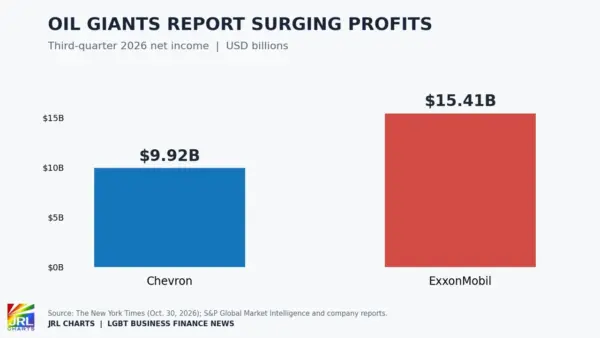
Chevron reported $9.92 billion in third-quarter 2026 profits, while ExxonMobil earned $15.41 billion, illustrating the earnings strength of America’s largest oil producers. Graphic: JRL CHARTS.
ExxonMobil reported $15.4 billion in quarterly earnings, with adjusted earnings reaching $17.5 billion. The company also generated $25.7 billion in operating cash flow, benefiting from strong refining margins and operational performance.
Chevron reported $9.9 billion in third-quarter profits, compared with approximately $3.5 billion during the corresponding quarter in 2025. Adjusted earnings reached $10.4 billion.
American refiners, including Valero and Phillips 66, have also benefited from tighter global refining capacity as military strikes and infrastructure disruptions constrain fuel production overseas.
Americans Face a $147 Billion Fuel Burden
While energy corporations celebrate soaring profits, American motorists are experiencing a very different financial reality.
Research from Brown University’s Climate Solutions Lab estimates that U.S. consumers have paid approximately $147 billion in additional gasoline and diesel costs since the Iran conflict began on February 28.
The financial pressure extends beyond filling a vehicle’s gas tank. Higher diesel costs increase transportation, shipping and distribution expenses, potentially pushing up prices across retail, food and other consumer industries.
According to AAA, the national average for regular gasoline stood at approximately $4.18 per gallon on October 31, remaining substantially above year-earlier levels.
Energy Prices Become a Midterm Election Flashpoint
The financial consequences are arriving at a politically sensitive moment for the Trump administration.
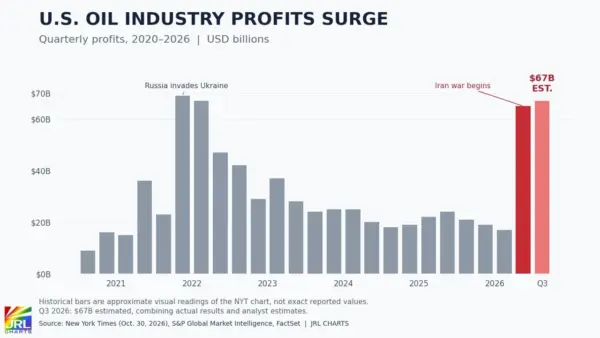
US oil industry profits surged during major geopolitical conflicts, with third-quarter 2026 earnings estimated at $67 billion. Historical figures are approximate. Graphic: JRL CHARTS, based on New York Times reporting and S&P Global Market Intelligence and FactSet data.
An October 29 Gallup survey found that 72% of registered voters consider gasoline prices either extremely or very important when deciding how to vote in the congressional midterm elections.
The survey separately found that 42% rated gasoline prices as extremely important, highlighting the issue’s significance alongside broader concerns about the economy, healthcare and the conflict with Iran.
For Republicans, the challenge is balancing support for domestic energy production with voter frustration over household expenses.
Although energy producers benefit from elevated commodity prices, prolonged inflation in transportation and consumer goods could weaken household purchasing power and complicate the broader economic outlook.
Wall Street’s Energy Boom Raises Bigger Questions
The earnings surge illustrates how geopolitical conflicts can produce sharply different outcomes across financial markets.
Energy companies with established production facilities and operational refining capacity can capture higher margins when global supplies tighten. Businesses dependent on transportation, manufacturing and distribution, however, face increased operating expenses.
For investors, the central question is whether elevated energy profits can continue as geopolitical conditions evolve.
For American consumers, the more immediate concern is whether gasoline, diesel and household expenses will return to more manageable levels.
The bottom line: America’s oil industry has emerged as a major financial beneficiary of the Iran war, but the broader economic and political costs are still unfolding.
Stay connected with JRL CHARTS LGBT Business Finance News for breaking financial market developments, corporate earnings, global energy trends and economic analysis impacting American businesses and consumers.

His reporting focuses on federal court rulings, legislative developments, international human rights issues, and government actions impacting LGBTQ communities worldwide.
With nearly two decades of experience, Goldberg is recognized for his balanced analysis, investigative insight, and commitment to accurate, fact-based journalism that informs readers on the political forces shaping equality and justice.