By Paul Goldberg — Senior Correspondent | Gay Adult Industry News
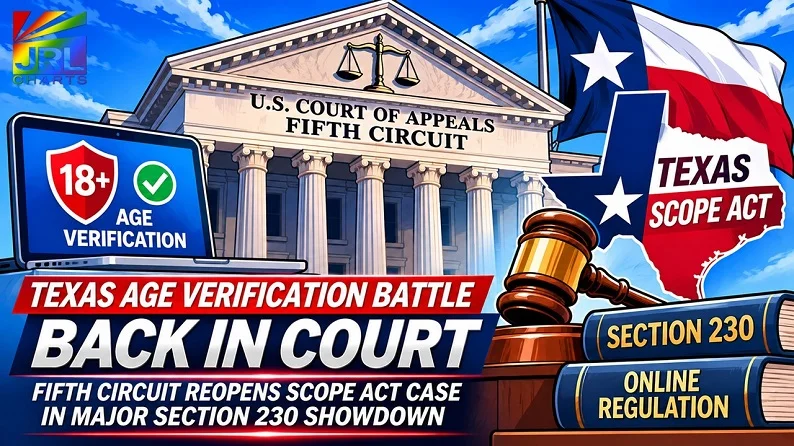
NEW ORLEANS, LA — (November 2, 2026) — A major legal battle over Texas’s online age-verification and child-protection regulations is heading back before the full U.S. Fifth Circuit Court of Appeals, reopening a dispute with potentially far-reaching consequences for digital platforms, content moderation and federal internet liability protections.
In an October 28 order, the federal appeals court granted rehearing en banc in two consolidated challenges to the Texas Securing Children Online Through Parental Empowerment (SCOPE) Act, also known as House Bill 18.
Trending LGBTQ News Coverage on JRL CHARTS:
• Breaking Military News involving LGBTQ Service Members and Security
• LGBT Politics Europe – Updates on Hate Crimes, Judicial Rulings
• Stay Up to Date on the Happenings in LGBT Politics Asia
• You Won’t Believe What Is Breaking Now on LGBTQ News
The decision vacates a July 24 appellate opinion that had found a central content-monitoring requirement of the Texas law preempted by Section 230 of the Communications Decency Act.
The latest order does not uphold or strike down the SCOPE Act. Instead, it sends the dispute back for reconsideration by the full appellate court.
Fifth Circuit Vacates July 2026 Section 230 Ruling
The consolidated litigation involves two legal challenges:
• Computer & Communications Industry Association and NetChoice v. Paxton
• Students Engaged in Advancing Texas v. Paxton
Both challenge provisions of Texas’s SCOPE Act, although the plaintiffs raise different objections involving online speech, age registration, content filtering and digital platform responsibilities.
In July, a three-judge Fifth Circuit panel concluded that the SCOPE Act’s monitoring-and-filtering provision conflicted with federal protections under Section 230.
The panel majority determined that the challenged requirement effectively regulated how covered platforms monitor and remove third-party content, conduct protected by federal law.
Judge James Ho disagreed with that conclusion, arguing that Texas was regulating platforms’ own content-curation decisions rather than imposing liability for third-party speech.
The October 28 order vacated the panel opinion and directed that the dispute receive additional consideration.
A new oral argument date has not yet been announced.
What Is the Texas SCOPE Act?
Enacted in 2023, the SCOPE Act establishes requirements for certain digital services operating in Texas, particularly platforms used by minors.
Its provisions address age registration, parental controls, personal data protections, targeted advertising and content considered harmful to minors.
The law applies to qualifying digital services that allow users to create profiles, interact socially and publish content accessible to others.
That definition can encompass various social media services and user-generated content platforms.
The legislation also contains provisions concerning age verification for services whose content is predominantly obscene.
Texas officials argue that these measures are necessary to protect minors from harmful online material and potentially exploitative digital practices.
Opponents contend that some provisions impose unconstitutional restrictions on protected expression and conflict with federal law.
Section 230 Takes Center Stage in Texas Legal Fight
At the center of the dispute is Section 230 of the Communications Decency Act, a federal statute that generally protects qualifying online services from being treated as the publisher or speaker of content supplied by third parties.
Section 230 has helped shape the legal framework governing social media networks, online forums, discussion platforms and user-generated content services.
However, those protections are not unlimited.
The Texas litigation raises an important question: When a state requires platforms to monitor and filter content, is it regulating the platforms’ own conduct, or imposing obligations that federal law preempts?
The July appellate majority accepted the latter interpretation for the challenged monitoring-and-filtering provision.
The full Fifth Circuit will now reconsider the legal arguments.
Its eventual decision could influence how similar online safety laws are interpreted within the circuit and potentially beyond it.
How the SCOPE Act Differs From Texas’s Adult Website Age Verification Law
For adult entertainment businesses, distinguishing the SCOPE Act from Texas House Bill 1181 is essential.
HB 1181 specifically requires covered commercial websites publishing sexual material harmful to minors to verify that visitors are at least 18 years old.
That legislation became the subject of a separate Supreme Court battle involving the Free Speech Coalition and adult industry businesses.
On June 27, 2025, the Supreme Court upheld HB 1181 in Free Speech Coalition v. Paxton, concluding that its age-verification requirements satisfied intermediate constitutional scrutiny.
The SCOPE Act litigation involves different statutory provisions and legal questions, including Section 230 preemption and restrictions affecting social platforms.
The Fifth Circuit’s latest order does not overturn the Supreme Court’s decision upholding HB 1181.
What the Rehearing Could Mean for Adult Industry Businesses
Although the SCOPE Act is not exclusively directed at adult entertainment websites, its interpretation may carry broader implications for businesses operating digital platforms.
Adult industry publishers, membership communities, content-sharing services and other online businesses already face increasingly complex compliance considerations involving age verification, privacy and content moderation.
Depending on a company’s services and whether a particular law applies, those considerations can include:
- Compliance costs: Additional spending on legal review, age-assurance technology and platform safeguards.
- Content moderation: Potential changes to how platforms evaluate and restrict user-generated material.
- Consumer privacy: Questions about collecting, retaining and protecting age-related information.
- Advertising operations: Restrictions affecting targeted advertising and services involving minors.
- Legal exposure: Uncertainty surrounding the relationship between state regulations and federal platform protections.
These are potential business implications, not new obligations created by the October 28 court order.
For adult industry operators, the key issue is whether future decisions clarify or further complicate the regulatory environment governing online publishing and digital commerce.
The Financial Stakes of Online Age Verification
The business implications extend beyond adult entertainment.
Social media companies, technology providers, online publishers and digital advertising businesses must evaluate the financial impact of evolving state-level regulations.
Different requirements across multiple jurisdictions can create additional operational expenses and complicate the design of nationwide digital services.
Age-assurance vendors, identity verification providers and compliance technology companies may also see changing demand as online safety legislation develops.
However, the Fifth Circuit has not issued a new substantive ruling, and any future commercial impact remains uncertain.
For now, companies must distinguish existing enforceable obligations from proposals, contested provisions and court orders still subject to further proceedings.
What Happens Next in the Fifth Circuit?
The Fifth Circuit has directed that supplemental briefing be scheduled and that the consolidated cases return for oral argument before the en banc court.
The judges will reconsider the disputed legal issues, including the relationship between Texas’s online safety requirements and federal Section 230 protections.
The rehearing also leaves unresolved questions involving First Amendment rights, platform responsibilities and the appropriate scope of state regulation.
No final decision on the merits has been issued through the October 28 order.
For digital publishers and adult industry businesses monitoring age-verification developments, the next appellate ruling could become an important part of the evolving legal framework for online operations.
JRL CHARTS Gay Adult Industry News and LGBT Business Finance News will continue tracking the Fifth Circuit’s Texas SCOPE Act litigation, Section 230 developments, age-verification regulations and their implications for digital publishers, adult entertainment businesses and online commerce.
His reporting focuses on federal court rulings, legislative developments, international human rights issues, and government actions impacting LGBTQ communities worldwide.
With nearly two decades of experience, Goldberg is recognized for his balanced analysis, investigative insight, and commitment to accurate, fact-based journalism that informs readers on the political forces shaping equality and justice.
- Texas Age Verification Battle Explodes Again as Fifth Circuit Reopens Section 230 Showdown - November 2, 2026
- Missouri Gay Dating App Ambush: 5 Attackers, 1 Victim — Teen Charged in Hate Crime - November 2, 2026
- Google’s AI Gamble: Can Gemini Save Search Without Destroying Its Cash Machine? - November 2, 2026