By Paul Goldberg — Senior Correspondent | LGBT Politics USA
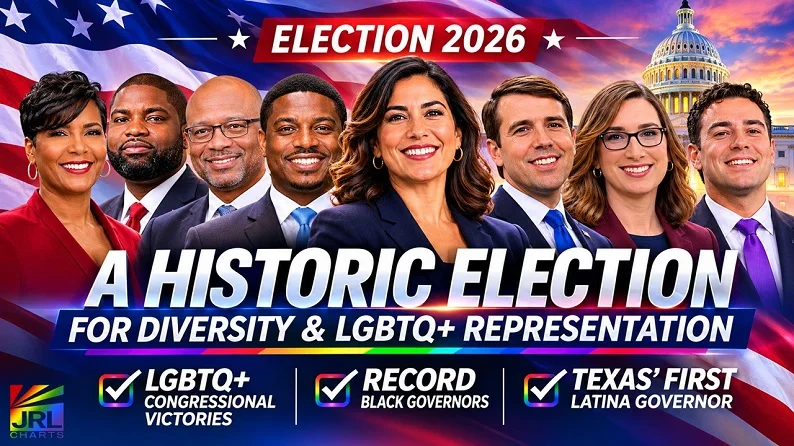
WASHINGTON, D.C. — (November 4, 2026) — America’s 2026 midterm elections delivered far more than a change in congressional leadership. Voters elected groundbreaking LGBTQ+ candidates, shattered longstanding barriers to gubernatorial office and shifted the balance of power across state governments.
Democrats secured majorities in both chambers of Congress, while historic victories in Georgia, Texas, Nevada, Wisconsin and other states reshaped the nation’s political leadership.
Trending International LGBTQ News on JRL CHARTS:
• Breaking Military News involving LGBTQ Service Members and Security
• LGBT Politics Europe – Updates on Hate Crimes, Judicial Rulings
• Stay Up to Date on the Happenings in LGBT Politics Asia
• You Won’t Believe What Is Breaking Now on LGBTQ News
But one of the election’s most consequential developments occurred beyond Washington: Democratic candidates gained control of legislative chambers and statewide offices that determine how laws are written, elections are administered and state governments operate.
Chris Pappas — New Hampshire
Pappas became the first openly gay man elected to the United States Senate, defeating former Republican Sen. John Sununu. His victory marked a milestone for LGBTQ+ representation in the upper chamber.
Sarah McBride — Delaware
McBride, the first openly transgender member of Congress, won reelection to the U.S. House, continuing her historic service.
JD Ford — Indiana
Ford defeated Republican incumbent Victoria Spartz, becoming Indiana’s first openly gay member of Congress.
LGBTQ+ Election Victories Make History Across America
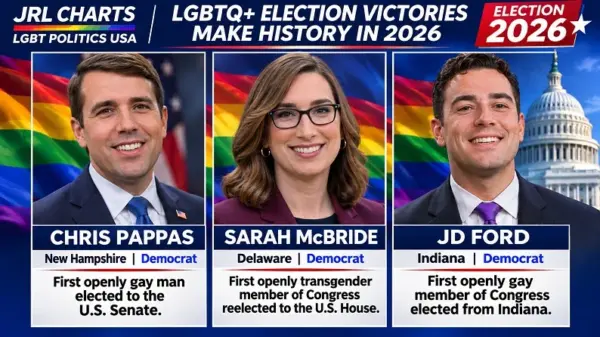
Chris Pappas of New Hampshire, Sarah McBride of Delaware and JD Ford of Indiana highlight historic LGBTQ+ congressional victories in the 2026 midterm elections.
Other newly elected LGBTQ+ members of Congress include Jeremy Moss of Michigan, JoAnna Mendoza of Arizona, Marni von Wilpert of California and Cait Conley of New York.
Returning openly LGBTQ+ House members include Sharice Davids, Ritchie Torres, Mark Pocan, Eric Sorensen, Emily Randall, Robert Garcia, Mark Takano and Becca Balint.
LGBTQ+ victories reach governors’ offices and state legislatures
Two openly lesbian governors won reelection: Maura Healey in Massachusetts and Tina Kotek in Oregon.
In state legislatures, voters elected or reelected numerous openly LGBTQ+ candidates, including:
-
Allison Montgomery — Alabama’s first openly transgender state legislator.
-
Bentley Hudgins — Georgia’s first openly transgender and nonbinary state lawmaker.
-
Jaelynn Scott — Washington’s first openly Black transgender woman elected to its state House.
-
Joanna Whaley — openly transgender Michigan state legislator.
-
Zooey Zephyr — reelected in Montana.
-
Malcolm Kenyatta — reelected in Pennsylvania.
-
Ann Johnson — reelected in Texas.
-
DeShanna Neal and Claire Snyder-Hall — reelected in Delaware.
Rhode Island also elected Kim Ahern as attorney general, making her the state’s first openly LGBTQ+ statewide elected official.
These are documented election winners, not a certified nationwide count of every openly LGBTQ+ candidate elected in 2026. Additional local and legislative results remain subject to verification.
Four Black Governors-Elect Mark an Extraordinary Moment in U.S. History
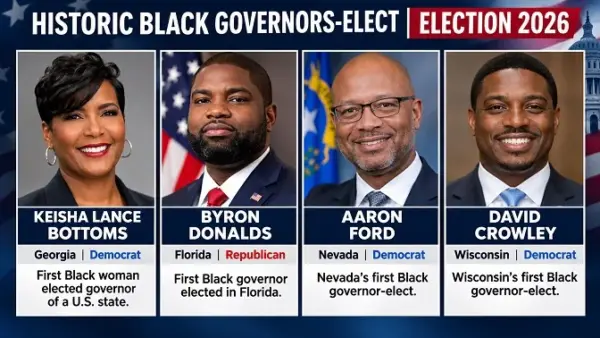
Keisha Lance Bottoms, Byron Donalds, Aaron Ford and David Crowley make gubernatorial history in Georgia, Florida, Nevada and Wisconsin.
These four historic winners join Maryland’s incumbent Democratic Gov. Wes Moore, who was not up for election in 2026. Assuming all take office as scheduled, the United States will have five simultaneously serving Black governors in January 2027, an unprecedented level of representation.
The distinction is important: four Black governors were elected on November 3; the fifth, Moore, is already serving.
Texas Elects Its First Latina Governor
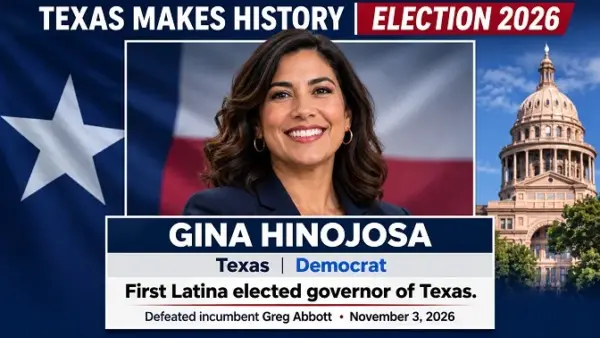
Democrat Gina Hinojosa makes history as Texas’ first Latina governor-elect following her November 3, 2026 victory.
Other gubernatorial milestones included Deb Haaland becoming the first Native American woman elected governor, in New Mexico, and Xavier Becerra becoming California’s first elected Latino governor.
The Overlooked Story: Democrats Didn’t Just Win Governorships — They Won State Governments
The November 3 results produced major changes in the balance of state power.
In American politics, a state government trifecta occurs when one party controls the governor’s office and both chambers of the state legislature. That arrangement gives the governing party greater ability to enact legislation, although courts, constitutional limits and internal disagreements still constrain its authority.
The statehouse power shift
States gaining Democratic trifecta control
- Michigan – Jocelyn Benson won the governorship as Democrats reclaimed legislative control.
- Minnesota – Democrats gained the state House, completing unified Democratic control.
- Pennsylvania – Democrats gained the state Senate, joining their control of the House and governor’s office.
- Wisconsin – David Crowley’s gubernatorial victory accompanied Democratic gains in both legislative chambers.
The changes extend Democratic influence beyond executive offices into state budgets, education, health care, election law and legislative agendas.
Four Republican trifectas broken
Georgia, Iowa, Ohio and Texas also experienced changes that ended Republican unified control.
However, breaking a Republican trifecta is not necessarily the same as creating a Democratic trifecta. Georgia and Texas, for example, also saw gains in statewide offices, but the precise legislative balance must be distinguished from full single-party control.
This difference is central to understanding what Democrats gained — and what remains divided.
Attorneys General and Secretaries of State: The Other Election Winners
The elections also shifted offices that often receive less national attention.
Democrats defeated Republican incumbents in secretary of state contests in Georgia, Indiana and Ohio, according to Reuters. Texas and Georgia elected a Democratic attorney general, changing which party controls offices responsible for significant state litigation and legal enforcement.
In Michigan, Democrat Garlin Gilchrist II won the secretary of state race, succeeding Jocelyn Benson as she moves to the governorship.
Wisconsin Attorney General Josh Kaul and Arizona Attorney General Kris Mayes also won reelection.
These offices matter because governors do not exercise all executive power alone. Secretaries of state frequently administer elections, while attorneys general shape litigation, consumer protection and the legal positions of state governments.
What the 2026 Results Mean for LGBTQ+ Americans
For LGBTQ+ communities, the election’s significance operates at two levels.
First, openly LGBTQ+ candidates will hold a broader range of federal and state offices, including historic firsts in the U.S. Senate, Congress and state legislatures.
Second, changes in state-government control may influence the direction of legislation concerning nondiscrimination, public education, health care, employment and civil rights.
Those policy outcomes are not automatic. They will depend on legislation introduced, votes taken, governors’ decisions, litigation and the final composition of individual state governments.
The 2026 election nevertheless marks a consequential change in American political representation and governing power — from Capitol Hill to state capitols.
JRL CHARTS LGBT Politics USA will continue tracking the incoming 2027 administrations, LGBTQ+ elected officials and changes in state legislative control as outstanding election results are finalized.

His reporting focuses on federal court rulings, legislative developments, international human rights issues, and government actions impacting LGBTQ communities worldwide.
With nearly two decades of experience, Goldberg is recognized for his balanced analysis, investigative insight, and commitment to accurate, fact-based journalism that informs readers on the political forces shaping equality and justice.
- Democrats’ 2026 Blue Tsunami Rewrites History: Gay Leaders Win, Black Governors Break Barriers and Statehouses Flip - November 4, 2026
- Texas Age Verification Battle Explodes Again as Fifth Circuit Reopens Section 230 Showdown - November 2, 2026
- Missouri Gay Dating App Ambush: 5 Attackers, 1 Victim — Teen Charged in Hate Crime - November 2, 2026