By: Paul Goldberg — Senior Correspondent | LGBT Business Finance News
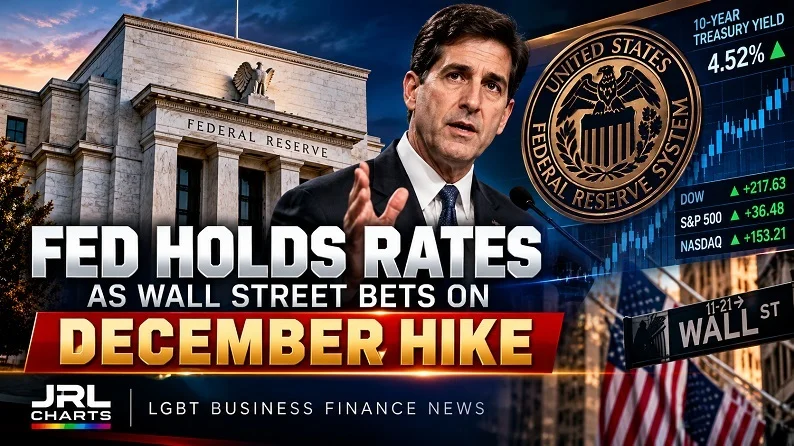
WASHINGTON, D.C. — (October 28, 2026) — The Federal Reserve kept its benchmark interest rate unchanged Wednesday, maintaining its target range of 3.75% to 4.00% as policymakers weigh persistent inflation against continued strength in the U.S. economy.
The decision, approved by a 10–2 vote of the Federal Open Market Committee (FOMC), follows September’s quarter-point rate increase. While the pause was widely anticipated, financial markets are increasingly focused on the possibility of another rate hike in December.
Trending LGBTQ Business and Politics News on JRL CHARTS:
• Stocks Up 12%, Bonds Under Pressure — Morningstar Reveals Wall Street’s Growing Divide
• American Express Profits Surge 28% — Then Comes the 3,500 Job Cut Bombshell
• Jamie Dimon Sounds the Alarm: 5 Economic Threats That Could Shake America
• Oil Prices Explode to $117 a Barrel as Iran War Sends Shockwaves Through U.S. Economy
• LGBTQ Nonprofit Makes $3 Million Move to Transform Downtown Buffalo
• Breaking Now on LGBT Business Finance News
Federal Reserve Divided Over Inflation Risks
Two policymakers — Federal Reserve Governor Lisa Cook and Cleveland Fed President Beth Hammack — opposed Wednesday’s decision, favoring an immediate quarter-point increase.
The central bank characterized economic activity as expanding at a strong pace, supported by resilient consumer spending, robust capital investment and stable employment conditions.
However, inflation remains above the Fed’s long-term 2% target, leaving policymakers reluctant to declare victory over rising consumer prices.
The Federal Reserve’s official statement emphasized that additional economic information will determine the appropriate path for monetary policy.
Wall Street Eyes December Rate Hike
Despite Wednesday’s pause, financial markets are positioning for further monetary tightening.
According to CME FedWatch figures reported Wednesday, approximately 77.9% of interest-rate traders were pricing in a quarter-point increase in December, potentially lifting the benchmark range to 4.00%–4.25%.
Goldman Sachs Asset Management and other financial institutions also anticipate additional tightening as inflationary pressures persist.
Treasury yields remained elevated following the announcement, reflecting continued uncertainty over borrowing costs and the direction of U.S. monetary policy.
Fed Chair Kevin Warsh Addresses Wall Street Concerns
Federal Reserve Chairman Kevin Warsh defended the central bank’s decision during Wednesday afternoon’s press conference, emphasizing the importance of reviewing incoming economic data before making another policy adjustment.
Warsh also rejected suggestions that the upcoming November midterm elections influenced the decision, maintaining that political considerations played no role in the committee’s deliberations.
The chairman stressed that the Federal Reserve remains committed to price stability while avoiding unnecessary damage to economic growth and employment.
What the Fed’s Decision Means for American Businesses
For retailers, small businesses and consumers, the decision offers temporary stability rather than immediate financial relief.
Elevated borrowing costs continue to affect commercial financing, business expansion, credit cards and consumer purchasing power. Higher energy and transportation expenses also remain important inflationary pressures for companies operating across the United States.
Businesses planning inventory purchases, capital investments or financing arrangements may now face another period of uncertainty as financial markets await December’s decision.
The Bottom Line: The Federal Reserve may have paused in October, but the battle against inflation is far from over. With Wall Street anticipating another possible increase, December could become a defining moment for U.S. borrowing costs heading into 2027.
Stay with JRL CHARTS LGBT Business Finance News for continuing coverage of Federal Reserve policy, Wall Street developments, inflation and the economic decisions shaping American business.
His reporting focuses on federal court rulings, legislative developments, international human rights issues, and government actions impacting LGBTQ communities worldwide.
With nearly two decades of experience, Goldberg is recognized for his balanced analysis, investigative insight, and commitment to accurate, fact-based journalism that informs readers on the political forces shaping equality and justice.
- Fed Holds Rates at 4% as Wall Street Bets on December Hike - October 28, 2026
- Stocks Up 12%, Bonds Under Pressure — Morningstar Reveals Wall Street’s Growing Divide - October 26, 2026
- American Express Profits Surge 28% — Then Comes the 3,500 Job Cut Bombshell - October 26, 2026