By: Paul Goldberg – Senior Correspondent | LGBT Politics USA
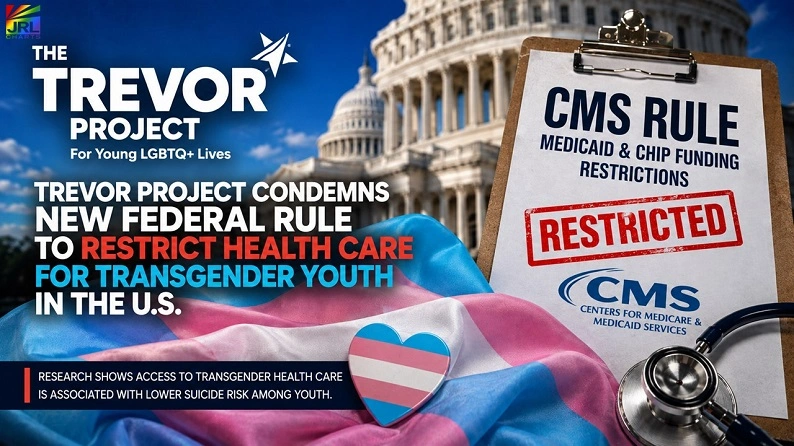
WASHINGTON, D.C. — (August 11, 2026) — The Trump administration has finalized a major new federal restriction on Medicaid and Children’s Health Insurance Program funding for certain transgender health care provided to minors, drawing immediate condemnation from The Trevor Project and setting the stage for another battle over federal transgender policy.
The Centers for Medicare & Medicaid Services (CMS) announced the final rule Tuesday, restricting the use of federal Medicaid and CHIP dollars for specified medical treatments for transgender young people. The policy is scheduled to begin taking effect in October 2026.
Now Trending on Transgender News on JRL CHARTS:
• Judge Hands Trump Major Win in Minnesota Transgender Title IX Battle
• Trump Cuts Medicare Drug Subsidies—LGBTQ Seniors Could Pay More
• Did the Pentagon Force Scouting America to Change Its Transgender Policy?
• Federal Judge Delivers Major Blow to DOJ Effort Targeting Transgender Youth Care
• Millions of Working Americans Are Going Hungry—and Nobody Is Talking About It
• Review More in LGBTQ Politics News Exclusively on JRL CHARTS
The rule represents another significant move by the Trump administration to reshape federal policy governing transgender health care. However, its reach is more limited than a nationwide prohibition: the policy restricts federal Medicaid and CHIP reimbursement rather than making transgender health care for minors illegal nationwide.
States could potentially continue financing affected services using their own funds, and hospitals are not categorically prohibited by this particular rule from providing the care.
The Trevor Project Condemns New CMS Rule
The Trevor Project responded shortly after the rule was announced, calling the policy a dangerous restriction on medical care and promising to work with partner organizations to challenge its implementation.
Rodrigo Heng-Lehtinen, Senior Vice President of Public Engagement Campaigns at The Trevor Project, said more than 35,000 public comments had been submitted after the rule was initially proposed in December.
“This rule is a dangerous restriction on doctor-prescribed health care,” Heng-Lehtinen said.
He argued that medical decisions involving transgender and nonbinary young people should remain between patients, physicians and families rather than being determined through a broad federal mandate.
“Personal medical decisions should be made by individual patients, their doctors, and their families – not by a one-size-fits-all mandate from the federal government,” Heng-Lehtinen said.
The organization also emphasized that the release of a final rule does not mean access will disappear immediately.
“Despite this being called a ‘final rule,’ we have time to fight back,” Heng-Lehtinen said.
What the New Federal Rule Actually Does
The distinction between restricting federal funding and imposing a nationwide ban is significant.
The new CMS policy targets federal Medicaid and CHIP reimbursement for specified treatments for minors. It does not, by itself, establish a nationwide criminal or civil prohibition against hospitals or medical providers offering transgender-related health services.
That distinction could become particularly important in states that have laws protecting access to transgender health care and may consider using state funding to maintain services previously supported through federal Medicaid dollars.
The policy therefore potentially creates a new state-by-state divide: states opposed to such care could embrace the federal funding restriction, while states supporting access may face decisions about whether to replace lost federal dollars with their own resources.
The final rule also follows months of controversy surrounding broader administration proposals aimed at transgender youth health care.
Mental Health Research Becomes Central to Debate
The Trevor Project is pointing to its research on transgender and nonbinary young people’s mental health as part of its opposition to the federal policy.
Its 2025 U.S. National Survey on the Mental Health of LGBTQ+ Young People found that 40% of transgender and nonbinary young people surveyed seriously considered attempting suicide during the previous year.
The survey additionally found that transgender and nonbinary respondents who wanted but were unable to access hormones were nearly twice as likely to report a past-year suicide attempt as respondents currently receiving hormones.
Among transgender and nonbinary young people who reported receiving hormones, 87% said they were concerned about losing access.
The organization has also cited a peer-reviewed 2022 study published in the Journal of Adolescent Health that found access to gender-affirming hormone therapy was associated with lower reported rates of depression and suicidality among transgender and nonbinary young people.
Those findings concern statistical associations and do not by themselves establish that any individual treatment will produce a particular mental-health outcome. They nevertheless form an important part of the research The Trevor Project is using to oppose restrictions on access.
Trump Administration Moves Forward With Transgender Health Policy
The administration has defended its broader efforts to restrict federally supported medical transition treatments for minors, arguing that federal programs should not finance interventions it considers inappropriate for children.
The issue has become one of the most consequential fronts in the administration’s transgender policy agenda, involving questions about federal spending authority, state Medicaid programs, parental decision-making and the government’s role in regulating medical treatment.
The final CMS rule also creates a potentially significant financial question for states.
Medicaid is jointly funded by federal and state governments. States that choose to maintain coverage affected by the new restriction could therefore face pressure to finance those services without the federal Medicaid contribution previously available for them.
Legal and Political Battle May Be Far From Over
Finalizing the regulation does not necessarily end the dispute.
The Trevor Project said it plans to continue working with partner organizations and allies around the country to oppose the rule. Other LGBTQ+ civil-rights and health organizations are also expected to scrutinize its legal and regulatory implications.
The policy arrives amid an already fragmented national landscape in which transgender health care for minors can vary dramatically depending on the state.
That means the practical impact of the CMS rule may ultimately depend not only on what happens in Washington, but also on how individual states respond — and whether forthcoming legal challenges delay, modify or prevent parts of the policy from taking effect.
For transgender and nonbinary young people currently receiving care through Medicaid or CHIP, October now becomes a particularly important deadline to watch.
Sources / Research Footnotes
[1] The Trevor Project — “The Trevor Project Condemns New Federal Rule to Restrict Health Care for Transgender Youth in the U.S.” — August 11, 2026
Official statement from The Trevor Project responding to the finalized federal rule, including Rodrigo Heng-Lehtinen’s statement and clarification regarding the scope and implementation of the rule.
[2] Centers for Medicare & Medicaid Services (CMS) — Official Federal Health Policy Information
Primary federal source for Medicaid, CHIP and CMS regulatory policy.
[3] The Trevor Project — 2025 U.S. National Survey on the Mental Health of LGBTQ+ Young People
National survey examining mental health, suicide risk, discrimination and access to care among LGBTQ+ young people, including transgender and nonbinary youth.
[4] Journal of Adolescent Health — “Association of Gender-Affirming Hormone Therapy With Depression, Thoughts of Suicide, and Attempted Suicide Among Transgender and Nonbinary Youth”
Peer-reviewed 2022 research cited by The Trevor Project examining associations between access to gender-affirming hormone therapy and depression and suicidality among transgender and nonbinary young people.
JRL CHARTS LGBT Politics USA will continue tracking the Trump administration’s transgender health policies, federal court challenges and state responses as the battle over Medicaid funding and access to transgender youth health care develops.
His reporting focuses on federal court rulings, legislative developments, international human rights issues, and government actions impacting LGBTQ communities worldwide.
With nearly two decades of experience, Goldberg is recognized for his balanced analysis, investigative insight, and commitment to accurate, fact-based journalism that informs readers on the political forces shaping equality and justice.
- Taipei Gay Bar Raid Sparks Outrage as Police Face LGBTQ Backlash - October 11, 2026
- LGBTQ Voters Are Fired Up for the 2026 Midterms — HRC Survey Reveals 87% Plan to Vote - October 11, 2026
- OnlyFans and MYM Escape Sweeping French Crackdown After Parliament Showdown - October 8, 2026