By: Paul Goldberg – Senior Correspondent | LGBT Politics USA News
LAS VEGAS — (May 1, 2026) — In courtrooms across the United States, a growing number of legal analysts, civil rights advocates, and constitutional scholars are raising the same alarm: America’s judiciary is undergoing a profound ideological shift.
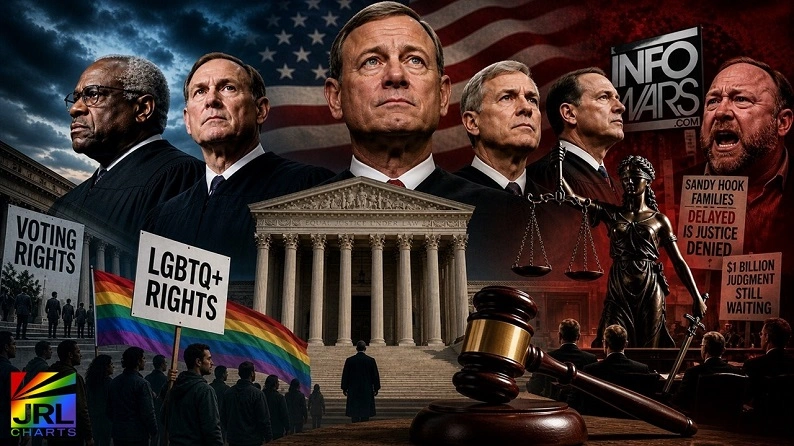
From the delayed enforcement of judgments in the Alex Jones InfoWars case to sweeping Supreme Court rulings on voting rights, executive power, and LGBTQ protections, critics argue that conservative courts are not merely interpreting the law — they are actively reshaping it.
Related LGBT Politics News on JRL CHARTS:
• Trump Inflation Approval Ratings Collapse, Pollster Says Data “Broke the Scale”
• Trump FY2027 Budget Proposal Draws Criticism Over LGBTQ+ Program Cuts
• Tennessee Passes “Charlie Kirk Act” Targeting Campus Protests Over Anti-LGBTQ+ Speakers
• Project 2025 Already 50% Complete: Inside Trump’s Plan Reshaping America
• U.S. Banking Rule Ends ‘Reputational Risk’ Barrier, Expands Access for Legal Businesses
• LGBTQ Corporate Participation Plunges 65% in 2026 as DEI Retreat Reshapes Business Landscape
InfoWars and the Question of Delayed Justice
The ongoing legal battle surrounding Alex Jones and the attempted sale of InfoWars has become a flashpoint in that debate. After being ordered to pay more than $1 billion to Sandy Hook victims’ families, efforts to liquidate his media empire — including a proposed transfer to The Onion — have faced repeated delays through appellate intervention.
Critics argue that such delays raise serious concerns about whether powerful defendants are able to extend legal proceedings indefinitely through procedural maneuvering. Supporters of the appellate process counter that such reviews are a fundamental safeguard of due process. But for many observers, the case has come to symbolize a broader tension between justice delivered and justice deferred.
The latest baseless delay took place on April 29 when the conservative packed Texas Third Court of Appeals temporarily blocked the sale of Alex Jones’s Infowars platform to the satirical news site The Onion, pausing a deal intended to pay off defamation judgments to the families of Sandy Hook Elementary School shooting victims. Once again stalling the handover of assets to a court-appointed receiver, effectively pausing the deal with The Onion.
The next steps in this delay has been set: The court-appointed receiver is now tasked with evaluating the next steps, with a new hearing set for May 28, 2026.
The Roberts Court Under Intensifying Scrutiny
At the center of the national conversation is John Roberts and the Supreme Court he leads. Long viewed as an institutionalist committed to protecting the Court’s legitimacy, Roberts now faces increasing criticism from scholars who argue that key rulings during his tenure have aligned with conservative legal priorities.
The most frequently cited example is Shelby County v. Holder, which struck down a central provision of the Voting Rights Act. Civil rights advocates argue that the decision weakened federal oversight of discriminatory voting practices, while supporters maintain it restored constitutional balance between federal and state authority.
This tension — between legal interpretation and perceived ideological outcome — continues to define debates around the Roberts Court.
The Rise of the 5th Circuit and Appellate Power
Nowhere is the judiciary’s ideological shift more visible than in the federal appellate courts, particularly the United States Court of Appeals for the Fifth Circuit.
Covering Texas, Louisiana, and Mississippi, the 5th Circuit has become one of the most influential courts in the country. Legal commentators have described it as a central battleground for national policy, with rulings on abortion, immigration, and federal regulatory authority frequently shaping outcomes across the United States.
Critics argue that the court’s increasingly conservative composition has positioned it as a powerful check on federal agencies and progressive policies. Supporters, however, contend that it is enforcing constitutional limits on government overreach.
A Decade-Long Strategy to Reshape the Courts
Behind this transformation, analysts point to a long-term, highly coordinated strategy to reshape the federal judiciary.
Reports from organizations like the American Constitution Society and major national publications have highlighted several key developments:
- The use of Senate control to slow or block judicial nominees during the Obama administration
- The elimination of filibusters for judicial appointments, accelerating confirmations
- Heavy reliance on organizations like the Federalist Society to vet candidates
- A record pace of appellate court appointments during the Trump presidency
- Significant financial backing from advocacy groups supporting conservative judicial nominees
According to multiple analyses, nearly one-quarter of the federal appellate bench was appointed during a single presidential term, fundamentally altering the ideological balance of the courts for decades to come.
The Shadow Docket and Expanding Judicial Power
Another growing point of concern is the Supreme Court’s use of its so-called “shadow docket” — emergency rulings issued without full briefing or oral argument.
Critics argue that this process allows the Court to make major policy decisions quickly and with limited transparency, affecting issues ranging from immigration enforcement to public health measures. Defenders of the practice note that emergency relief has long been part of the Court’s authority, though its frequency and impact have increased in recent years.
LGBTQ Rights and the Shift in Judicial Interpretation
The impact of these judicial shifts is particularly visible in cases involving LGBTQ rights.
While landmark decisions like Bostock v. Clayton County expanded workplace protections, more recent rulings have moved in a different direction, emphasizing religious freedom and First Amendment claims.
Key decisions include:
- Fulton v. City of Philadelphia, allowing a religious agency to decline working with same-sex couples
- 303 Creative LLC v. Elenis, affirming a designer’s right to refuse services for same-sex weddings
- United States v. Skrmetti, upholding restrictions on gender-affirming care for minors
In 2026, the Court also struck down a state-level ban on conversion therapy, ruling that restrictions on such practices violated First Amendment protections for counselors — a decision that drew sharp criticism from medical organizations and LGBTQ advocates.
At the lower court level, rulings on transgender participation in sports, restroom access, and school curricula have further reflected deep divisions over how constitutional protections should be applied.
Some justices, including Clarence Thomas, have also suggested reconsidering landmark precedents such as Obergefell v. Hodges and Lawrence v. Texas, raising additional concerns among civil rights groups.
Conclusion: A Judiciary at the Center of America’s Political Future
From the InfoWars case to voting rights, from appellate court rulings to LGBTQ protections, the role of the judiciary in American life is under intense scrutiny.
Supporters of recent decisions argue that courts are restoring constitutional limits and protecting fundamental freedoms such as religion and speech. Critics counter that the judiciary is increasingly functioning as a political actor, advancing a long-term ideological agenda that reshapes the law beyond the reach of voters.
What is clear is this: the courts are no longer just interpreting the rules of American democracy — they are helping define them.
Stay with JRL CHARTS LGBT Politics USA News for in-depth reporting on the courts, civil rights, and the legal battles shaping America’s future.
His reporting focuses on federal court rulings, legislative developments, international human rights issues, and government actions impacting LGBTQ communities worldwide.
With nearly two decades of experience, Goldberg is recognized for his balanced analysis, investigative insight, and commitment to accurate, fact-based journalism that informs readers on the political forces shaping equality and justice.