By: Paul Goldberg – Senior Correspondent | LGBT Politics Minneapolis
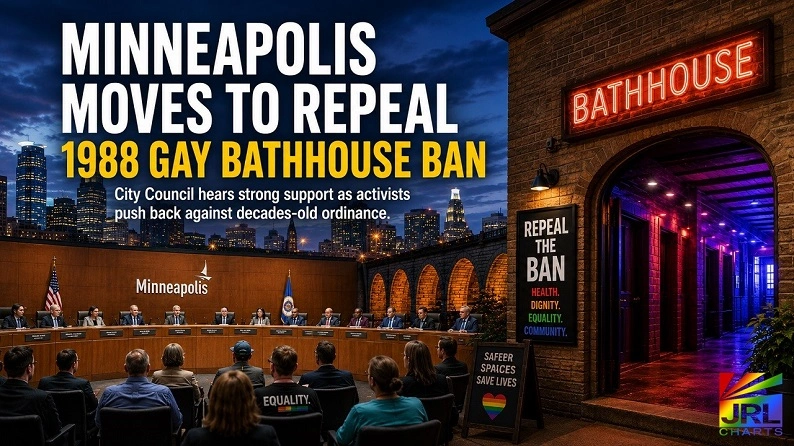
MINNEAPOLIS, MN — (June 19, 2026) — More than two months after Minneapolis officials began considering the legalization of regulated bathhouses, the debate returned to City Hall this week as supporters urged council members to repeal the city’s 1988 gay bathhouse ban.
The proposal has drawn backing from LGBTQ advocates, public health organizations and tourism supporters who argue the decades-old ordinance no longer reflects modern public health strategies or the realities of LGBTQ community spaces.
Now Trending on LGBT Business, Finance and Politics News on JRL CHARTS:
• Minneapolis Moves to Legalize Bathhouses Decades After AIDS Crisis Shutdown
• LGBTQ Consumers Shift Spending Away from Target, Walmart and Amazon
• Millions of Working Americans Are Going Hungry—and Nobody Is Talking About It
• LGBTQ Business Owners Join Growing Coalition Against Bank Account Closures
• China’s Rising Yuan Could Hit LGBTQ Businesses Worldwide
• Project 2025 Already 50% Complete: Inside Trump’s Plan Reshaping America
The Minneapolis City Council held its second public hearing on ordinances that would repeal the ban on venues where consenting adults can engage in sexual activity while establishing a new regulatory framework governing their operation.
Council members heard testimony from more than 30 residents, with many arguing that the law was enacted during a period of fear and uncertainty surrounding the HIV/AIDS epidemic and should be reevaluated through the lens of modern public health practices.
“Our task is not to eliminate places where people have sex but bring people out of the shadows where we can give them the tools that we have in place. Research has shown that pushing sexual activity into less visible spaces does not eliminate the risk. It makes outreach and education more difficult,” Aliveness Project researcher Jay Orne told council members.
Another LGBTQ activist, Patrick Scully, reflected on living through the period when the ordinance was originally adopted.
“I have lived most of my life criminalized and excluded by the system. Discrimination against me was legal until I was almost 40 years old in Minnesota. Sex was a crime in Minnesota until I was in my 50s. Marriage was not an option until I was in my 60s,” Scully said. “So don’t expect me to live my life like you live your life if you’re a heterosexual. You forced me to find other ways to live my life.”
Several speakers also pointed to the potential economic impact of repeal, arguing that regulated venues could strengthen Minneapolis’ appeal as an LGBTQ-friendly destination while creating opportunities for safer-sex education and outreach.
Though Minneapolis Mayor Jacob Frey has not identified the issue as a major legislative priority, he has indicated he would sign the repeal should it reach his desk following council approval.
Historical Legacy Remains Part of the Debate
While LGBTQ advocates are pushing to overturn the ordinance, discussion has also centered on the legacy of Brian Coyle, Minneapolis’ first openly gay city council member, who supported the original ban during the height of the AIDS crisis.
According to historical reporting, many LGBTQ leaders at the time viewed the restrictions as a public health response to an epidemic that was devastating communities across the country.
Council Member Jason Chavez, currently the council’s only openly LGBTQ member, rejected suggestions that repealing the ordinance would diminish Coyle’s legacy.
“I have deep respect for Brian Coyle, and I know when he did this vote it was because of an epidemic that was impacting my community,” Chavez said. “But, at the same time, there were folks who supported the efforts to ban this because of homophobia. Because they did not believe in the existence of LGBTQ+ people, and that can not be removed from history.”
Culture-War Politics Enter the Conversation
The Minneapolis debate is also unfolding as national political campaigns begin ramping up ahead of the 2026 midterm elections, where LGBTQ-related issues have once again become a focal point of partisan messaging.
Several conservative media outlets have already framed the proposal as the latest example of what they describe as progressive social policies, while critics argue such coverage is designed to generate outrage and energize culture-war narratives aimed at LGBTQ communities. Supporters of repeal contend that these portrayals often ignore the public health, civil liberties and local governance issues at the center of the discussion, choosing instead to depict LGBTQ residents and their allies in a negative light.
Advocates say the controversy represents one of several recent examples where LGBTQ-related policy debates have become targets of election-year political messaging. They argue that while reasonable disagreements over public policy are expected, efforts to sensationalize issues involving LGBTQ communities frequently serve broader political objectives rather than encouraging informed discussion.
As Minneapolis prepares for a final vote, supporters maintain that the proposal is ultimately about updating a law enacted during one of the most difficult chapters of the HIV/AIDS epidemic. Opponents view the issue differently, citing concerns about community standards and public policy.
The Minneapolis City Council is expected to vote on the ordinance next week.
For continuing coverage of LGBTQ rights, public policy and the political debates shaping communities across America, follow JRL CHARTS LGBT Politics Minneapolis.
His reporting focuses on federal court rulings, legislative developments, international human rights issues, and government actions impacting LGBTQ communities worldwide.
With nearly two decades of experience, Goldberg is recognized for his balanced analysis, investigative insight, and commitment to accurate, fact-based journalism that informs readers on the political forces shaping equality and justice.
- Supreme Court Blocks Trump’s Transgender Prison Care Ban in Major Legal Setback - October 21, 2026
- UNC Settles 18 Trump Administration Probes as Race and DEI Rules Face New Scrutiny - October 19, 2026
- Catholic Relief Services Loses Major LGBTQ Benefits Battle in Federal Appeals Court - October 19, 2026