By: Paul Goldberg – Senior Correspondent | JRL CHARTS LGBT Business Finance News
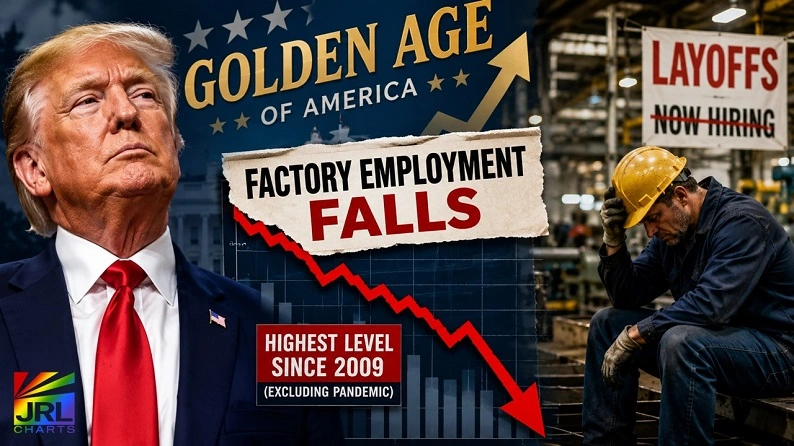
WASHINGTON, D.C. — (June 23, 2026) — President Donald Trump continues to promote what he calls America’s new “Golden Age,” but fresh economic data suggests that many manufacturers are becoming increasingly cautious as factory employment declines at a pace not seen since the aftermath of the Great Recession.
According to the latest S&P Global U.S. Flash PMI report, factory job cuts accelerated in June, reaching their highest levels since 2009 when pandemic-era disruptions are excluded. The report found that manufacturing employment fell for a second consecutive month as businesses focused on reducing costs amid elevated input prices and uncertainty surrounding future demand.
Now Trending on LGBT Business Finance News on JRL CHARTS:
• LGBTQ Consumers Shift Spending Away from Target, Walmart and Amazon
• Millions of Working Americans Are Going Hungry—and Nobody Is Talking About It
• LGBTQ Business Owners Join Growing Coalition Against Bank Account Closures
• China’s Rising Yuan Could Hit LGBTQ Businesses Worldwide
• Project 2025 Already 50% Complete: Inside Trump’s Plan Reshaping America
• U.S. Banking Rule Ends ‘Reputational Risk’ Barrier, Expands Access for Legal Businesses
• LGBTQ Corporate Participation Plunges 65% in 2026 as DEI Retreat Reshapes Business Landscape
The findings arrive at a time when the White House continues to highlight positive economic indicators and strong headline employment numbers. However, economists are warning that conditions within the manufacturing sector tell a more complicated story.
“Most worrying was the further fall in employment, notably in the manufacturing sector,” said Chris Williamson, Chief Business Economist at S&P Global Market Intelligence. “Factory job cuts are running at the highest since 2009 if the pandemic is excluded, reflecting concerns over the sustainability of the recent upturn in demand alongside worries over the escalating cost of raw materials.”
Manufacturing Sector Sends Warning Signals
While S&P Global’s manufacturing index rose to 55.7 in June, indicating expansion in factory activity, economists note that production growth may be receiving a temporary boost from inventory stockpiling and supply-chain concerns rather than long-term consumer demand.
Manufacturers surveyed by S&P Global cited rising operating costs, raw material inflation, and concerns over future business conditions as key reasons behind workforce reductions.
The report also found that supply delays continued to impact operations, while businesses remained concerned about the broader economic outlook heading into the second half of the year.
A Different Economic Environment
The latest manufacturing data highlights a markedly different economic environment than those experienced during much of the Obama and Biden administrations.
During the years following the 2008 financial crisis, manufacturing employment generally expanded alongside a broader economic recovery. Likewise, much of the post-pandemic recovery under President Joe Biden was characterized by historically low unemployment rates and strong job creation across multiple sectors of the economy.
Today’s economy presents a more mixed picture. While overall employment growth remains positive according to government data, businesses continue to face higher borrowing costs, lingering inflation pressures, trade uncertainty, and weaker consumer confidence than many economists would like to see.
These factors have contributed to growing caution among manufacturers despite continued expansion in certain areas of the economy.
Job Market Remains Resilient — For Now
Not all economic indicators point to weakness.
According to data from the U.S. Bureau of Labor Statistics, manufacturing employment has increased by approximately 23,000 jobs so far in 2026. CNBC also reports that the broader labor market has remained relatively resilient, posting strong employment gains in four of the first five months of the year.
Nevertheless, factory employment has historically served as an early indicator of economic slowdowns, making the latest manufacturing job losses particularly noteworthy.
“The service sector continues to grow at an especially subdued pace,” Williamson noted. “Reflecting push-back from customers over high prices amid low levels of consumer confidence in particular.”
Questions for the Second Half of 2026
Back in February, President Trump celebrated January’s jobs report, calling the employment gains “far greater than expected” and declaring that “The Golden Age of America is upon us.”
Four months later, the latest manufacturing data suggests that many employers remain unconvinced.
While the broader economy continues to grow, rising factory layoffs, elevated business costs, and concerns about future demand are creating a growing disconnect between political messaging and the challenges being reported by manufacturers on the ground.
As the second half of 2026 begins, investors, economists, and business leaders will be watching closely to determine whether the recent factory job losses represent a temporary adjustment—or an early warning sign of broader economic weakness ahead.
For the latest coverage of labor markets, economic policy, manufacturing trends, and business finance developments affecting LGBTQ professionals, entrepreneurs, and investors, stay connected with JRL CHARTS LGBT Business Finance News.

His reporting focuses on federal court rulings, legislative developments, international human rights issues, and government actions impacting LGBTQ communities worldwide.
With nearly two decades of experience, Goldberg is recognized for his balanced analysis, investigative insight, and commitment to accurate, fact-based journalism that informs readers on the political forces shaping equality and justice.