By: Paul Goldberg – Senior Correspondent | LGBT Business Finance News | LGBT Politics USA
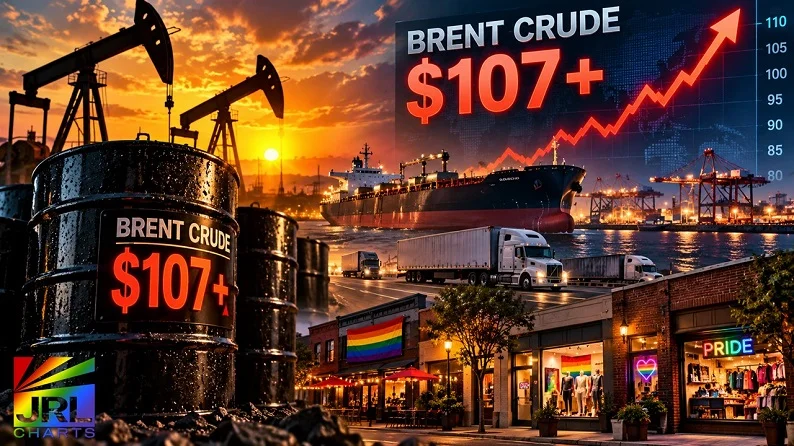
LAS VEGAS, NV — (September 24, 2026) — Something extraordinary happened in the global energy markets Thursday: Brent crude oil surged above $107 a barrel as renewed geopolitical tensions sent another shock through a world economy already wrestling with expensive fuel, inflation and elevated borrowing costs.
Yet anyone depending primarily on America’s political cable-news conversation could be forgiven for wondering where the urgency is.
Trending LGBTQ Business and Politics News on JRL CHARTS:
• UNT Deletes LGBTQ History Page After Texas Lawmaker Attack — But the Archive Isn’t Gone
• SC Holds Back Grants From Only Two Arts Groups — Both Are LGBTQ+
• Michigan Church Targets LGBTQ Acceptance in California With Massive 248-Page Complaint
• Southlake City Council Unanimously Rejects Permit for LGBTQ Pride Festival
• Texas A&M Slashes LGBTQ, Race and Climate Courses From Core Curriculum
• Review More in LGBTQ Business and Politics News on JRL CHARTS
Brent crude climbed as high as $107.18 a barrel on Sept. 24 before settling at $106.60, up 3.4% for the day, as renewed attacks involving Saudi Arabia and continuing uncertainty surrounding the Middle East pushed supply concerns back to the forefront.
For LGBTQ-owned businesses, retailers and consumers, $107 oil isn’t simply a number scrolling across the bottom of a financial television screen.
It can eventually become a freight bill, an airline ticket, an inventory surcharge, a more expensive delivery, another squeeze on household spending — and potentially another complication for interest rates and business financing.
Brent Crude Is Back Above $107
The latest oil surge followed renewed geopolitical developments involving Saudi Arabia and continuing uncertainty over U.S.-Iran diplomacy and energy flows through the Middle East.
The Strait of Hormuz remains particularly important because of the enormous amount of global petroleum that traditionally moves through the waterway.
The consequences aren’t limited to the price attached to a barrel of Brent.
Global oil markets must also contend with the increasingly expensive business of physically moving petroleum around disrupted supply routes. When transportation, insurance and logistical costs rise alongside the commodity itself, businesses farther down the supply chain can eventually feel the effects.
And that chain reaches much farther than oil companies.
$107 Oil Is an Inflation Story
For American businesses, one of the most important consequences of expensive crude is what happens after the barrel leaves the oil market.
Diesel powers much of the country’s commercial transportation network. Trucks deliver merchandise to stores, food to restaurants, supplies to warehouses and products from distributors to independent retailers.
When transportation becomes substantially more expensive, somebody eventually has to absorb the additional cost.
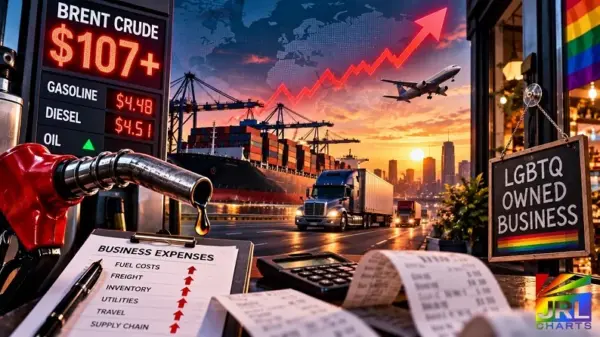
Brent crude above $107 can ripple through the economy as higher fuel, freight, inventory and transportation expenses put additional pressure on small and LGBTQ-owned businesses. | JRL CHARTS LGBT Business Finance News
Sometimes that’s the carrier.
Sometimes it’s the manufacturer or distributor.
Sometimes it’s the retailer.
And sometimes it reaches the consumer through higher prices.
The United States is already experiencing extraordinary diesel-market pressure. Record diesel prices have become a concern for transportation and other industries heavily dependent on commercial fuel, increasing fears that elevated transportation costs could feed broader inflation.
That matters because another persistent inflationary impulse could complicate the outlook for interest rates.
Oil therefore doesn’t have to reach $150 or $200 a barrel to become an economic problem. Remaining above $100 for an extended period can itself change business calculations.
So Why Isn’t $107 Brent Dominating Cable News?
That’s the question JRL CHARTS believes deserves asking.
This isn’t a claim that American news organizations have completely ignored energy prices.
Financial news organizations, wire services and business publications have been reporting extensively on crude oil, diesel, inflation and the consequences of the Middle East conflict.
CNN and other mainstream organizations have also reported on the broader energy and inflation story.
But the prominence of Brent crude returning above $107 a barrel has not necessarily matched the magnitude of the economic consequences potentially attached to it across the broader cable-news conversation.
During JRL CHARTS monitoring of television coverage Thursday, the Brent price was visible on Bloomberg’s market ticker while other subjects commanded the discussion.
That doesn’t mean Bloomberg or other television networks haven’t reported on oil elsewhere during the day.
It does illustrate something increasingly strange about this energy crisis: one of the world’s most economically consequential commodities can sit above $100 a barrel — and even cross $107 — without necessarily becoming the dominant television story that consumers might expect.
The financial markets aren’t treating oil as background noise.
Investors are watching the relationship between energy prices, inflation expectations, Treasury yields and future monetary policy closely.
Small businesses don’t have the luxury of treating it as background noise either.
LGBTQ-Owned Businesses Aren’t Insulated From the Oil Shock
There is a legitimate LGBTQ business dimension to this story.
According to the Federal Reserve’s Small Business Credit Survey, approximately 6% of small employer businesses are at least partially owned by someone who identifies as LGBTQ.
Those businesses operate in the same economy and encounter many of the same energy-sensitive costs as every other company.
Think about an LGBTQ-owned independent retailer receiving merchandise from a distributor.
Or an LGBTQ bar receiving regular deliveries.
Or a Pride merchandise company importing products.
Or an independent fashion brand shipping orders around the country.
Or an LGBTQ travel company confronting more expensive transportation.
Or an adult retailer receiving cartons of products from manufacturers and distributors.
None of those companies needs to purchase a barrel of Brent crude for the oil market to reach its balance sheet.
Transportation connects them to it.
Packaging can connect them to it.
Petrochemical-derived materials can connect some products to it.
Business travel connects them to it.
And perhaps most importantly, their customers’ wallets connect them to it.
Small Businesses Were Already Feeling the Fuel Squeeze
There is evidence that fuel costs were pressuring small companies even before Thursday’s latest surge.
Bank of America Institute reported that gasoline spending per small-business client jumped nearly 31% year over year in April 2026, while small-business profitability declined 1.3% year over year, its weakest reading in two years.
An earlier April report found gasoline spending per small-business client had already risen 23% year over year in March, with higher fuel expenses spilling into freight, fertilizer and inventory costs.
Conditions have subsequently improved in some measures. Bank of America’s September Business Checkpoint found stronger profitability growth among small businesses during August.
But $107 Brent introduces another variable.
If elevated crude and diesel prices persist, businesses that have only recently seen improving margins could once again face pressure from transportation and other energy-sensitive expenses.
The Consumer Is the Other Half of the Equation
The business consequences don’t stop at operating expenses.
Higher fuel costs can also reduce the amount of discretionary money consumers have available.
Every additional dollar going into a fuel tank, utility payment or airline ticket is a dollar that potentially isn’t going toward restaurants, nightlife, apparel, entertainment, travel, wellness products or discretionary retail purchases.
Those categories matter enormously to many businesses serving LGBTQ consumers.
That means a prolonged energy shock can hit a company from both directions:
higher operating costs on one side and a more financially cautious customer on the other.
For smaller independent businesses without the purchasing power or margins of national corporations, that combination can be particularly difficult.
Oil Could Complicate the Interest-Rate Story Too
Then comes the financial-market consequence.
Persistently expensive energy can contribute to inflation directly through gasoline, diesel and transportation and indirectly through the cost of moving goods throughout the economy.
If inflation remains stubborn, policymakers have less room to ease monetary conditions.
For small businesses, interest rates aren’t an abstract Wall Street subject either.
They affect credit cards, business loans, lines of credit, equipment financing and the cost of borrowing money to expand.
That creates a potentially ugly chain reaction:
Higher oil → higher transportation costs → inflation pressure → higher-for-longer borrowing costs → tighter business margins.
Not every link in that chain is automatic, and oil prices can reverse quickly. Geopolitical developments, production changes, demand expectations and diplomacy can send crude sharply lower as easily as they can drive it higher.
But at $107 a barrel, dismissing the risk becomes increasingly difficult.
The Number on the Ticker Matters
Cable news doesn’t determine the price of Brent crude.
Nor does the amount of television coverage determine whether Thursday’s oil surge becomes a lasting economic shock or another temporary spike.
But news prominence can influence which economic risks ordinary consumers and small-business owners recognize and prepare for.
Right now, financial markets are watching oil closely.
Transportation companies are watching diesel.
Central banks are watching inflation.
Businesses are watching costs.
And consumers are watching what remains in their wallets after the bills are paid.
For LGBTQ-owned businesses, there is no separate economy shielding them from any of it.
Brent crude crossing $107 deserves attention precisely because oil doesn’t remain inside the oil market.
Eventually, it travels.
And when it does, the bill can arrive almost everywhere.
As Brent crude again pushes beyond $100 a barrel, JRL CHARTS LGBT Business Finance News will continue tracking what the energy shock means for LGBTQ-owned businesses, consumers and an economy where the consequences extend far beyond the oil market.

His reporting focuses on federal court rulings, legislative developments, international human rights issues, and government actions impacting LGBTQ communities worldwide.
With nearly two decades of experience, Goldberg is recognized for his balanced analysis, investigative insight, and commitment to accurate, fact-based journalism that informs readers on the political forces shaping equality and justice.
- GameStop Hit With Federal Lawsuit After Gay Employee Reports Threats — Then Gets Fired - October 16, 2026
- Meta Paid 29 Anti-LGBTQ Accounts as 2026 Midterm Misinformation Spreads - October 14, 2026
- Orbán’s Anti-LGBTQ Legacy Crumbles as Hungary Votes 139–51 for Change - October 13, 2026