By: Paul Goldberg — Senior Correspondent | JRL CHARTS LGBTQ News
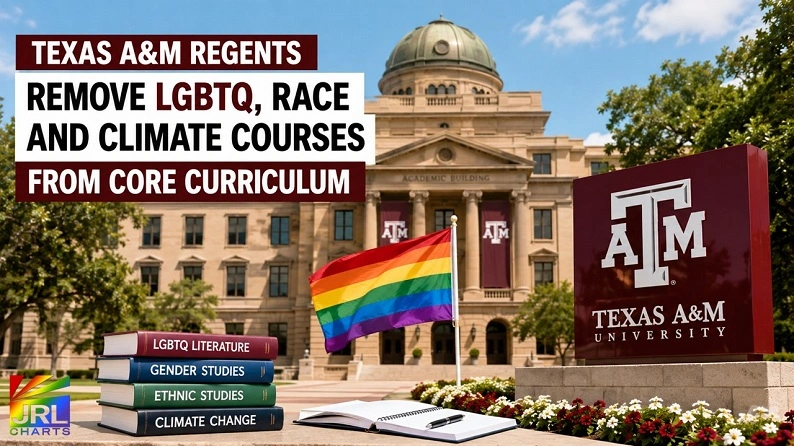
AUSTIN, TX — (September 3, 2026) — The Texas A&M University System is dramatically narrowing the courses students can use to satisfy core graduation requirements, removing more than 200 classes across 11 universities from general-education offerings — including courses covering LGBTQ literature, gender studies, race, ethnicity and climate change.
The Texas A&M System Board of Regents approved the changes Thursday following a systemwide curriculum review triggered by Texas Senate Bill 37, a state law that gives governing boards greater responsibility for determining which courses belong in universities’ general-education curricula.
Now Trending on LGBT Business and Politics News on JRL CHARTS:
• Maria Bartiromo OUT at Fox News in Shocking Effective-Immediately Exit
• America’s Job Market Just Got Worse — And Higher Interest Rates Could Be Next
• HRC Launches $15M Campaign to Defend LGBTQ+ Rights in 2026 Midterms
• America’s ‘Golden Age’? U.S. Job Growth Since January 2025 Tells a Different Story
• Millions of Working Americans Are Going Hungry—and Nobody Is Talking About It
• Review More in LGBT Business and Politics News
The move does not necessarily eliminate the affected courses from campuses. Universities may continue offering them outside the core curriculum. Instead, the decision determines which classes students can select to fulfill general-education requirements regardless of their majors.
That distinction is significant: removing a course from the core can reduce its accessibility and relevance to students who might otherwise have taken it to satisfy graduation requirements.
Texas A&M Flagship Faces Largest Reduction
The scale of the overhaul varies considerably across the Texas A&M System.
The agenda reviewed by regents contained 360 removal entries across 11 universities, although some courses appeared multiple times because they were listed under more than one department or core category.
Texas A&M University’s flagship College Station campus accounts for 103 removal entries — the largest number in the system.
Texas A&M-San Antonio has 76 removal entries, followed by Tarleton State University with 48. West Texas A&M University and Texas A&M University-Texarkana each have 21.
Among the College Station courses being removed from the core curriculum are:
- LGBTQ Literatures
- Introduction to Women’s and Gender Studies
- Introduction to Latinx Literature Studies
- Introduction to Race and Ethnicity
- Women Writers
- Gender and Health
- Blacks in the United States
- Bible as Literature
- Climate Change
The breadth of that list has intensified questions over whether the restructuring represents a straightforward effort to streamline general education or reflects a broader political shift underway across Texas public higher education.
Senate Bill 37 Reshapes Texas Higher Education
At the center of the overhaul is Senate Bill 37, which requires governing boards at Texas public universities to comprehensively review their general-education curricula at least once every five years.
Under the law, boards must determine whether core courses are foundational to a sound postsecondary education, prepare students for civic and professional life, equip graduates for the workforce and provide sufficient breadth of knowledge.
Boards must also consider whether general-education requirements impose additional costs on students through tuition, fees or additional time needed to earn a degree.
Texas A&M Regent Sam Torn characterized the review as an effort to streamline course offerings that had become overly expansive while better preparing students for the modern workforce.
But critics argue the subjects disproportionately affected by the review tell a different story.
Faculty Leader Calls Decision Political
Leonard Bright, president of the American Association of University Professors chapter at Texas A&M-College Station, has sharply criticized the review, arguing that the pattern of courses selected for removal reflects political pressure rather than purely academic considerations.
Bright warned that reducing the role of courses dealing with race, gender and cultural diversity in the core curriculum could leave students with a narrower understanding of the society and global environment they will encounter after graduation.
Texas A&M System officials reject the suggestion that the review determines which subjects are legitimate areas of academic study.
System spokesman Chris Bryan said individual universities conducted course-by-course reviews and stressed that removing a class from the core curriculum does not mean the institution has determined that the subject should not be taught.
Universities can continue offering affected courses as electives or within relevant degree programs.
LGBTQ Curriculum Already Facing Separate Restrictions
The core curriculum overhaul comes amid another battle involving LGBTQ-related instruction inside the Texas A&M System.
Last fall, regents adopted a separate policy restricting academic courses from advocating what the system defines as race or gender ideology or subjects involving sexual orientation and gender identity.
Under that policy, certain non-core and graduate courses can receive exceptions when university leadership provides prior written approval and establishes an educational need.
That policy emerged following conservative backlash over a classroom lesson involving gender identity.
It is important, however, to separate the two actions: Thursday’s core curriculum restructuring stems from the review required under SB 37, while the restrictions involving race, gender identity and sexual orientation were adopted under a separate university system policy.
The distinction has not stopped faculty members from viewing the developments as part of a broader transformation of academic governance at Texas public universities.
Professors Challenge A&M Policy in Court
The American Association of University Professors and four Texas A&M System professors filed a lawsuit August 3 seeking to block the separate race and gender instruction policy.
The professors contend the restrictions violate their First Amendment rights and interfere with academic freedom.
A judge has not yet ruled on their challenge.
The litigation means the fight over how Texas universities handle race, gender and LGBTQ-related academic material is now playing out not only in classrooms and university boardrooms but also in federal court.
Prairie View A&M and Other Campuses Also Affected
The restructuring extends well beyond Texas A&M’s flagship campus.
At Prairie View A&M University, a historically Black institution, courses including Mexican-American Culture and Sociology of Minorities appear among the removal entries.
East Texas A&M has a course titled Diversity on its removal list.
Texas A&M-Central Texas is the system’s lone university without removal entries, largely because it serves transfer students who generally complete lower-level core requirements before enrolling.
The overhaul isn’t exclusively about removing courses.
Regents’ materials also identified 27 additions across seven universities. New core offerings include Human Nutrition at Texas A&M-College Station, Precalculus at Prairie View A&M, Mexican American Literature at Texas A&M International and Professional Ethics and Environmental Sustainability at Texas A&M-Kingsville.
Texas Universities Undergoing Broader Core Curriculum Shift
Texas A&M isn’t operating in isolation.
Public universities across Texas are reassessing their general-education offerings as institutions respond to SB 37 and an increasingly aggressive state role in university governance.
The University of Houston has reduced its flagship core-course menu from 241 classes to 144, with introductory LGBT Studies and Global Climate Change among the courses removed from the core.
The University of Texas at Austin is considering eliminating more than 100 core courses while developing a substantially different general-education structure.
Under a proposal presented by UT-Austin President Jim Davis, students would complete courses across 12 designated subject areas rather than selecting from the university’s existing broad menu.
Those areas would include Western civilization, American politics, world politics and cultures, science, computer science and artificial intelligence, and a category called “Great Questions of Human Life.”
Taken together, the changes point toward a potentially significant restructuring of undergraduate education across the state’s public university systems.
The Fight Is Bigger Than Individual Courses
For LGBTQ students and advocates, the Texas A&M decision carries implications beyond whether one particular literature or gender-studies class satisfies a graduation requirement.
Core curricula help determine which subjects universities consider part of the broad educational foundation available to students across disciplines.
Supporters of the Texas reforms argue governing boards have an obligation to keep those requirements focused, academically foundational and financially efficient.
Critics counter that systematically reducing access to courses examining LGBTQ experiences, race, ethnicity, gender and climate risks narrowing the range of perspectives students encounter during their undergraduate education.
And with Texas universities continuing to implement SB 37 while separate legal battles over academic speech move through the courts, Thursday’s vote is unlikely to end the debate.
Instead, it may represent another major step in a much larger fight over who ultimately decides what constitutes a foundational college education in Texas.
JRL CHARTS LGBTQ News will continue tracking the rapidly changing landscape of LGBTQ education, academic freedom and public university policy as Texas reshapes the rules governing its higher-education system.

His reporting focuses on federal court rulings, legislative developments, international human rights issues, and government actions impacting LGBTQ communities worldwide.
With nearly two decades of experience, Goldberg is recognized for his balanced analysis, investigative insight, and commitment to accurate, fact-based journalism that informs readers on the political forces shaping equality and justice.
- Meta Paid 29 Anti-LGBTQ Accounts as 2026 Midterm Misinformation Spreads - October 14, 2026
- Orbán’s Anti-LGBTQ Legacy Crumbles as Hungary Votes 139–51 for Change - October 13, 2026
- Japan Faces a $101.5 Billion LGBTQ Equality Problem, Economic Study Warns - October 12, 2026