By: Paul Goldberg – Senior Correspondent | Nashville LGBTQ News
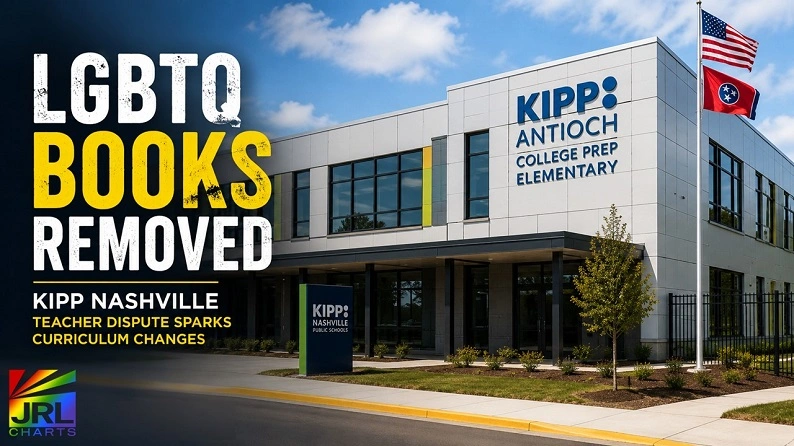
NASHVILLE, TN — (September 2, 2026) — A dispute involving a first-grade teacher’s religious objection to books depicting same-sex families has escalated into a broader controversy over LGBTQ-themed materials at KIPP Nashville schools, placing the charter network at the intersection of religious accommodation, parental rights and LGBTQ representation in Tennessee classrooms.
First Liberty Institute announced August 27 that KIPP Nashville had removed several books and other materials from its 2026–27 curriculum following an earlier dispute involving teacher Eric Rivera. Separate reporting has placed the number of removed books at more than 20.
Now Trending on LGBTQ Politics News on JRL CHARTS:
• Tucson Gay Bar Shooting Sparks Hate Crime Probe After Suspect Found With List of LGBTQ Businesses
• Paris Homophobic Attack Leaves LGBTQ Rights Leader Pierre Picavet Seriously Injured
• Divide and Conquer: How the Transgender Culture War Is Fracturing LGBT Political Power
• Log Cabin Republicans Drop the ‘T’ as Group Refocuses on LGB Advocacy
• Democrats Blow Up the 2028 Presidential Map as DNC Rewrites Road to White House
• Millions of Working Americans Are Going Hungry—and Nobody Is Talking About It
• Review More in LGBTQ Politics News Exclusively on JRL CHARTS
The controversy dates back to early 2026 at KIPP Antioch College Prep Elementary School, where Rivera taught first grade.
According to First Liberty, Rivera objected on religious grounds to two books depicting same-sex marriage and sought permission for another teacher to handle those readings. The legal organization says Rivera subsequently received a final warning and was threatened with termination if he did not teach the assigned curriculum.
In Our Mothers’ House Becomes Center of Nashville Dispute
One of the books at the center of the controversy was Patricia Polacco’s In Our Mothers’ House.
Published in 2009, the children’s picture book follows a family headed by two mothers and their three children. Publisher Penguin Random House describes it as a story about family, love and celebrating differences. The American Library Association included the title on its 2010 Rainbow Project Book List and classified it for grades K–3.
Rivera maintained that personally teaching the material conflicted with his sincerely held religious beliefs.
Rather than preventing students from hearing the assigned reading altogether, Rivera arranged for another teacher to read the material, according to First Liberty’s account of the dispute. His attorneys subsequently argued that permitting that arrangement constituted a reasonable religious accommodation.
That distinction is important because the controversy ultimately expanded beyond the contents of one children’s book into a dispute over the competing rights and responsibilities of teachers, parents, students and schools.
First Liberty Challenged KIPP Nashville Over Religious Accommodation
First Liberty Institute eventually sent KIPP Nashville a demand letter on Rivera’s behalf.
The organization argued that the school was required to consider Rivera’s request for a religious accommodation under federal employment law, including Title VII of the Civil Rights Act.
According to First Liberty, the dispute resulted in an agreement in March under which KIPP Nashville cleared Rivera’s disciplinary record and agreed to consider reasonable religious accommodations for employees. First Liberty says teachers may request that another employee present material that conflicts with their faith.
The organization subsequently announced in August that KIPP Nashville had removed additional materials from its curriculum.
“We are thrilled that KIPP Nashville voluntarily removed books that could run afoul of parents’ rights under the Constitution and Tennessee law,” First Liberty Senior Counsel Cliff Martin said in announcing the development. “It is paramount that religious views be respected in schools.”
Tennessee Law Adds Another Layer to LGBTQ Books Fight
The controversy also comes against the backdrop of Tennessee laws governing instructional materials and discussions of sexual orientation and gender identity.
First Liberty’s demand letter specifically cited Tennessee Code § 49-6-1308, arguing that the two books fell under state requirements concerning parental notification for instruction involving sexual orientation or gender identity. The group’s letter alleged that required notification had not been provided.
KIPP Nashville’s publicly available policies separately state that parents and guardians are entitled to review instructional materials used in their child’s classroom.
First Liberty said KIPP Nashville later informed the Tennessee Attorney General’s Office that it had removed substantial materials, including numerous books, from its 2026–27 curriculum as it sought to comply with Tennessee law and address the concerns of staff, students and parents.
LGBTQ Representation vs. Religious Accommodation
The Nashville dispute illustrates a much larger battle playing out around LGBTQ-themed books in American schools and libraries.
For religious-liberty advocates, the Rivera case raises the question of when an employer must accommodate an employee who objects to particular instructional material on religious grounds.
For LGBTQ advocates and opponents of book restrictions, the broader concern is what happens when resolving an individual employee’s objection ultimately coincides with the removal of books depicting LGBTQ people and same-sex families from educational settings.
That debate extends far beyond Nashville. A new PEN America report released this week describes increasing political pressure and censorship disputes affecting public libraries around the country, with LGBTQ-themed materials among those frequently targeted.
The Nashville case therefore involves two related but distinct questions: whether Rivera was entitled to an accommodation allowing someone else to teach material that conflicted with his religious beliefs, and whether LGBTQ-inclusive books should subsequently have been removed from the curriculum more broadly.
Those questions do not necessarily have the same answer.
KIPP Nashville Book Removal Could Keep Debate Alive
First Liberty has publicly celebrated the curriculum changes as a victory for religious liberty and parental rights.
The significance for Nashville’s LGBTQ community, however, extends beyond Rivera’s individual employment dispute. Removing materials portraying same-sex families raises a separate debate over whether LGBTQ students and families will continue to see themselves represented in classroom literature.
And with Tennessee continuing to regulate how schools handle material involving sexual orientation and gender identity, the KIPP Nashville controversy could become another closely watched example of how schools attempt to balance religious accommodation, parental authority, state law and LGBTQ representation.
For now, First Liberty has provided the most detailed public account of the agreement and subsequent removals. That makes continued clarification from KIPP Nashville particularly important as questions remain about exactly which books were removed, where they were removed from and how the changes will affect students during the 2026–27 school year.
Stay with JRL CHARTS Tennessee LGBTQ News for continuing coverage of LGBTQ rights, education policy, Tennessee legislation and the political and legal battles affecting LGBTQ communities across Nashville and the Volunteer State.
His reporting focuses on federal court rulings, legislative developments, international human rights issues, and government actions impacting LGBTQ communities worldwide.
With nearly two decades of experience, Goldberg is recognized for his balanced analysis, investigative insight, and commitment to accurate, fact-based journalism that informs readers on the political forces shaping equality and justice.
- Japan Faces a $101.5 Billion LGBTQ Equality Problem, Economic Study Warns - October 12, 2026
- Alito Says Gay Marriage Is Safe — But Didn’t They Say That About Roe v. Wade? - October 12, 2026
- Feds Raid Ilhan Omar’s Home — She Fires Back at Trump: ‘I Will Not Be Silenced’ - October 12, 2026