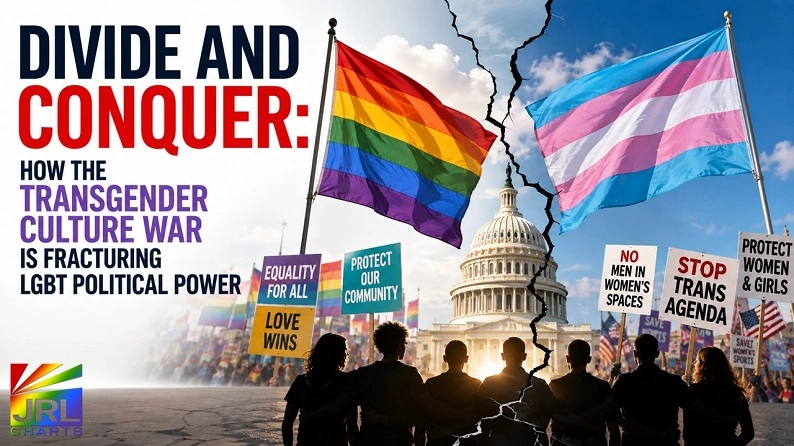
By: Paul Goldberg – Senior Correspondent | LGBT Politics USA
LAS VEGAS, NV — (August 26, 2026) — The political genius of a wedge issue isn’t convincing everyone to agree. It’s convincing former allies to fight one another.
As America races toward the November 2026 midterm elections, transgender rights have become one of the most powerful and persistent culture-war issues in American politics. Questions surrounding transgender athletes, schools, healthcare, bathrooms, military service and gender identity have repeatedly dominated political campaigns and media coverage.
But something larger may now be happening.
The fight isn’t simply dividing Republicans and Democrats anymore.
It is increasingly dividing the LGBT community itself.
Now Trending on LGBTQ Politics News on JRL CHARTS:
• Log Cabin Republicans Drop the ‘T’ as Group Refocuses on LGB Advocacy
• Transgender Suspect Sentenced to 73 Months in Scott Bessent Assassination Plot
• Democrats Blow Up the 2028 Presidential Map as DNC Rewrites Road to White House
• HRC Launches $15M Campaign to Defend LGBTQ+ Rights in 2026 Midterms
• America’s ‘Golden Age’? U.S. Job Growth Since January 2025 Tells a Different Story
• Millions of Working Americans Are Going Hungry—and Nobody Is Talking About It
• Review More in LGBTQ Politics News Exclusively on JRL CHARTS
The Political Battle Has Found Its Pressure Point
For decades, gay men, lesbians, bisexual and transgender Americans operated politically under an increasingly broad coalition despite having different experiences, priorities and sometimes sharply different opinions.
Marriage equality, employment discrimination, military service, adoption and equal treatment under the law provided common political ground.
Transgender policy has proved considerably more complicated.
Republican strategists recognized the political vulnerability early.
During the 2024 election cycle, transgender issues became the subject of an enormous advertising campaign against Democrats. The now-famous message declaring that Democrats were “for they/them” while Donald Trump was “for you” distilled a complicated collection of gender-policy disputes into an extraordinarily simple political message.
Two years later, the strategy has hardly disappeared.
As the 2026 midterms approach, Republican candidates are again focusing heavily on gender identity and transgender policy. In the Texas Senate race, attacks involving transgender Americans have already emerged alongside a Democratic campaign attempting to keep attention focused on affordability and economic conditions.
Whether voters ultimately respond to that strategy in November remains to be seen.
What is already visible, however, is the strain the debate has placed on LGBT political unity.
Log Cabin Republicans Just Drew the Line
JRL CHARTS documented one of the clearest examples of that fracture only days ago.
On August 20, Log Cabin Republicans formally narrowed its national advocacy mission to lesbian, gay and bisexual issues, reversing the organization’s 2015 decision to formally include transgender people in its mission.
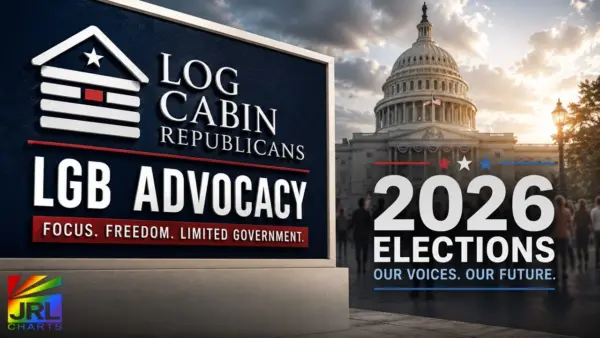
Log Cabin Republicans’ shift toward an LGB-focused national advocacy mission has become a prominent example of the widening political divide within LGBT America. | JRL CHARTS LGBT Politics USA
President Ross Hemminger described the organization plainly: an “LGB advocacy organization.”
Transgender conservatives can remain members, but transgender advocacy will no longer be part of the national organization’s core mission.
That distinction matters.
Log Cabin Republicans argues that contemporary transgender activism—particularly debates involving minors, schools, women’s sports and gender-affirming healthcare—has moved away from the organization’s traditional focus on sexual orientation, limited government and individual liberty.
The Human Rights Campaign sees the development very differently, arguing that separating lesbian, gay and bisexual Americans from transgender Americans weakens the broader political coalition.
Those competing interpretations expose a divide that can no longer be dismissed as an argument occurring exclusively on social media.
A major national gay political organization has now formally redrawn the boundaries of its advocacy.
Disagreement Doesn’t Have to Mean Political Divorce
There is another reality LGBT organizations may eventually have to confront.
Gay, lesbian, bisexual and transgender Americans do not—and never have—agreed about everything.
Nor should anyone expect them to.
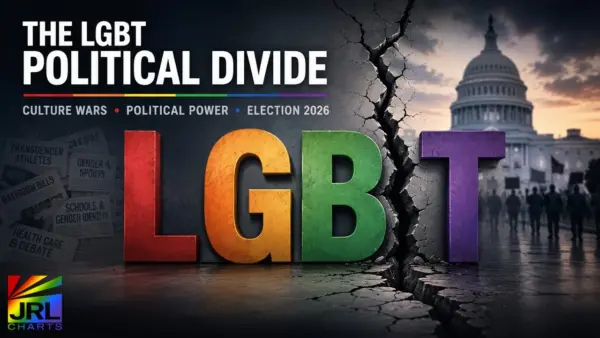
Political battles over transgender issues are testing the unity of the LGBT coalition as voters head toward the November 2026 midterm elections. | JRL CHARTS
An LGBT coalition encompasses millions of Americans across different races, religions, generations, incomes, political parties and geographic regions. There will inevitably be disagreements about transgender participation in sports, healthcare involving minors, parental rights, schools and the government’s treatment of gender identity.
But disagreement and political fragmentation are not the same thing.
A voter can question a particular transgender policy while opposing employment discrimination against transgender adults.
A gay voter can disagree with a transgender activist without believing that transgender Americans should lose basic civil protections.
And transgender Americans can advocate for their interests without requiring every gay, lesbian or bisexual American to hold identical opinions.
The danger begins when those disagreements become so consuming that the coalition spends more energy fighting itself than examining the people and institutions exercising political power over everyone within it.
The Culture War May Not Stop With the ‘T’
That brings LGBT America to a much bigger question.
If transgender Americans can successfully be separated politically from gay and lesbian Americans, what guarantees that the process stops there?
The LGBT coalition was never built because every letter represented identical people.
It was built because minorities that lacked sufficient political power individually discovered greater influence collectively.
Once that coalition begins breaking into smaller political identities, every remaining group possesses less collective leverage.
Today, the argument centers on the “T.”
Tomorrow’s dividing line could be entirely different.
And that is precisely why LGBT voters should distinguish between legitimate policy disagreements and political messaging designed to make those disagreements the only issues that matter.
November 2026 Is About More Than the Culture War
The approaching midterm elections will determine control of Congress and influence the direction of federal policy for the remaining two years of President Donald Trump’s current term.
That makes the stakes considerably larger than any single culture-war controversy.
LGBT voters will have the same concerns confronting millions of other Americans: wages, jobs, healthcare, housing, inflation, taxes, public safety, immigration, education, civil liberties and the cost of simply getting through another month.
They will also have legitimate questions about LGBT rights.
But perhaps the most important question voters can ask themselves before November is remarkably simple:
Am I doing better today than I was two years ago?
Look at your paycheck.
Look at your rent or mortgage.
Look at your grocery bill.
Look at your healthcare costs.
Look at your job security.
Look at your civil rights.
Then decide which issues will actually determine your family’s future after Election Day.
Because culture wars are extraordinarily effective at deciding what Americans talk about.
They don’t have to decide what Americans vote about.
LGBT America Needs to Keep Its Eye on the Ball
The transgender debate isn’t going away.
Neither are the genuine disagreements within the LGBT community surrounding it.
But LGBT political power does not require ideological conformity. It requires recognizing the difference between debating one another and allowing those debates to destroy the coalition itself.
Log Cabin Republicans dropping the “T” may eventually be remembered as an isolated ideological realignment.
Or it could prove to be something much more significant: evidence of an LGBT political coalition beginning to fracture under years of relentless culture-war pressure.
November will provide another test.
LGBT Americans can spend the months ahead fighting over which letter deserves blame for the latest controversy.
Or they can keep their eyes on the people making the laws, controlling the government and deciding which rights—and whose rights—remain protected.
The transgender culture war may have started with the “T.” There is no guarantee it ends there.
JRL CHARTS LGBT Politics USA will continue tracking the political forces, campaign strategies and civil-rights battles shaping LGBT America as voters head toward the November 2026 midterm elections.
His reporting focuses on federal court rulings, legislative developments, international human rights issues, and government actions impacting LGBTQ communities worldwide.
With nearly two decades of experience, Goldberg is recognized for his balanced analysis, investigative insight, and commitment to accurate, fact-based journalism that informs readers on the political forces shaping equality and justice.
- Federal Watchdog Drops $78 Million Bombshell on Trump’s Healthcare Funding Cuts - October 7, 2026
- NYC Puts $8.9 Million Behind Trans Youth Care After Major Hospitals Back Away - October 6, 2026
- Bronx Anti-LGBTQ Attack Leads to Arrest — But Police Say a Second Suspect Is Still Out There - October 5, 2026