By: Paul Goldberg – Senior Correspondent | LGBT Business Finance News
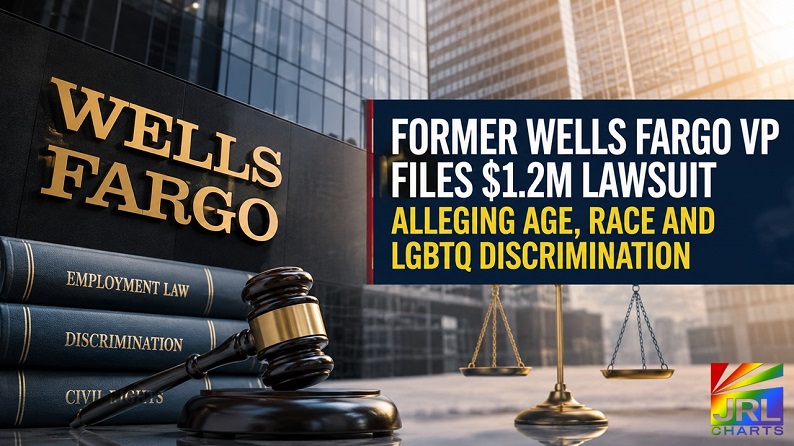
CHARLOTTE, N.C. — (August 16, 2026) — A former Wells Fargo senior vice president who spent nearly four decades with the banking giant and its predecessor companies has filed a federal lawsuit alleging that age discrimination, disability-related treatment, racial bias and hostility surrounding his LGBTQ involvement contributed to the collapse of a career that had lasted approximately 39 years.
Robert Propst, 63, alleges that his working environment changed dramatically following management changes at Wells Fargo, eventually culminating in his departure from the company in August 2023.
Now Trending on LGBT Business Finance News on JRL CHARTS:
• Where are the Jobs? America Was Promised Private-Sector Hiring — The Data Tells a Different Story
• VA Loses Again as Judge Blocks Third Attempt to Cancel AFGE Contract
• Millions of Working Americans Are Going Hungry—and Nobody Is Talking About It
• America’s ‘Golden Age’? U.S. Job Growth Since January 2025 Tells a Different Story
• LGBTQ Business Owners Join Growing Coalition Against Bank Account Closures
• China’s Rising Yuan Could Hit LGBTQ Businesses Worldwide
• LGBTQ Corporate Participation Plunges 65% in 2026 as DEI Retreat Reshapes Business Landscape
The former executive is seeking to recover more than $1.2 million in alleged lost wages and benefits, along with additional unspecified damages, according to the lawsuit allegations.
Propst’s claims remain allegations and have not been proven in court.
Nearly Four Decades at Wells Fargo Ends in Dispute
Propst’s tenure stretched across Wells Fargo and predecessor companies for approximately 39 years — an unusually long career that now sits at the center of his employment discrimination case.
According to the allegations, problems intensified in 2022 after changes in leadership placed Propst under a supervisor whom he claims repeatedly focused on his age and encouraged him to consider early retirement.
Propst alleges those comments were accompanied by increasingly unfavorable treatment despite a lengthy history of positive performance evaluations.
The lawsuit contends that the pressure eventually escalated into a broader pattern involving his age, medical accommodation, employees working under his supervision and his participation in LGBTQ workplace programs.
Lawsuit Alleges Pressure to Retire Early
Age discrimination represents one of the central themes of Propst’s case.
According to the allegations, his supervisor repeatedly raised retirement and made comments concerning Propst’s age. Propst says he intended to remain employed until reaching the full retirement age of 67.
Instead, his employment ended when he was 63.
The lawsuit further alleges that Wells Fargo subsequently replaced Propst with a substantially younger employee — an allegation that could become particularly important as the case moves through the federal court system.
Employment decisions involving workers age 40 and older can fall under the federal Age Discrimination in Employment Act, although the precise statutory claims asserted by Propst should ultimately be determined from the filed complaint and subsequent court record.
Vision Impairment and Remote-Work Accommodation Become Flashpoint
The dispute also involves Propst’s vision impairment and his ability to work remotely.
According to the allegations, Propst had successfully performed his responsibilities remotely and continued receiving favorable evaluations before the management changes.
Propst claims his new supervisor nevertheless pressured him to return to the office and scrutinized his office attendance by monitoring badge activity.
The lawsuit alleges that Propst was exempt from the badge-tracking requirement being applied to him.
That distinction could prove significant because federal disability law can require employers to provide reasonable accommodations to qualified employees with disabilities, depending on the circumstances of the job and accommodation.
Whether Wells Fargo violated those requirements in Propst’s case will ultimately be a matter for the court.
Majority-Black Team Allegedly Received Different Treatment
The lawsuit goes beyond Propst’s individual treatment.
Propst alleges that his predominantly Black team was marginalized after the management changes and received less support than other employees.
According to the allegations, his supervisor diminished the team’s work, declined to meet with its members and responded negatively when concerns were raised.
Propst further claims that members of the team later received poor performance evaluations.
Those allegations add a racial-discrimination dimension to a case already involving age and disability issues.
They also make the litigation particularly noteworthy from a corporate-management perspective because the allegations concern not merely hiring or promotion but the treatment and evaluation of an established team inside one of America’s largest financial institutions.
Propst’s LGBTQ Leadership Becomes Part of the Case
Propst’s long involvement with Wells Fargo’s LGBTQ employee community also figures prominently in the lawsuit.
Propst is gay and alleges that he participated in Wells Fargo’s PRIDE LGBTQ+ employee resource group for more than 20 years.
According to the suit, his supervisor declined to support Propst’s continued involvement with the organization and allegedly indicated that it was time for younger leadership.
The allegation potentially connects two significant elements of the dispute: Propst’s age and his LGBTQ workplace advocacy.
Employee resource groups have become an established component of corporate diversity programs across major U.S. employers, particularly within financial services, technology and other large multinational industries.
For Propst, however, the lawsuit alleges that a workplace role he had maintained for more than two decades became another source of friction with management.
Interracial Marriage Also Raised in Complaint
One of the lawsuit’s more striking allegations concerns Propst’s marriage.
Propst alleges that his supervisor reacted with surprise and dismay after discovering during a work call that Propst was married to a Black man.
If litigated, that allegation could bring several overlapping workplace discrimination questions into the case, including race and sexual orientation.
Title VII of the Civil Rights Act prohibits employment discrimination because of race, and the U.S. Supreme Court held in its landmark 2020 Bostock v. Clayton County decision that discrimination because an employee is gay or transgender constitutes discrimination because of sex under Title VII.
That does not establish that discrimination occurred in Propst’s case. It does, however, provide important federal legal context for the LGBTQ-related allegations contained in the dispute.
Complaint to Human Resources Allegedly Followed by Poor Review
The timing of Propst’s complaints could become another major issue.
According to the lawsuit allegations, Propst raised concerns with human resources about his treatment.
He subsequently received what he describes as the first poor performance review of his career.
Propst alleges the review itself referenced his age and that the combination of negative evaluations, pressure to retire, disputes surrounding his medical accommodation and treatment of his predominantly Black team made his working environment intolerable.
His employment ended in August 2023.
The litigation will ultimately determine whether those events were connected in the manner Propst alleges or whether Wells Fargo can establish legitimate, nondiscriminatory reasons for its employment decisions.
$1.2 Million in Alleged Lost Wages and Benefits
The financial stakes are substantial.
Propst estimates that losing his position four years before his intended retirement age resulted in more than $1.2 million in lost wages and employment benefits.
He is seeking recovery of those losses as well as additional damages.
That distinction matters: the case should not necessarily be characterized as seeking only $1.2 million. Rather, Propst is alleging more than $1.2 million in economic losses while pursuing additional relief through the litigation.
Wells Fargo Case Could Put Corporate DEI Practices Under a Different Spotlight
The lawsuit arrives during a period of intense scrutiny surrounding diversity, equity and inclusion policies across corporate America.
Much of the national debate has focused on whether companies should maintain or scale back DEI initiatives. Propst’s allegations raise a different question: what protections exist for longtime employees who claim discrimination affected their careers despite years of participation in corporate diversity and employee-resource programs?
Wells Fargo has separately faced litigation involving diversity-related corporate practices, including an investor lawsuit challenging representations surrounding the bank’s diverse-candidate hiring initiative. That litigation is unrelated to Propst’s employment case and does not establish the merits of his allegations.
Propst’s case instead centers on what he says happened inside his own workplace: nearly four decades of employment followed by an abrupt deterioration in his relationship with management and, ultimately, the end of his career.
For LGBT professionals and corporate employers alike, the case could become one to watch as the allegations move from the complaint into the federal litigation process.
All discrimination, retaliation and workplace-misconduct claims discussed in this report are allegations contained in the plaintiff’s case and have not been adjudicated as fact. Wells Fargo is entitled to contest those allegations and present its defenses in court.
Follow JRL CHARTS LGBT Business Finance News for continuing coverage of LGBTQ workplace rights, corporate America, employment litigation and the financial issues shaping today’s business community.

His reporting focuses on federal court rulings, legislative developments, international human rights issues, and government actions impacting LGBTQ communities worldwide.
With nearly two decades of experience, Goldberg is recognized for his balanced analysis, investigative insight, and commitment to accurate, fact-based journalism that informs readers on the political forces shaping equality and justice.
- GameStop Hit With Federal Lawsuit After Gay Employee Reports Threats — Then Gets Fired - October 16, 2026
- Meta Paid 29 Anti-LGBTQ Accounts as 2026 Midterm Misinformation Spreads - October 14, 2026
- Orbán’s Anti-LGBTQ Legacy Crumbles as Hungary Votes 139–51 for Change - October 13, 2026